|
|
Herulian Destruction Debris in and around west end of Middle stoa and in and around Civic offices (House F) . Separated in two groups: H-I 12:1 and I 12:1. Asterisk: I 12* ... Separated in two groups: H-I 12:1 and I 12:1 ... Asterisk: I 12* |
| Susan I. Rotroff ... Grave 5. Adult (female?) inhumation.
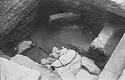
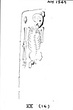
Cist grave lined and covered with slabs of limestone, sandstone and schist. Cut into virgin soil under Royal Stoa at I/12,13-5/3,4. Grave measures 1.79x0.39-0.49x ca ... Final Mycenaean/Submycenaean ... Susan I. Rotroff |
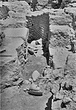
| A tile lined well under Room I of Byzantine House.
A concrete shaft belonging to the mill cut off the top of the well and left in place 3 complete sets of tiles and most of a fourth set. All but the lowest ... 17-18 c. A.D ... I/20-3/12 |
| Susan I. Rotroff ... Burial 3 beneath the floor of the Stoa Basileios. It consisted of a rectangular pit cut into bedrock to a depth of 0.44m, lined on all sides and covered with an admixture of narrow stone slabs of soft ... Final Mycenaean/Submycenaean ... I/6,8-5/2,3 |
| Susan I. Rotroff ... Grave 4 under Royal Stoa. Cist Grave cut into bedrock and lined with limestone and schist slabs. There were two layers of cover slabs with a layer of dirt between. Grave measured 0.98x0,25-0,32x0,25-0,30 ... Final Mycenaean/Submycenaean ... I 5:4 ... I 5:4 |
| Susan I. Rotroff ... Grave 2. Adult female inhumation. Grave extending under the south retaining wall of the Temenos of the Royal Stoa. It is oriented ne-sw, with head at sw. Grave built of slabs of schist, with packing of ... Final Mycenaean/Submycenaean ... I 5:2 ... I 5:2 |
| Located in Middle Stoa, west, south aisle, beneath pressure pipe (cf. A 4900). The siting of the well is remarkable in its proximity to Well I 13:3, also Geometric in date, which was found in 1968 only ... Second half of 8th c B.C ... I 13:4 ... I 13:4 |
Cistern shaft at 63/ΚΓ. Part of H-I 16-17 system. Contents of 3rd c. disturbed.
Part of extensive cistern system, of which one chamber, three drawshafts, and two blind tunnels were excavated (H 16:2, ... 3rd c., disturbed ... Part of H-I 16-17 system. Contents of 3rd c. disturbed.
Part of extensive cistern system, of which one chamber, three drawshafts, and two blind tunnels were excavated (H 16:2, I 16:6, I 17:4) |
Fill against back wall foundations of Royal Stoa I/6,9-4/8,14. Dug separately, these many fills contain material which joined horizontally and vertically all along back wall of Royal Stoa. Fill seems to ... 2nd/3rd quarters of 5th c.-420s ... I 4:2 ... I 4:2 |
Well east of Geometric Grave. The upper part collapsed into a pit, cut into by Middle Geometric grave I 18:1 and by a Byzantine wall. Some evidence for period of use; little pottery. At the top a few Geometric ... Early Protogeometric ... The upper part collapsed into a pit, cut into by Middle Geometric grave I 18:1 and by a Byzantine wall. ... At the top a few Geometric sherds, perhaps displaced from I 18:3. |
| Eugene Vanderpool ... Rectangular pit, oriented east-west, cut party into filling of Early Protogeometric pit-well (I 18:4), to a preserved depth of about 0.30m. A late Byzantine wall founded below the floor of the grave destroyed ... Middle Geometric I ... Rectangular pit, oriented east-west, cut party into filling of Early Protogeometric pit-well (I 18:4), to a preserved depth of about 0.30m. |
Cistern Shaft at 61/Β and south passage to E.W. drain.
Part of H-I 16-17 system. Coins:
8 April 1932 #14
9 April 1932 #1-#8
11 April 1932 #1-#3
12 April 1932 #1 ... 8-16 April 1932 ... I 16:6 ... I 16:6 |
Undisturbed fill at 34-36/I-K (Heliaia Peristyle, west aisle).
Two pieces (T 3662 and SS 14440) are recorded as "undoubtedly from Peristyle fill of third quarter of 4th century B.C." although "from area ... Third quarter of 4th c. B.C ... Undisturbed fill at 34-36/I-K (Heliaia Peristyle, west aisle).
|
Pit in SW corner of Heliaia Peristyle (mint).
The four Athenian imperial coins (Κ-1641 - Κ-1644) belong to the Athenian Imperial Group III, a series that can be very closely dated to the middle of the ... Mid 3rd c. A.D ... I 15:3 ... I 15:3 |
| Homer A. Thompson ... (Grave XXX: EG)
Rectangular cutting with burned bones of a female 40-45 years old, and both burned and unburned pottery fragments.
Rectangular trench, measuring approximately 0.80m long, 0.40m wide, with ... Middle Geometric I ... I 18:3 ... I 18:3 |
| (Grave XXIX: EG).
Rectangular cutting with remains of charred human bones and both burned and unburned pottery fragments. Bones discarded.
Rectangular trench cut through earth into bedrock, oriented east-west ... Middle Geometric I ... Middle Geometric I |
| Susan Rotroff ... Grave 1. Burial of a child perhaps 6 years old, covered by broken amphora. Skeleton lay extended on its back, oriented N-S, with head at south. No grave gifts. PD 2207 ... Final Mycenaean/Submycenaean ... I 5:1 ... I 5:1 |
| Royal Stoa, N. Annex building fill, N Trench, Layer 7 ... 4th quarter of 5th c. B.C ... I 4:1 ... I 4:1 |
Burial disturbed. Located in Middle Stoa, north aisle, "upper trench", piers 3 and 4. Two individuals: small child (ca. 5 yrs. old) and adult female.
In its disturbed state the burial was found (at elevation ... First half of 7th c. B.C ... I 13:5 ... I 13:5 |
Located beneath line of Poros Gutter, from a square settling basin cut in bedrock at the north end of Trench II, South of Theseion, 1.30m below the modern road surface. The basin is lined with rough-picked ... Last quarter of 5th c. B.C.-early 4th c. B.C ... I 16 |
Homer A. Thompson ... Well at the northwest foot of the Areopagus. Use filling of the Roman period. After the abandonment of the well and the collapse of the well-curb, the upper 2m of the shaft were filled with a dump apparently ... 1st-3rd c. A.D., 5th century ... Same deposit with I 16:2. |
Well at 62/ΙΑ, 63/ΙΑ, at the northwest foot of the Areopagus. Use filling in the lowest meter of the shaft.
The upper part of the shaft was filled with clay containing only occasional fragments of pottery; ... Ca. 600-540 B.C ... Note that pp. 70 and 76 are in NB. I, ΣΤ not ΣΤ'.
"In notebook references this well has been commonly placed in 62/ΙΑ. |
Cut to east of Exedra. Accumulated road packing between the Stoa of Zeus and the early altar to the east, various levels and dates, as late as early as 6th c. B.C. and as late as 5th c. A.D ... 15-17 April 1935 ... I 6:1 ... I 6:1 |
Late pit in bedrock ... Late Byzantine-Turkish? ... I 6:2 ... I 6:2 |
L 1079 and L 1080 are identified as from a pit at 29/ΝΓ. L 1082 and P 2130 are from a pit at 26-29/ΜΘ-ΝΑ. Probably the same pit as indicated on a note in deposit cardex. The finds are recorded together ... 5th c ... I 7:1 ... I 7:1 |
Coins:
22 March 1933 #1-#44 ... Late Roman- Mid 5th c ... I 7:2 ... I 7:2 |
Exploration in the area between the east front of the Hellenistic Metroon and the Great Drain, from accumulated road metal of early north-south road.
For levels in the same road further south, see F-G ... 575-525 B.C ... I 9:1 ... I 9:1 |
| Side-chamber at the bottom of a circular shaft. AA 27; ST 103 from shaft above burial. PD 427 ... Neolithic ... I 9:2 ... I 9:2 |
Late (Turkish) well at Northeast corner of porch of Metroon ... Turkish ... I 9:3 ... I 9:3 |
| Well west of the Eponymous Heroes monument. The shaft was of irregular width (ca. 0.81m where the full circle was first preserved), sunk in soft bedrock clay much of which had collapsed around the top ... Ca. 600-550 B.C ... I 10:1 ... I 10:1 |
Found during removal of late Roman wall in area Ι/11. No container ... 28 June 1967 ... I 11:1 ... I 11:1 |
NW corner of Civic Offices, lowest layer above Roman road metal[classical floor, see nbp. 1907]. Coins:
12 May 1950 #1-#10 ... Mid 3rd. c. A.D ... I 12:1 ... I 12:1 |
Civic Offices, North Pit, Room 1. Filling mixed to Hellenistic; some archaic material ... Prehistoric- 6th c. B.C.- Hellenistic ... I 12:2 ... I 12:2 |
| Pyre in Horos Terrace Trench, East end, set into Strosis 5.
In room 1 (court), near north wall. Concentration in stratum, no pit discerned; described as a "little nest of pots" within layer V (Lot ΜΣ ... 350-325 B.C ... I 12:3 ... I 12:3 |
Well beneath 4th c. Klepsydra Drain, within foundations of west end of the Middle Stoa. Diameter 0.90m, cut through bedrock, with handholes on sides. Top 4.50m. dumped fill; 4.50-6.15m. period of use ... Mid-8th c. B.C ... I 13:1 ... I 13:1 |
Backfill of demolition of Great Monument beneath Middle Stoa.
[Soft pit below Layer II of south aisle (=fill of early "Great Drain")] ... Early 4th c. B.C ... I 13:2 ... I 13:2 |
Crosscut between Middle stoa Piers 1 and 2 from west (south aisle), layer II.
Chiefly late 5th to mid-4th c. B.C. Coins:
2 July 1965 #1 ... Late 5th to mid-4th c. B.C ... I 13:3 ... I 13:3 |
Near the SW corner of the market square beneath the north part of the Heliaia (?).
No clear distinction in the filling, either of date or of character, could be observed but the presence of a number of ... Ca. 625-570 B.C ... I 14:1 ... I 14:1 |
Located in front of west end of Stepped Retaining Wall, Heliaia. Filled in and covered in last stages of grading of area after construction of Middle Stoa.
Pottery from settling basin nondescript. Single ... 175-150 B.C ... I 14:2 ... I 14:2 |
Coins:
16 April 1934 #2
17 April 1934 #1 ... Late Roman- Ca. A.D. 400 ... I 15:1 ... I 15:1 |
After the abandonment of the well and the collapse of the well-curb, the upper 2.00m. of the shaft were filled with a dump apparently dug up nearby. Material for the most part of the 5th c. B.C. but containing ... 7th c. A.D ... I 16:1.1 ... I 16:1.1 |
Coins:
3 June 1932 #1
8 June 1932 #1-#9 ... 5th c. A.D ... I 16:1.2 ... I 16:1.2 |
Coins:
8 June 1932 #2-#9
9 June 1932 #1-#14
10 June 1932 #1-#13
11 June 1932 #1-#9
13 June 1932 #1-#3, #6 (dump) ... 1st-3d c. A.D ... I 16:1.3 ... I 16:1.3 |
A late curbed well. The filling consisted of clay and small stones. The sherds were uniform from top to bottom and appear to be late Byzantine. From measurements in notebooks (pp. 340, 729), S 2855 is ... Late Byzantine ... I 16:3 ... I 16:3 |
Cistern at 79/Γ (= 80/Δ) on lower north slope of the Areopagus. Filling of 2nd c. B.C. with some later intrusions (Turkish pottery indicates disturbance).
Single Knidian stamped amphora handle dates around ... Hellenistic-Turkish ... I 16:5 ... I 16:5 |
Well at 75/ΚΖ (75/ΚΗ, 76/ΚΣΤ-ΚΖ). A dumped filling; an accumulation for the most part of the late 6th and early 5th centuries.
Tiled well; of the lining only a single set of tiles, of unusual make, remained ... Ca. 450-425 B.C ... I 17:1 ... I 17:1 |
Digging terminated at 14.50m. due to falling bedrock. Scanty pottery remains at 10.00m. In the mouth and upper part of the shaft was a heavy dumped filling of much shattered fragments, for the most part ... Last quarter of 5th c. B.C ... I 17:3 ... I 17:3 |
Cistern shaft, part of cistern system in Η-Ι 16-17. Filling disturbed to bottom; general run of the pottery is to late Hellenistic, lamps as late as Knidos type. Finds from 60/ΙΘ-62/ΙΘ, 61/ΙΗ. "Some Arretine" ... 5 May 1932
18 June 1932 ... I 17:4 ... I 17:4 |
| At the northwest foot of Areopagus. Square stone-curbed well with no clear evidence for a period of use; appears to be a single dump ... Ca. 500 B.C ... I 17:2 ... I 17:2 |
| Susan I. Rotroff ... Grave 2 (bis). Cut into by builders of I 5:2. No remains.
Possible contents in I 4-5:1 Layer C (= layer 6, lower building fill), catalogued as ΒΓ 2065 - ΒΓ 2125 ... Middle Helladic or later Bronze Age (date uncertain) ... Susan I. Rotroff |
Cistern system: chambers and shafts numbered separately:
H 16:2 at 52/Θ, I 17:4 at 61/ΙΘ, I 17:5 at 63/ΚΓ and I 16:6 at 63/Β. Finds and containers from the entire system are listed here, i.e. combining ... 18 June 1932 ... H-I 16-17 ... H-I 16-17 |
The Building Fill had been badly disturbed and has been divided into several different lots, resulting in two main divisions: layer 5 (upper building fill) and layer 6 (lower building fill). Later investigation ... 23 June-16 July 1973 ... I 4-5:1 ... I 4-5:1 |
Exploratory excavation trench between east front of Hellenistic Metroon and Great Drain.
Cf. Hesperia Suppl. 4 (1941), p. 106.
Cf. also Metroon Drain Cut I 9:1 and F-G 12:1 and H 12:9 ... 8th-6th c. B.C ... Cf. also Metroon Drain Cut I 9:1 and F-G 12:1 and H 12:9. |
Exploration in the peristyle of the Heliaea (1960); evidence for rebuilding in the third quarter of the 4th c. B.C. with some disturbance as late as 1st-2nd c. A.D. Date of reconstruction ca. 325 B.C ... Ca. 350- 325 B.C ... I-K 14-15 |
Layer I.
Material from trenches:
a) 1.00-7.00m. from East End of Stoa.
b) 18.40-21.40m. from East End of Stoa.
c) 46.60-48-60m. from East End of Stoa.
d) 51.00-53.00m. from East End of Stoa.
e) 79.00-81.00m ... 2nd-3rd c. A.D ... Layer I.
Material from trenches:
a) 1.00-7.00m. from East End of Stoa.
b) 18.40-21.40m. from East End of Stoa.
c) 46.60-48-60m. from East End of Stoa.
d) 51.00-53.00m. from East End of Stoa.
e) 79.00-81.00m. from East End of Stoa. |
Lamps all found together at the southeast corner of the excavated area, in a deposit running in part under the dike of earth which has been left against the wall of the street.
Includes 10 lamps in Section ... 17-18 June 1931
15 May 1933 ... L 955-L 965 are also listed in deposit H-I 7-8:1 because they fall within the burnt layers of that deposit. |
Investigations in the area around the Tholos, especially to the east and south of the building, between it and the Great Drain, and not otherwise specified as deposits.
This "deposit" has no form. It ... various levels and dates ... G-I 11-12 ... G-I 11-12 |
8/ΛΘ to 14/ΛΒ. Coins:
12 February 1932 #2-#3, #13-#14, #25-#28
13 February 1932 #8, #31-#33
15 February 1932 #7-#12, #13-#27, #28-#42
16 February 1932 #5-#10 ... Late Roman- Ca. A.D. 520-540 ... I-J 9:1 ... I-J 9:1 |
Red Figure Pocket in front of Retaining Wall at 74-77/ΛΖ-ΛΘ.
Pit , a large cutting in bedrock, irregular in outline, reaching a depth of ca. 1m; dumped filling of alternating layers-broken pottery fragments ... Ca. 430-410 B.C ... I-J 18:1 ... I-J 18:1 |
Material from trenches:
a) 1.00-7.00m. from East End of Stoa.
b) 18.40-21.40m. from East End of Stoa ... 2nd c. A.D ... I-O 15:1.2 ... I-O 15:1.2 |
Material from trenches:
a) 1.00-7.00m. from East End of Stoa.
b) 18.40-21.40m. from East End of Stoa ... 1st c. A.D ... I-O 15:1.3 ... I-O 15:1.3 |
Material from trenches:
c) 46.60-48-60m. from East End of Stoa.
d) 51.00-53.00m. from East End of Stoa.
e) 79.00-81.00m. from East End of Stoa. Coins:
12 July 1960 #1-#2 (illegible)
9 July 1965 #4 ... 2nd c. B.C.-2nd c. A.D ... I-O 15:1.4 ... I-O 15:1.4 |
Material from trenches:
a) 1.00-7.00m. from East End of Stoa.
b) 18.40-21.40m. from East End of Stoa, with some disturbed fill including 1st c. A.D. material.
c) 46.60-48-60m. from East End of Stoa.
d) ... 2nd c. B.C ... I-O 15:1.5 ... I-O 15:1.5 |
Material from trenches:
a) 1.00-7.00m. from East End of Stoa.
b) 18.40-21.40m. from East End of Stoa.
c) 46.60-48-60m. from East End of Stoa.
d) 51.00-53.00m. from East End of Stoa.
e) 79.00-81.00m. from ... 2nd c. B.C ... I-O 15:1.6 ... I-O 15:1.6 |
Burnt Layer inside retaining wall of Middle Stoa Terrace (Θ) and NW Corner of Middle Stoa, burnt debris inside terrace retaining wall (Ζ). Coins Ζ: Coins Θ:
1 June 1951 ... Mid-3rd c. A.D ... H-I 12:1 ... H-I 12:1 |
Hellenistic fill South of Middle Stoa near NW corner of Heliaea. This fill contained material later in date than that which made up the middle Stoa Building Fill.
Only the coins (and a few amphora handles ... To ca. 140 B.C ... H-I 14:1 ... H-I 14:1 |
The data in the Deposit Notebook is presented by trench; an attempt is made here to accumulate data from similar layers across the trenches. Subdivisions:
.1=Post Hadrianic cleanup
.2=Marble working waste ... 2nd c. B.C.-3rd c. A.D ... I-O 15:1 ... I-O 15:1 |
Abandoned digging at 12.85m. due to collapse of side walls. Well H contents probably thrown in to Well I during cleaning in early Roman times; the pottery from the two wells is similar. Cf. E 14:6 ... 350-250 B.C ... Well I |
Pit I at 45/ΙΘ (= Well) (noted also 4th c. pocket in side of this pit).
This is part of the Terracotta Deposit (H 17:4) and the objects listed here are also listed in H 17:4. Containers/lots for this ... Geometric-Protoattic ... Pit I at 45/ΙΘ (= Well) (noted also 4th c. pocket in side of this pit).
|
| Sacrificial Pyre I, Classical Building II.
The pyre was set through the original floor level of the northern room of the Classical Building and apparently is the remainder of a ritual conducted when the ... Ca. 375-350 B.C ... Sacrificial Pyre I, Classical Building II.
|
Estimated Grid ... Late 2nd c. A.D ... Layer I |
Byzantine, 4th c. A.D ... Layer I |
Turkish sherds from this level. No tins of pottery ... August 1951 ... Fill I |
Coins:
23 April 1937 #1-#16 d22.80m. (bottom)-22.25m.d ... 2nd. c. B.C. POU ... Fill I |
Abandoned digging at 6.25m. due to water level. Tile well could be associated with a bit of late Roman wall to the south, with floor level about one meter above that of pebble floor. Well tiles were not ... 14-22 April 1948 ... Well I |
Middle Stoa Building Fill.
Cf. also H-I-J 14-15, H-K 12-14 (ask SIR) (unsolved)
This deposit is not definitive and must be considered with the above deposits before details are entered into database; ... Before ca. 150 B.C ... H-I-J 12-13 ... H-I-J 12-13 |
| Destruction Fill in channel of Apsidal Building.
Cf. nb.p. 989 for continued digging in this channel. Coins:
24 July 1990 #202, #204, #208
27 July 1990 #219-#222
30 July 1990 #226
31 July 1009 #236
1 August ... 14 June-3 August 1990 ... I-J 2-3:1 ... I-J 2-3:1 |
Hellenistic Fills South of Middle Stoa (1954) (cf. K-M 13-14, etc) (unsolved)
This deposit is not definitive and must be considered with the above deposits before details are entered into database; left ... H-I-J 14-15 ... H-I-J 14-15 |
Accumulated debris on the west side of the market square.
Related layers added 1999/2000 (JWH), e.g. "Gravelly layer above burning", "Clearing Classical floor", "Lowest level above bedrock", "Below burning", ... First half of 5th c. A.D ... H-I 7-8:1 ... H-I 7-8:1 |
Cistern system West of Bouleuterion: (see also B: cistern system to West of Tholos). First Chamber from North.
Part of three-chamber cistern system, including also G 11:1, with Byzantine and modern disturbance ... 150-ca. 75 B.C., with Byz. disturbance ... Cistern Chamber I |
| Sacrificial Pit I in notebook = RSY Grave 20 ... Ca. 510-490 B.C ... Sacrificial Pit I in notebook = RSY Grave 20. |
Well I: archaic. On the northwest slope of the Acropolis below the Klepsydra. Diameter ca. 1.10m. Water level ca. -9.50m. Substantial use filling in the lower 0.75m. In the upper debris filling both the ... End of 6th c. B.C. - Early Byzantine ... Well I in ΟΑ |
1st-2nd c. A.D ... Bouleuterion Plateia Layer I |
Nbp. 3104: Container includes a miscellaneous accumulation of Greek and Roman pottery with some fragments of Byzantine brown glaze. No joins were observed between this layer and Layer II ... 16-24 May 1937 ... Layer I- Turkish Dump |
Deposit alongside Greek House I, perhaps giving the construction date of the second phase. Deposit list title it as : outside of east wall of Roman House H ... Last quarter of the 4th c. B.C ... Deposit along Greek House I |
9/Ι at 59.00m. General. Coins:
8 May 1933 #1-#11
9 May 1933 #36-#39 ... 8-9 May 1933 ... Coin Deposit at 9/I |
| Well at 52/Ι, on the lower northeast slopes of the Areopagus. It was cut down and re-used in the late Roman period, in connection with the water channel. Use fill of 1st to early 2nd c.
Dump fill 5th to ... Early to Late Roman ... Roman Well at 52/I |
Well at 74/Ι, on the lower north slope of the Areopagus.
Use fill from early 1st to 3rd c. A.D.
Dump fill from 4th c. A.D. Coins
9 April 1938 #2
9 May 1938 #1 Container 20 (lost) p. 1529 ... 1st c. to 3d c. A.D ... Roman Well at 74/I |
Nbp. 3104: When dug, the fill of the well divided itself into 3 deposits.
Objects catalogued from the "earth" are: L 4838, P 21602, P 21603, P 21604. Dumped filling of Turkish times. Coins:
17 May 1937 ... Late 6th-7th c. A.D ... 1=Layer I |
Debris, Room I of Street Stoa (R/16,20-13/10,15).
The lack of any rooftiles and similar architectural debris suggests that perhaps it was brought in from an adjacent area and dumped in the room. This is ... 6-8 May 1975 ... Debris From Room I of Street Stoa |
Pre-Stoa Pit beneath floor of Shop I ... 2nd c. B.C ... Pre-Stoa Pit beneath floor of Shop I |
G-H 11-12 was probably extended to G-I and is hereafter G-I 11-12. Asterisk: G-H 11-12* ... Hesperia Suppl. 4, pl. I, II. |
Now I-O 15:1. Asterisk: K 15:1* ... Now I-O 15:1. |
| Grave XX in notebook = RSY Grave 16. PD 731-i ... Late 6th. c. B.C ... PD 731-i |
Large pit in the bedrock over Wells H and I. Fill of the pit thrown in after filling of Well H, containing almost entirely coarse ware. First 4m of Well I, filling the same. Below that Well I fill similar ... Late Roman- 1st c. A.D. (mainly early ?) ... Large pit in the bedrock over Wells H and I. Fill of the pit thrown in after filling of Well H, containing almost entirely coarse ware. First 4m of Well I, filling the same. Below that Well I fill similar to that of Well H. |
| Laura Gawlinski ... Well in courtyard of Early Building I, adjacent to wall of Room B. Tile lined; upper course in situ, lower two collapsed probably in antiquity. Letters inscribed on rims (eta, phi, omicron, theta). Medium ... First quarter of the 4th c. B.C ... Excavations | 2008 | Trenches | Gawlinski | Early Building I | Room B | Well Fill |
Cistern to N of well in Room 9 of South Stoa I.
The well apparently cut through some cistern or early cavity which the builders of the well filled with whole amphorae and stones. We did not remove all ... 7 July 1967 ... Cistern to N of well in Room 9 of South Stoa I.
The well apparently cut through some cistern or early cavity which the builders of the well filled with whole amphorae and stones. |
| Eugene Vanderpool ... E.L. Smithson: Grave XXXV. Adult female inhumation. Deposit summary and notebook write at 31/Θ-I ... Final Mycenaean/Submycenaean-Early Protogeometric ... Deposit summary and notebook write at 31/Θ-I. |
Pit in colonnade of south Stoa I, north of S. half of room 4. Estimated Grid ... Pit in colonnade of south Stoa I, north of S. half of room 4. |
Area I; layer I. Soft, loose destruction fill of Street Drain in front of Greek House δ. Represents closing of drain in preparation for construction of Basilica. Top elevation 55.40m at west, 55.96m at ... 1st c. A.D ... Area I; layer I. Soft, loose destruction fill of Street Drain in front of Greek House δ. |
|
|