|
|
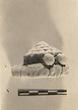
| The back, pierced by a hole, and most of the face, broken away.
The hair arranged in a coronet of nodules over the brow. A roll of drapery passes over the top of the head.
Hollow head. Traces of white ... 25-29 February 1936 |
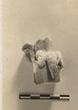
| Square box-like object.
Broken away from the left side of a figurine.
Clusters of grapes hang down its front.
Traces of white and pink color.
ADDENDA: Blond clay.
Belongs with the Herms T 1566. Cistern ... 25-29 February 1936 |
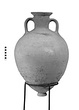
| Complete. Much chipped in lower body. Small ring foot; round body; depression at base of each handle. Wide flaring rim.
Graffito on shoulder: Ε
Unglazed pinkish-buff clay. Well. Leica, 94-14-7(6) ... 1 June 1965 ... Hesperia 69 (2000), no. 54, p. 46, fig. 8 ... Hesperia 35 (1966), p. 84, pl. 28 h. |
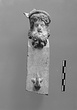
| Bearded head, crowned with elaborate garland most of which is broken off.
Broken off below.
Hole at back near bottom.
White painted, with traces of red over, on hair, lips and beard. Black and pink ribbons ... 29 February 1936 |
| Unglazed inside. Part of a shield with red circles on rim; white winged horse, left, as device in center.
Glaze black to red.
Cf. CVA Madrid, pl. 28, no. 2=ARV, p. 128, no. 96. Green Hellenistic disturbed ... 28 February 1935 |
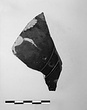
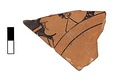
| Fragment from wall of a krater, broken all around. Part of the head of a trumpet player to left, wearing crested Attic helmet and round shield; his trumpet to his lips. Relief contours throughout; rim ... 26 May 1937 ... Hesperia 35 (1966), pp. 25-30, pl. 10 ... ARV, p. 124, no. 39, Kleophrades P ... ARV2, p. 186, no. 46. |
| Inscribed fragments.
List of names by tribes and demes.
Fragments ΘΘ 104 and ΘΘ 124 (a) four joining fragments.
Inscribed face only preserved; parts of two columns.
Fragments ΘΘ 121a, ΘΘ 121b, ΘΘ 124b, ... 4th. century B.C ... Hesperia Suppl. 14 (1975), p. 79 ... Hesperia 35 (1966), pp. 149, 219, pl. 43a, fig. 3 ... Hesperia 10 (1941), p. 46. |
Wall fragment. Glaze mottled on outside. Max. dim. 0.063. A. Ashmead, Hesperia 35, 1966, pl. 10:o (mispoised); A. Bélis, BCH 110, 1986, p. 213, fig. 12 (mispoised).
Trumpeter (most of face, a little of ... Ca. 480 B.C ... Ashmead, Hesperia 35, 1966, pl. 10:o (mispoised); A. ... Ashmead (Hesperia 35, 1966, p. 28 and note 58) rejects the identification as an Amazon because the figure has no earring and no long lock of hair. ... Ashmead (Hesperia 35, 1966, p. 26) wants 257 to be part of 256, Corbett (p. 25, note 25a) to keep it separate. |
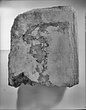
| Fragment of inscribed stele; inscribed on two faces.
Broken away below and on one side.
One face is earlier than the other; face A earlier, laws of 410-404 B.C.; face B later, sacred calendar of 403-400 ... Late 5th. century B.C. |
| Inscribed fragments.
Confiscated property of Alcibiades.
"POLETAI" record.
Fragment ΣΤ 604 from upper right corner of inscribed block.
Full thickness of block preserved, but large flakes broken from surface ... (ΣΤ 604) 11 May 1932
a) (Κ 1350) 16 July 1947
b) (Κ 22) 22 January 1934
c) (ΘΘ 5) 18 December 1936
c) (ΙΙ 242b) March 1938
d) (ΘΘ 30) 30 December 1936
d) (ΘΘ 44) 17 January 1937
d) )ΙΙ 133) 7-8 March 1938 ... Hesperia 85 (2016), p. 172, n. 114, fig. 4 ... Hesperia 17 (1948), p. 34, no. 17 ... Hesperia 5 (1936), p. 38, no. 6. |
Five non-joining wall fragments, a with start of keel. Glaze much pitted on underside of bowl. P.H. a) 0.18; max. dim. a) 0.25, b) 0.174, c) 0.087, d) 0.107, f) 0.062; est. circumference at ground line ... Ca. 500 B.C ... Ashmead, Hesperia 35, 1966, pl. 11:5.a--d, f.
... The slanting position of the left calf and foot on fragment c indicates an athlete in a fairly active pose (cf. the javelin thrower in the tondo of Munich 2637 by Onesimos [ ARV2 322, 28; Paralip. 359, 28; Mind and Body, cat. no. 46; Addenda 215]). ... My identification of the last athlete as an acontist differs from that of Ashmead, who interpreted him as a wrestler and suggested that the hand on fragment c belongs to him, his victorious opponent being the one whose left calf and foot appear at the left of this fragment (p. 32). This interpretation does not explain how the javelin overlapping the feet of the trainer on fragment a fits into the composition, for as Ashmead rightly remarks (p. 31, note 53), "there is not room for an acontist's body" in the space that would be available. |
|
|