|
|
| A deeply concave mold for making the face and the side of the head (including ears) of a bearded male, about life size.
Right half broken away; original surface preserved at top, left edge and back.
The ... 25 April 1940 ... Hesperia 10 (1941), p. 6, fig. 6 ... Agora VI, no. 903, p. 72, pl. 22 (cast). |
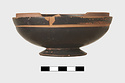
Narrow sharply rounded rim, flaring disc foot.
Another from the same context, P 5159, ibid., had a lightly rolled rim, like 1801; so also P 9474 C 9:6 Hesperia, Suppl. V, 1941, p. 138, fig. 64, 26 ... Context ca. 470-460 B.C. |
Flaring ring foot; high double handle. Glazed: the neck, a band below the handle-attachment, and on the top surface of the foot.
There are three published examples from deposits of the second quarter ... 480-450 B.C ... There are three published examples from deposits of the second quarter of the 5th century: P 5154 H 6:5 Hesperia, V, 1936, p. 343, fig. 10; P 9473 C 9:6 Hesperia, Suppl. V, 1941, p. 138, fig. 64, 25; P 10822 G 12:22 Hesperia, Suppl. IV, 1940, p. 127, fig. 94 b. |
| Intact, save for chip from rim. High flaring ring foot and rounded body; reserved groove outside below rim; upstanding inner rim to hold lid. Black glaze all over except: bottom of bowl inside foot, resting ... 25 April 1940 ... Hesperia 20 (1951), pl. 42 a-6 (Grave 12) ... Hesperia 10 (1941), p. 2, fig. 1. |
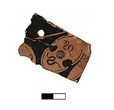
| Fragment from near top, broken all around. Two warriors in combat. Of the one on the right there remains a thigh, a Boeotian shield with two snakes flanking a rosette, and a spear; of the one on the left, ... 13 March 1937 |
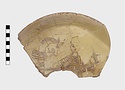
| From a large dish with flat floor, upturned rim, and a low ring foot. One rim fragment does not join. Akritas, at right, holds a bow. At left, the head of the dragon bends over, its neck pierced with five ... 12th.-13th. c. |
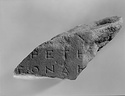
| Fragments of Latin inscription.
Grave stone; Tweddell's Epitaph.
Fragment Β 66 (a), back rough picked; otherwise broken.
Five letters preserved.
Fragment ΚΚ 1190c (b), inscribed face only preserved ... a) (Β 66) 31 January 1934
b) (ΚΚ 1190b) 9 March 1939
c) (ΚΚ 1190c) 9 March 1939
d) (ΚΚ1261a) 14 June 1939
e) (ΚΚ 1261b) 14 June 1939 |
| Broken but nearly complete. Double rosette in medallion; elongated petals divided by jewelled lines on side wall. No upper zone or incised line.
Metallic glaze inside and out. Stoa Pit F, footing trench ... 21 April 1934 |
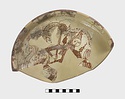
| Less than half preserved. Large plate on very low ring foot. Almost vertical rim A warrior, facing, wearing a high conical cap, a tight-fitting suit of crisscrossed underwear covering arms and legs, and ... 16 March 1937 |
| Inscribed fragment.
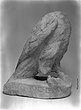
Head missing, and part of right leg; minor fractures.
The eagle is standing, his left foot advanced. Feathers carved in shallow but naturalistic style. In bottom surface of plinth, ... (ΙΙ 430) 9 May 1938
(ΘΘ 296) 21 May 1938 ... Hesperia 10 (1941), p. 258, no. 62 ... Hesperia 8 (1939), p. 208, fig.6 ... Agora III, no. 228, p. 83. |
| Inscribed fragments.
Year of Hegesios.
ΚΚ 788 (a) inscribed face only preserved; much broken.
Seven lines of the inscription preserved; stoichedon.
Spacing (five lines including) 0.079m.
ΚΚ 1182a (b) ... 324/3 B.C. |
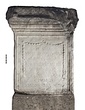
| Large inscribed base of grave monument.
Dimensions preserved complete, though at the bottom the projecting base-moulding has been broken away, and the under surface is preserved only near the middle of ... 113-136 A.D. |
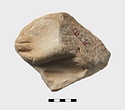
| Much weathered. Rough-picked beneath, with surface cut off by drill holes. Broken at back.
A female right foot, with drapery hanging down beside it.
Possibly a pedimental piece from the Temple of Hephaistos ... 28 April 1936 |
| Inscribed stele.
Intact, the top front edge slightly worn by traffic.
The top is crowned by a simple angular moulding; the bottom 0.08m. of the front face is finished only with the toothed chisel; the ... 367/6 B.C. |
| Mended from many pieces; the profile complete; most of the rim missing; also one handle and large fragments from the body. Restored in plaster. Heavy moulded conical foot; shallow wheel-run grooves on ... 3 March 1934 |
| Inscribed fragments.
List of names by tribes and demes.
Fragments ΘΘ 104 and ΘΘ 124 (a) four joining fragments.
Inscribed face only preserved; parts of two columns.
Fragments ΘΘ 121a, ΘΘ 121b, ΘΘ 124b, ... 4th. century B.C. |
| Completely preserved except for phallus. The top of the head is flat and rough-picked, and was probably originally finished with stucco.
Realistic portrait of an elderly man, the lines and folds of flesh ... Period of Hadrian |
|
|