|
|
Low disk foot.
Red glaze.
For the decorative motif in the handle zone, see Young, Hesperia, Suppl. II, 1939, p. 217; two later examples, Ath. Mitt. 88, 1973, pl. 8:1, no. 3, 2, no. 2 ... MG II ... For the decorative motif in the handle zone, see Young, Hesperia, Suppl. II, 1939, p. 217; two later examples, Ath. |
Bottom missing.
Bulging walls, outturned rim, bridged spout. Firm lustrous glaze on upper surface of rim, on spout and handles and for banding; thin glaze wash inside ... Context probably 6th c. B.C ... Hesperia, Suppl. II, 1939, p. 114, fig. 81, B 17. |
Three of the legs restored.
Mane pinched to a sharp, straight ridge; tail applied against left rear leg. Faint traces of glaze show that the horse was glazed over most of its body, with reserved band ... 7th c. B.C ... Young, Hesperia, Suppl. II, 1939, pp. 224-225, for Subgeometric horses. |
Foot and much of body missing.
Narrow body, high triple handle. Ring at junction of lip and body. Below the ring, pendant tongues, incised, with added red, white and red repeating. Round the body, below ... Ca. 600 B.C ... Hesperia, Suppl. II, 1939, p. 119, fig. 86 and p. 120, B 42. |
Torus rim, high flaring ring foot, arched rolled handles from neck. Streaky brownish glaze on rim, body and upper part of foot; neck and handles unglazed. Graffito on shoulder, a symbol "like an elongated ... Context ca. 600 B.C ... Hesperia, Suppl. II, 1939, p. 22, fig. 8; p. 226, fig. 144, graffito (Grave II, 1). |
Flat bottom; shallow convex body; offset rim, tilted outward. Outside: bands and zigzags. Inside : procession of birds and horses to right (five horses and one bird partially preserved); in field, double ... LG IIB ... Young, Hesperia, Suppl. II, 1939, pp. 202-203. |
Handles missing.
Flaring ring foot; low bowl with vertical wall just below rim. Flat top to rim which is folded over. Horizontal ribbon handles. Reserved: resting surface and underside, disc in center ... Early 6th c. B.C ... Somewhat earlier, P 4635 F-G 12:1 Hesperia, Suppl. II, 1939, p. 119, fig. 86, B 43, with more elaborate decoration. |
Stroke polishing on neck.
Unglazed and handmade.
Small, unpainted votives are found in great quantities at many sanctuary sites. Only about 100 were saved from the dump on Hymettos, although the total ... 8th-7th c. B.C ... Most of those saved resemble examples from the Athenian Agora published by Young, Hesperia, Suppl. II, 1939, p. 157, fig. 111, C 71-C 76. |
Fragment of rim and body only.
Flat rim, projecting over sides. Shallow body, straight sides.
Clay: fine, grey (burned); black glaze inside and out (except inside curve). Assembly Place, filling of ... 1932 |
NM 16167
Complete but for handle.
Black glaze.
Other examples: Ath.Mitt. 28, 1903, Beil. XXIV,4; Hesperia 19, 1950, pl. 104, b; Kerameikos V, 1, pl. 111, inv. no. 831. The tankard developed from the ... MG II |
Complete.
Two warts on front, glazed over; inside, reserved dot on floor and band at rim with sets of short strokes. Ladder pattern on band handle.
Shiny black to red glaze.
Other large cups are listed ... EG II |
NM 16173
Flat bottom and oval mouth. Entirely reserved outside except for a large swastika on either side, and dot rows on upper edge of lip, along outer edges of handles, and across bottom of lower handle ... LG II |
NM 16062
Flat bottom. Ladder pattern on beginning of handle at top; three glaze bands on rim inside.
Black glaze, brown where thin.
Like the mugs from the Isis Grave, C.V.A., Athens 1[1], 4[4], 1-4 ... MG II |
NM 16135
Shiny black to dull reddish brown glaze.
The gear pattern is rare on Attic skyphoi; another example, Ath. Mitt. 81, 1966, Beil. 14: 4, no. 7 ... MG II |
NM 16168
Flat bottom; shallow, convex lower body.
High slightly concave neck decorated with four goats, couchant and regardant.
Thin brown glaze.
For the goats cf. P. Amandry, Journ. Near East St ... LG II |
NM 16080
Complete.
Flat bottom; straight neck, increasing upward. Dot series on upper edge of lip; two glaze bands below lip inside; on handle, alternating sets of bars and St. Andrew's crosses.
Dull ... LG II |
NM 16071
Complete.
Flat bottom; continuous profile; rising band handle. Top of lip glazed; inside unglazed; ladder pattern on handle interrupted by a St. Andrew's cross.
Dull black to red glaze ... LG II |
NM 16086
Complete.
Ring foot. All glazed inside except for reserved dot on floor and three bands at rim.
Shiny black glaze.
Cf. Kerameikos V, 1, pl. 92, inv. no 238 ... MG II |
Thin brown glaze ... LG II |
Nothing of base.
Black glaze.
Like Brann I 35 ... MG II |
Base completely restored.
Dull black glaze.
Young XX 1-3 and Brann 261 are similarly decorated but deeper and less rounded so probably later than ours ... MG II |
Bottom completely restored.
Compass-drawn rings.
Dark brown glaze ... MG II |
Base and lower body all restored.
Shiny brown glaze, peeled.
Cf. Brann L 26 (LG IIA); Brann 131 (LG IIB) ... LG II |
Nothing of base.
Black glaze ... MG II |
Reserved dot at center of floor inside, band at rim.
Black glaze.
Cf. Brann I 32; also J.N. Coldstream, Arch. Anz. 78, 1963, col. 203 ... MG II |
Low disk foot.
Black to reddish brown glaze.
The decorative scheme in the handle zone appears to be strictly Middle geometric: cf. J. N. Coldstream, Arch. Anz. 78, 1963, cols. 202-203 ... MG II |
Three handles restored.
All glazed inside except for a reserved dot at center of floor and three bands below rim.
Dull glaze, brown to red.
For stacked skyphoi cf. C.V.A., Heidelberg 3 [27], text, ... LG II |
Unpainted two handled cups are discussed under Brann. Ours is closer to Agora examples which were found in Middle Geometric contexts ... MG II |
Rising band handles applied against shoulder and decorated with ladder pattern.
Shiny black glaze ... MG II |
Bottom missing.
Ladder pattern and St. Andrew's crosses on handles.
Dull glaze, brown to red ... LG II |
Flat bottom; rolled handle across the mouth. Inside unglazed; three glaze bands on handle.
Thin brown glaze, in places thick and black ... LG II |
Flat bottom and two-storeyed body.
Black glaze shading to red ... MG II |
Flat bottom; rising band handle decorated on its outer face with an elongated St. Andrew's cross.
Black glaze, fired red in places.
For system of complete banding which is Corinthian, cf. Brann 55 ... LG II |
Low ring foot. On handle, ladder pattern.
Shiny dark brown glaze.
Cf. Kerameikos V, 1, pl. 75, inv. no. 298 ... MG II |
Nothing of neck, mouth, or handle. Squat body with flat bottom. At either side, a set of three concentric circles around a dotted quatrefoil; front and back, same scheme: wavy vertical lines to point ... LG II |
Entirely glazed inside.
Shiny brown glaze ... LG II |
Nothing of mouth or handle. Low ring foot; conical body.
Shiny black glaze, brown where thin.
For other Late Geometric oinochoai with conical bodies, cf. Brann F 13 ... LG II |
All glazed except for lower edge of foot and a reserved band on either side of rim. On each handle a St. Andrew's cross.
Dull red glaze ... MG II |
Neither handle preserved.
Flat bottom; squat rounded body with slightly outward-turned lip. At level of handle zone, elongated blobs surrounded by dots to either side of a zigzag. Completely glazed interior ... LG II |
Flat bottom. Ladder pattern and blob stars on handles.
Dull black glaze, brownish where thin.
Cf. Brann 169 ... MG II |
Dot series on upper edge of lip; single glaze band below lip inside.
Black glaze, brown where thin ... LG II |
Flat bottom; high, flaring upper wall; one vertical band handle (missing but restored correctly as indicated by handle attachments), and one horizontal rolled handle.
Inside all glazed except for a reserved ... LG II |
Flat bottom, Ladder pattern on handle.
Black glaze.
For imitation of the Corinthian Light-on-Dark technique in which white paint was used cf. Brann N 8 ... LG II |
Glaze band around edge of rim inside; ladder pattern on handle.
Thick brown glaze.
Cf. Kerameikos V, 1, pl. 25, inv. no. 253 ... EG II |
Intact.
All glazed inside and out except for reserved band on either side of rim; ladder pattern on band handle.
Black glaze ... EG II |
Intact.
All glazed inside and out except for reserved dot on floor inside, upper edge of rim; ladder pattern and St. Andrew's cross on handle.
Thick black glaze.
Cf. Kerameikos V, 1, pl. 105, inv. nos ... EG II |
Preserves part of bottom and a third of body and rim.
Flat bottom; sharply convex body curving continuously to high, concave neck with flaring rim. On shoulder (presumably at level of handle attachment) ... LG II |
Straight wall; plain lip. From left to right: man with sword (head missing), a shield-like object, and a bird (?) facing right. Glazed inside as far as preserved except for a reserved band below the lip ... LG II |
Preserves part of high, vertical neck and flaring round mouth.
Neck reserved and decorated with a row of pointed-handled tripod-cauldrons. Inside unglazed as far as preserved, except for three glaze bands ... LG II |
Low disk foot and very squat body. In handle zone, at one side, two birds with striped bodies to right, a third bird with solid body squeezed in at right; on either side, two opposed birds facing center, ... LG II |
Slightly rounded shoulder continuous with plain lip. Outside reserved and decorated with a man leading a horse with spike mane to right, zigzags in field. Glazed inside as far as preserved.
Dull glaze, ... LG II |
| Nozzle and handle missing, and chips.
Small bottom flat beneath, rising to a cone at the center inside. Angular body. Broadly projecting rim. Rolled horizontal handle.
Black glaze except for handle space ... Publication: last years of 6th c. -ca. 480 B.C ... I.
Hesperia Suppl. 5 (1941), p. 145, no. 42.
For context, cf. Hesperia Suppl. 4 (1940), pp. 30-33.
Hesperia Suppl. 8 (1949), pp. 229-231. |
| Complete.
Thin brown glaze inside; a brown band around the top of each handle; also around the underside of the foot; dot and circle at center. Two wide purple-red bands below the handles; the other decoration ... Early 6th. c. B.C ... Hesperia Suppl. 2 (1939), no. II 2, p. 23, fig. 9. |
No. 20.
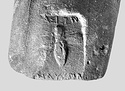
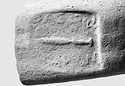
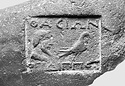
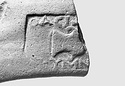
A few letters of the end of a name preserved at what seems to be the lower right corner of a narrow rectangular stamp.
Brownish clay, buff core. Nb. No. 5. Trench E. 1056 ... Latter 4th - 3rd century BC |
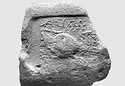
No. 43.
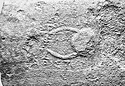
Vestiges of a device or letters. The handle may belong to an earlier period. Nb. No. 5. Wall Trench E. 1111 ... Latter 4th - 3rd century BC |
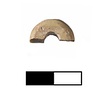
| Circular bone button or bead, about half preserved.
Flat back. Facetted top and side. Hole pierced through center.
Polished, light yellow brown bone. Finished Early Building II, Layer II. From fill in ... 28 July 2008 |
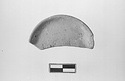
| More than half broken away. Unglazed miniature saucer. Belongs with Pyre I 12:3. Finished Classical Building II, sacrificial pyre II. 82-59-30 ... 6 August 1982 |
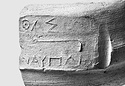
No. 10. Nb. No. 5. ΘΕΣΜΟΦΟ
ΡΙ[ΟΥ] ΔΙΣΚΟΥ 1039 ... Late 4th - Mid 3rd century BC |
No. 19. Nb. No. 5. Trench A, fill of dromos. ΕΛΛΑΝΙΚΟ[Υ] 1055 ... Late 4th - Mid 3rd century BC |
Dark brown glaze ... MG II-LG I |
Low ring foot; rolled handle.
Black glaze.
Cf. Brann 49 ... Transition to LG II |
Mouth and neck restored.
Ring foot.
Thick shiny black glaze ... EG II- MG I |
NM 16094
Very slightly convex lid, almost flat; plain rim, slightly thickened below; large inverted conical handle.
Black glaze.
Cf. Brann I 59 ... MG II-LG I |
| Slightly chipped at one edge otherwise complete.
Red and yellow pigment preserved on interior surface. Finished Northwest corner of Room II. 8137 ... 14 June 2007 |
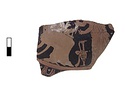
Female figure, seated right on a rectangular seat (?), leaning on her right hand. She wears a thin chiton with embroidered bodice, a white hair ribbon and bracelet. In the upper left corner of the fragment ... November 1932 |
Lower part of a draped figure standing right, resting his left foot on a large stool, and leaning on his staff. His drapery (chiton?) reaches to just below the knee of his right leg. Near the top of the ... 17 December 1930 |
A woman left, in front of her a wool basket; behind, an uncertain object. Her right hand is raised toward her forehead; in her left she holds a string of beads. Her chiton has a white yoke and a white ... 3 January 1931
12 February 1931 |
| Two female figures, one seated right in a chair (klismos), holds in her lap a large basket for offerings; the other, approaching from the right, appears to be hanging a string of beads over the basket ... 21 January 1931 |
Mended from two pieces.
A woman wearing a peplos with overfold and embroidered bodice moves right, looking back left. In either hand she carried a large box, from which hangs long, embroidered taeniae ... 5 October 1932 |
Part of Eros flying to right, a large palmette, head and neck of swan to left, and part of a winged figure (Eros or Nike?) to right. Pairs of straight strokes (?) on rim. At the centre a moulded ring, ... 1931 |
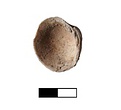
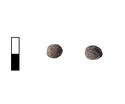
| Two globular pellets.
Light brown fabric. Pyre beneath floor of Classical Building II, Room 1 ... 20 June 2001 |
| Clay; dark red; micaceous, containing some white grit East Sanctuary; from cleaning the course of the terrace wall ... 1931 |
| Pnyx 59
Clay; dull buff in color containing fine grains of mica. East Sanctuary; Clearing North of Terrace Wall ... October 1932 |
| No. 76.
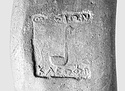
Light red clay, buff core. Nb. No. 5. ΘΑΣ[ΙΩΝ]
ΑΡΙΣΤΟΦΑ[ΝΗΣ] 1153 ... Late 4th - 3rd century BC |
| WT 144.
Buff clay. Nb. No. 6. From the construction debris of the City Wall of the late 4th c. B.C. ΘΑΣΙΩΝ
ΚΛΕΟΦΩ[Ν] 1307 ... Late 4th - 3rd century BC |
| WT 226.
Dark russet clay. Along the upper edge, the effects of a flaw in the die. Nb. No. 7. Wall Trench R, destruction debris of mortared wall. Context as late as medieval. ΘΑΣΙΩΝ [ΤΗ]ΛΕΜΑΧΟΥ 1481 ... Late 4th - 3rd century BC |
| Small pyramidal lead weight. Well preserved.
Hole drilled though 0.003m. from top.
Slightly tilted. Finished In rubble fill of Early Building II, Room A. 4545 ... 17 July 2008 |
| Clay; russet, fine, micaceous. Assembly Place; Filling of Period III ... 1931 |
| Pnyx 65.
Clay; bright buff in color containing gritty and mica grains. East Sanctuary; clearing south of terrace wall ... October 1932 |
| Single fragment of albastron, broken all around.
Alabster. Inventoried July 2002. Layer II in Stoa Shop VI ... 27 May 1955 |
| WT 145.
Hard-baked reddish buff clay. Nb. No. 6. From construction filling of East Stoa, at east end of building ΘΑΣΙΩ[Ν]
ΣΚΥΜΝ[ΟΣ] 1308 ... 2nd halfof 4th century Bc. |
Glaze bands outside on rim; below, apparently a dot row.
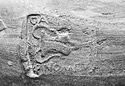
Letters incised left to right just below the rim. -ΟΝΙ- Votive dump. -ΟΝΙ- ... Late Geometric II or Subgeometric |
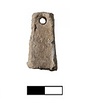
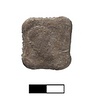
| Square lead weight, complete.
Raised rounded corners, cone-shaped object in relief slightly off center.
Surface worn. Finished Early Building II, Room C; Fill Below Surface, South; Cutting in Bedrock ... 22 July 2009 |
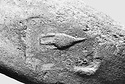
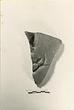
| Uncertain representation: body of carnivore (?).
Broken all around.
Red-buff clay. South Stoa II, Building; Hellenistic fill. Leica ... 7 May 1953 |
| Flaring ring foot, ovoid body, shallow groove at base of neck, raised ring half way up neck; trefoil mouth. One high vertical strap handle, shoulder to back of rim.
The siren, standing right, looking ... Early 6th. c. B.C ... Hesperia Suppl. 2 (1939), no. II 4, p. 23, fig. 9. |
Diameter of top and foot appears mostly the same; the side slightly concave
Clay: Reddish, unglazed East Stoa, Northeast Corner, Layer II. 606, 607, 741 ... 1934 |
Flat at the top; the sides flaring downward.
Clay: Reddish, unglazed East Stoa; Northeast Corner, Layer II 606, 607, 741 ... 1934 |
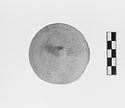
Flat, circular, perferation through center; single groove around edge. Wall Trench Q, WT 136, East of Stoa, II Layer. 1290 ... 12 July 1937 |
| Intact. Lid of miniature lopas, similar to P 31355.
Unglazed. Finished Classical Building II, sacrificial pyre I. 82-67-19, 82-67-20 ... 15 July 1982 |
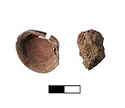
| Mended from two fragments, gap along edge close to the hinge.
Ovoid shell with red pigment on interior surface also embedded in soil sample kept from the inside of the shell. Finished Northwest corner ... 14 June 2007 |
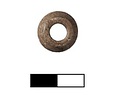
| Circular bone bead. Chipped at one rim. Covered in concretions.
Large hole in the center. Biconical profile with flat collar at top and bottom.
Yellow ivory color. Finished Late floor, Layer IV. In fill ... 19 July 2007 |
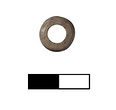
| Intact.
Small circular bone ring with rounded edge.
Large center hole. Small flattened patch on two opposite sides, worn or intentional?
Yellow bone with slight tint of green. Finished Late floor, Layer ... 18 July 2007 |
Clay; dull buff, yellow on surface; fine but containing some grit. Assembly Place; Filling of Period II;
Along with Hellenistic and Roman Sherds ... 1931 |
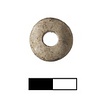
| Complete.
Circular flattish bone bead, polished smooth. Large hole in center. Roughly rounded edge. Thinner edge on two opposite areas from wear.
Pale white yellow in color. Finished Early Building II, ... 23 July 2009 |
|
|