|
|
| Evidence of a 4th Century Building. Hellenistic Building; Room 1 ... ΠΠ-12 2381, 2382 Lot ΠΠ 364 Lot ΠΠ 365 Lot ΠΠ 366 ... Jul 2 1956 ... Evidence of a 4th Century Building ... Hellenistic Building; Room 1 |
| Northwest. Original Building. 4th century. Roman Wall. Hellenistic. Basin. Well. Pithos. Cutting ... ΟΟ-13 2536, 2537 ΟΟ 1051 P 19985 ΟΟ 1417 P 20431 Lot ΟΟ 629 ... 14-16 May 1949 ... 4th century ... Hellenistic |
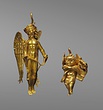
| Gold earrings: youthful Eros with a ribbon (4th century B.C.), J 160, baby Eros playing the kithara (Hellenistic), J 154 ... Craig Mauzy ... Horizontal (normal) ... 11 Oct 2004 ... Gold earrings: youthful Eros with a ribbon (4th century B.C.), J 160, baby Eros playing the kithara (Hellenistic), J 154. |
| Part of the mold for the upper part of a lamp.
The groove around the rim and the ivy leaf pattern of the upper body preserved.
Type XIX or XVIII of Corinth collection, type 46C of Agora collection. House ... 22-24 July 1947 ... House H, Room 10; brown fill, mixed Hellenistic. 4th. to 2nd. century B.C. |
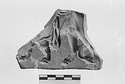
| The legs and the part of the body of a lion or panther walking right. Animal leg with drapery falling over is preserved, suggests it had rider (who perhaps holds a staff?).
Part of the lower edge preserved ... 29 May 1947 ... Loose Hellenistic fill; mixed 4th. century to Hellenistic. |
| Dull buff clay, darker inside; red paint on neck.
Cf. Dumont (1872), pl. IX, 3. Par: Dumont 1871, Pl IX,3*
Dip: red paint on neck* Finished 4th century B.C. and Hellenistic fill. Δεινώ̣π̣ας̣
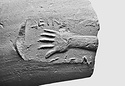
hand
[Θά]σιο̣ν ... 14 March 1936 ... 4th century B.C. and Hellenistic fill. |
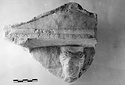
Face of terracotta figurine. 4th century or Hellenistic. End of nose and head from ears back gone. Fine work. Wavy hair. Head turned to right. Reddish clay. Munsell (fabric/surface) 5 YR 6/4 light reddish ... 14 December 1933 ... Face of terracotta figurine. 4th century or Hellenistic. |
| Section ΠΠ 1948 ... Mabel Lang ... The western and northern parts of Section ΠΠ were brought down to Roman level. Revealed were Roman houses (North House and South House), drains and roads (East-West Road with two drains underneath it, ... 16 Mar-29 Apr 1948 ... In places where Roman structures had been destroyed, the excavation reached earlier periods (Early Roman, Hellenistic and 4th century B.C. remains). |
| Section ΠΠ March-June, 1956 ... A. Boegehold ... The ruins unearthed in section ΠΠ represent six roughly defined periods: 4th century B.C. to Hellenistic, Augustan, pre-Herulian, post-Herulian, Byzantine and Turkish.
The results of the excavation are ... 20 Feb-29 Jun 1956 ... The ruins unearthed in section ΠΠ represent six roughly defined periods: 4th century B.C. to Hellenistic, Augustan, pre-Herulian, post-Herulian, Byzantine and Turkish.
|
Complete except for a few chips.
Low foot; rounded resting surface; convex underside. Very slight groove above foot. Convex wall. Rim concave on top, with ridge at inner edge. Thick, shiny red glaze, ... 325-300 ... Other concave-rim plates from Hellenistic contexts: 818, 819, and P 21010 (H--K 12--14), very crudely made, but possibly dating in 4th century; P 1092 and P 1093 (H 17:5), also possibly 4th century. |
| Early Building II; Room A. General Late Hellenistic Level. Strosis III. Strosis II. Strosis I. Late Pithoi. Late Hellenistic Fill. Rubble Wall. Hellenistic Fill. 4th Century Fill. Roman Street. Sandy Earth ... Ζ-5 811, 812 ... 1933 ... General Late Hellenistic Level ... Late Hellenistic Fill ... 4th Century Fill |
| Part of rim and side with one horizontal handle attachment at left.
Incised on side.
Black glaze.
Type VI (early 4th. century variety) of Corinth collection, type 23C of Agora collection.
In Hellenistic ... 27 February 1936 ... Type VI (early 4th. century variety) of Corinth collection, type 23C of Agora collection.
... In Hellenistic and early Roman fill. |
Parts of wall and one-third of rim missing.
Flat bottom with hole in center, broken away from flat surface to which it was once attached. Squat body with distinct shoulder.
Outwardly thickened rim, with ... 4th century? |
Half of rim and large parts of wall restored.
Rounded resting surface (worn); convex underside. Flaring rim with taut molded profile; inner wall straight. Slightly rising spurs with flaring sides. Dull ... 265-250 |
Fragment of upper part of lower body, broken all around.
Wall is decorated with ribs; top of one rib preserved, outlined by painted ridge. There is also paint in the triangular area between the petals ... Late 4th century? |
| Table of Contents. Preface. List of Illustrations. Abbreviations and Bibliography. Technical Terms and Conventions. Introduction. Imported Lamps. Lamps of the 1st Century Before Christ through the 2nd ... Agora 7 vi ... Lamps of the 4th to 6th Century ... Lamps of the 4th to 7th Century ... Note on the Chronology of the 3rd and 4th Century Lamps |
| House E; Hellenistic and 4th B.C. House; North of East-West Street by Great Drain; i.e., Northwest Corner of Section. House F; Latest Hellenistic-Early Roman House; South of Street Above Northeast Corner ... ΟΟ-7 1328, 1329 ... 1948 ... House E; Hellenistic and 4th B.C. ... Area of Poros Building; 4th Century; Marble Workers ... Area of Poros Building; General 4th Century |
Over half preserved; rim chipped, knob missing. Darkened by fire.
Small, domed lid with projecting rim. Three holes (probably originally four) pierced through dome. Micaceous, light reddish brown fabric ... 4th century? |
P 17703 a, b, c
Three sections preserve over half of foot and part of lower wall (a), part of rim (b), and about one-fourth of lid (c). Burning on edge of rim.
Flat underside. Projecting molding at bottom, ... 4th century |
Connected with G 14:3.
There was a layer of Late Roman fill. It rested over a layer of 2nd c. B.C Hellenistic and then another of 4th c. B.C Hellenistic; the passage between the two cisterns contained ... Late Hellenistic ... B.C Hellenistic and then another of 4th c. B.C Hellenistic; the passage between the two cisterns contained Hellenistic material. Therefore, it appears that this cistern had several periods of use: Hellenistic (at least one phase contemporary with the 2nd century B.C, phase of House E to the north), Late Roman (probably associated with the amphora and perhaps also maybe the platform and the drain), and finally Byzantine.
|
Part of dome, flange, and cylinder preserved.
Flange has thickened edge; face reserved with two grooves. Reserved band with two grooves surrounds dome. Lustrous black-to-green glaze ... Late 4th to early 3rd century? |
Lid.
Broken all around, with knob missing.
Knob or stem made separately, with two square moldings at base.
Decoration in red glaze: lotus petals with dotted ribs alternate with plain petals on wall ... Disturbed 4th-century context |
| Broken on all sides.
Parts of four lines of the inscription preserved.
Hymettian marble. Found in mixed Hellenistic and Roman context, outside the Market Square, to the southwest, in the disturbed area ... 4th. century B.C. |
| Section ΛΛ 193
Excavation Summary ... Dorothy Burr Thompson ... Excavations in Section ΛΛ revealed that the original contour of Kolonos Agoraios had been much sharper than in modern times. No traces of early graves were found in the area; first sign of habitation is ... 1 Feb-23 Jun 1937 ... The best preserved material belongs to the 4th century B.C. The area was probably covered with houses of which five establishments were well preserved, several others less preserved.
In the early 3rd century the easternmost houses went out of use to leave space for the Hellenistic Building.
... In the late 4th century A.D. the area suffered much damage.
|
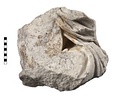
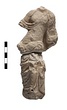
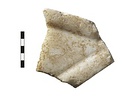
| Fragment from a large draped statue, probably in himation. It is not immediately apparent to what part of the statue it belongs. Joint-surface for an inset member shows that the statue was pieced.
Carefully ... Late 4th c. B.C. or Hellenistic ... Carefully worked, the thick-textured drapery suggests late 4th century or Hellenistic.
|
Digging abandoned at 17.10m.
Nbp. 2863: The fill in the mouth to -6.50 was a dump of mixed hellenistic and late roman sherds. From -6.50 to -11.00m. small stones with a few late roman sherds 4th-5th c ... 4th-5th c. A.D ... Nbp. 2863: The fill in the mouth to -6.50 was a dump of mixed hellenistic and late roman sherds. From -6.50 to -11.00m. small stones with a few late roman sherds 4th-5th c. From -11m. the well deposit started and was very heavy and continuous to abandonment depth, 4th-5th c. A.D. pots and 4th c. coins. A third century phase was beginning to appear at time of abandonment. |
| Complete except for chips, glaze badly worn. Underside recessed, concave. Foot slopes up toward interior yielding resting surface toward outside. Rim convex and drooping toward outside. Added white garland ... 13 May 1971 |
Handle and part of rim missing.
Slightly concave underside, reserved and painted with miltos.
Globular body curves out smoothly into flaring rim. Handle round in section. Dull brown to shiny black glaze ... 4th century? |
Back fill in an unfinished well, originally dug only to a depth of 3.80m. Apparently dug in the 3rd. c. B.C. and refilled at once; the filling contained a scattering of 5th. and 4th. c. fragments as well ... To early 3rd century. |
| Section ΟΟ 1949
Grave Area ... Margaret Crosby ... A report on the excavation in the immediate vicinity of the Early Geometric burial found in 1948 in Section ΟΟ. Two Geometric graves were uncovered, and also walls and drainage systems belonging to the ... 28 Mar-9 Nov 1949 ... Two Geometric graves were uncovered, and also walls and drainage systems belonging to the industrial establishments of the later 6th and 5th B.C. centuries, as well as sporadic remains from later periods, such as a 4th B.C. century pit and a Hellenistic cistern. |
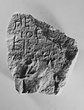
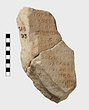
| Inscribed fragment.
Only the upper left hand part remains.
A stele with gabled top, the mid-part of its front deeply cut back to hold the relief; a figure of the Mother seated on her throne, facing front ... 4th. century B.C. |
[cmk.: bunch of grapes] Worn illegible. Worn illegible ... 4th century B.C. and Hellenistic ... 4th century B.C. and Hellenistic |
[cmk.: cornucopia in incuse oval] Worn illegible. Worn illegible ... 4th century B.C. and Hellenistic ... 4th century B.C. and Hellenistic |
[cmk.: dolphin on trident] Worn illegible. Type of beardless head ... 4th century B.C. and Hellenistic ... 4th century B.C. and Hellenistic |
[cmk.: dolphin on trident in incuse square] Worn illegible. Worn illegible ... 4th century B.C. and Hellenistic ... 4th century B.C. and Hellenistic |
[cmk.: bunch of grapes] Written in envelope that is probably K-1495 Worn illegible. Worn illegible ... 4th century B.C. and Hellenistic ... 4th century B.C. and Hellenistic |
[cmk.: lyre] Worn illegible. Worn illegible ... 4th century B.C. and Hellenistic ... 4th century B.C. and Hellenistic |
Type A Pyxis.
Foot and lower body preserved.
Ring foot with three wide areas cut away to make tripod support; rounded resting surface; slightly convex underside. Cylindrical body, slightly concave. Fairly ... Context of 325-200 with late Hellenistic disturbance |
Aryballos: Impressed Decoration.
One-third of rim and part of body restored, including center of floor.
Flat bottom. Profile in two stages divided by concave band bounded by groove above and below. Stamped ... Context of second half of 4th century and early 3rd century, with a few late 3rd-century pieces |
Fragment of rim missing.
Straight ring foot with angle in inner face; flat resting surface; flat underside. Slightly convex profile with clear horizontal facets.
Plain rim. Metallic black glaze, much ... Late 4th to early 3rd century |
Stamped Plate.
Part of foot and floor.
Ring foot. Stamp on floor, not centered: ligature of the letters ΘΕΟΥ in oval field. Light brown fabric (7.5YR 6/4) with very little mica; metallic black glaze ... Context of late 1st century B.C. to early 1st century after Christ |
Fragment of wall.
Nearly flat wall, with stamp within irregular sunken area with curved end: Φιλ̣[. Micaceous, light reddish brown fabric (5YR 6/4); metallic black glaze outside, with some dribbled on ... 200-150 |
Upper body and pieces of foot and flange missing; center of floor and one-fourth of lower body restored. Very battered.
Molded foot with scraped groove between moldings; grooved resting surface, reserved ... Late 4th to early 3rd century? |
Sikyon ... [Kleiner 1976, p. 21, no. 112.(B 20:9)] Coin no. 40. Hole in bedrock at bottom of drain. Hellenistic sand. Dove flying l.; other details illegible. ςI in olive-wreath. 1489 ... End 4th or first half 2nd century B.C. |
Sikyon ... [Kleiner 1976, p. 21, no. 113.(B 20:9)] Coin no. 77. Hole in bedrock at bottom of drain. Hellenistic sand. Dove flying l.; other details illegible. ςI in olive-wreath. 1493 ... End 4th or first half 2nd century B.C. |
| Inscribed fragments.
Fragment ΟΑ 235, inscribed face only preserved.
Eight lines of the inscription preserved.
Part of IG II2, no. 46.
Fragment ΟΑ 393, inscribed face only preserved.
Fourteen lines of ... 4th. century B.C. |
| Section ΟΟ 1948 ... Margaret Crosby ... Work in Section ΟΟ was concentrated on the east and west ends of the north side of the section: parts of the ancient east-west street were explored; ca 20 meters of the Great Drain was clearly exposed; ... 8 Mar-26 Apr 1948 ... Work in Section ΟΟ was concentrated on the east and west ends of the north side of the section: parts of the ancient east-west street were explored; ca 20 meters of the Great Drain was clearly exposed; remains of a house (House E) from the 4th century and Hellenistic period, with cistern (Cistern A), water storage tank and a well (Well I) were found; the Roman Bath (Building A and Hypocaust area) was further explored, and a well in the central court (Well II) dug out; a trial cut was dug in a long, narrow poros building with a large open yard and a series of small rooms; and an early Geometric grave was found and excavated. |
Part of foot.
Broadly spreading, convex foot with scraped groove at half height and at top of preserved segment. Beveled resting surface. Underside reserved. Shiny black glaze, mostly missing; miltos ... Late 4th or 3rd century |
Parts of upper body and one strap handle preserved; partly restored. Fragments have not all been restored in correct position relative to one another.
Slender body flaring out to rim. One strap handle ... Late 4th-early 3rd century |
About one-fourth preserved, with complete profile.
Straight foot with groove in outer face. Beveled resting surface; nippled underside. Groove halfway up wall. Angle at top of wall.
Slightly convex, ... Late 4th to early 3rd century |
| Agora 2, no. 18. Agora 5, G 182. Well. Kroll 1973, p. 324, no. 1. Walker 1980, p. 63, no. 36. Cistern. P.E. Corbett, Attic Pottery of the Later Fifth Century from the Athenian Agora, Hesperia 18, 1949 ... Agora 26 305 P 5364 D 11:1 D 15:3 D 17:5 A-B 19-20:1 D-E 8-9:1 E 14:2 ... Time of Hadrian |
Jug With Thin Neck.
Intact.
Raised base with flaring profile; concave underside. Pear-shaped body. Long, thin neck. Flaring rim with angular profile, concave to inside. Strap handle from shoulder to ... Context of 325-300 |
About one-sixth of rim and wall preserved; center of floor missing.
Ring foot; flat resting surface. Convex wall with two grooves at top.
Slightly rolled rim. Metallic black glaze, red on stacking circle ... Late 4th to early 3rd century |
About one-fourth preserved, partly restored.
Ring foot; rounded resting surface; convex underside. Convex profile, with area below rim offset and marked with two grooves. Rim convex on top. Metallic red ... Late 4th to early 3rd century |
Small chips missing.
Angular ring foot; rounded resting surface; slightly pointed underside. Very slightly convex wall, with broad, very shallow groove at top. Slightly rolled rim. Shiny brown glaze, ... Late 4th to early 3rd century |
One-third of foot, two-thirds of wall and rim restored.
Ring foot with slight angle in outer face; beveled resting surface; flat underside. Slightly convex profile with shallow concave band below rim ... Late 4th to early 3rd century |
Over half of rim restored.
Low ring foot; broad, rounded resting surface; nippled underside.
Straight wall with offset at one-third height. Slightly incurved rim.
Metallic black glaze, brown to orange ... Late 4th to early 3rd century |
| Section Φ Season of 1937 ... Eugene Vanderpool ... In antiquity the area included in Section Φ lay outside the Agora proper and were apparently occupied only by houses and small buildings. The earliest period of which any considerable remains were found ... 25 Jan-17 Jun 1937 ... Some of the objects from the well belong to the early years of the 5th century B.C.
In the northeast corner fragments of terracotta water pipes were found, some in situ, dating from the late 6th or the 5th century B.C.. ... It was built in the early 4th century B.C. and continued in use until the end of the 2nd century B.C.
Remains of the Hellenistic period are few. |
Shallow bowl on high spreading stand; foot moulded, and a moulded ring at junction of stand and bowl. Scraped groove on upper ring, and two around foot. Rim thickened, flat on top; on it, nine small shallow ... Late 4th c. B.C ... Eleven fragments from similar black kernoi, each pre- serving one of the small bowls broken from the rim, have been found in contexts extending from the 4th century well into the Hellenistic period: P 5884; P 8595 E 6:2; P 9359 M 18:5; P 11275 B 13:8-U; P 11537 E 5:2; P 16157 K-L 18-20:1; P 17036 B 20:2; P 19522; P 22116 J 11:1; P 25569; P 26025. |
Jug With Thin Neck.
A few chips missing.
Raised base; deeply concave underside. Pear-shaped body. Thin neck.
Flaring mouth with thickened lip. Strap handle from shoulder to neck.
Soft, fine, micaceous, ... 4th-century context |
| Grave Area. North Wall; Northeast Rooms of Poros Building. Area Walls X, Y, Z and Pre-Roman Levels in F5. East Wall Line of Poros Building. House F; Roman and Late Hellenistic. Hellenistic and 4th Century ... ΟΟ-17 3202, 3203 ΟΟ 1001 P 19944 ΟΟ 1235 SS 10791 ΟΟ 953 S 1402 ΟΟ 865 P 19844 Lot ΟΟ 325 Lot ΟΟ 326 Lot ΟΟ 327 Lot ΟΟ 328 Lot ΟΟ 329 Lot ΟΟ 330 Lot ΟΟ 331 Lot ΟΟ 332 Lot ΟΟ 333 Lot ΟΟ 334 Lot ΟΟ 335 Lot ... Hellenistic ... House F; Roman and Late Hellenistic ... Hellenistic and 4th Century ... F4; Roman and Hellenistic |
Plastic Vase: Foot Askos.
Top and part of instep preserved.
Concave strainer pierced with six holes in top. Edge of top surrounded by fine groove. Trace of handle on right ankle, seemingly not a ring ... 225-175 |
| Section Ω 1938 ... M. Crosby ... Section Ω lies in the east end of the north slope of the Areopagus, well to the southeast of the market square proper. Excavation showed, as expected, that the area was a residential district throughout ... 16 Jan-17 Jun 1938 ... A few sherds of prehistoric date was found but there were no definite sign of habitation before the end of the 6th century B.C. By that time however, there was a street running diagonally up through the section, and remains of buildings, wells, cisterns, etc. from that period and onwards were found. Not until the end of the 4th or early 5th century A.D. are there any traces of buildings other than private houses. Part of the area was covered by a mass of destruction debris from the 7th or 8th century A.D., and it was probably not built up in Byzantine times; the Turkish and modern houses rested directly on the late Roman fill at the north and southeast, on Classical and Hellenistic in the center, and on bedrock in the southwest. |
http://agathe.gr/guide/metroon.html Metroon (Archives) The Metroon served two functions; it was both a sanctuary of the Mother of the Gods and the archive building of the city, a repository of official records (Fig. 19). The present remains ... The present remains date to the mid-2nd century B.C. and overlie traces of earlier public buildings, including the Old Bouleuterion. The Hellenistic building had four rooms set side-by-side, united by a facade of fourteen Ionic columns. ... A dedicatory relief of the Mother of the Gods, 4th century B.C.; one of several dozen copies found in the Agora. |
House R, fill under drain tiles and fillings associated with house K in industrial area, including what was C 19:15, plus C 19:16 and
C 19:17.
a) House built as dwelling in second half of 5th.c.
b) Used ... Ca. 5th and 4th c. B.C ... House R, fill under drain tiles and fillings associated with house K in industrial area, including what was C 19:15, plus C 19:16 and
C 19:17.
a) House built as dwelling in second half of 5th.c.
b) Used as marble-workers' shop from beginning of 4th. c. to near middle of century. Rebuilt as an industrial establishment about middle of 4th. c.
c) Area built over in Hellenistic times.
... Most of the material comes however from the second and third phases noted above: either the marble-workers' shop, or the heavy filling of dumped earth and marble chips thrown in over the area when the level was raised for the remodelling of the building at about the middle of the 4th c. B.C. It is not always possible to distinguish between these two periods; the objects from both, mostly of the late 5th into the first half of the 4th c., have been listed together. |
[cmk.: crude wreath?]
Ob. Beardless male head r.
Rev. Illegible. Circular mark of short strokes, perhaps modern. Coin no. 15. Third triangle. Layer I. Red fill. Worn illegible. Worn illegible. 1615, 1783 ... 4th century B.C. and Hellenistic ... 4th century B.C. and Hellenistic |
Large Closed Vessel.
Wall fragment.
Fragment from nearly horizontal shoulder of large, closed vessel.
Star pattern consisting of two long, incised strokes bordered by white dots crossed in an X, with ... Context of 4th to 2nd century, with coin of 130-90 (ΠΠ-620, Agora XXVI, variety 100; cf. Svoronos, pl. 107:54) |
| Small lamp with central collar.
Complete except for part of interior collar.
High ring base, slightly convex side wall. No handle. Round body, short nozzle, collar inside over hole in bottom.
Pinkish buff ... Later years of 3rd. quarter of 4th. century -250 B.C. |
Small Plate With Projecting Rim: Rome Or Etruria.
Fragments of rim missing.
Angular ring foot; beveled resting surface; flat underside. Broad, projecting rim, curving down at edge and undercut on inside ... Context of ca. 275-210 |
| Two fragments which join at one point. Head and lower arms missing; much worn and chipped. Dowel holes for attachment of head and left toes.
A female figure, her weight resting on her right leg, the left ... 24-26 August 1937 ... ADDENDA Statuette looks very Hellenistic, but is not.
... Well in Theseion Plataea (4th century B.C.). |
| Preliminary Report on the 2007 Excavation Season ... John McK. Camp II ... Excavation continued this year in the sections ΒΖ, ΒΗ and Γ.
In Section ΒΖ South, two areas were investigated: the north-south road and the areas west of the road. In the road, hard-packed gravel surfaces ... 13 Jun-3 Aug 2007 ... All these channels were in use in the 4th or 5th centuries A.D. To the west, Hellenistic and Classical levels were excavated, and a pyre buried under a floor was exposed, dating to the late 4th or early 3rd century B.C.
... A draw-shaft and part of the tunnel of a Hellenistic cistern complex was found outside the building to the east. |
| Inscribed fragments.
"POLETAI" record.
Fragment Ζ 628, lower part of an inscribed stele.
Preserved to full width and thickness; broken away at the top.
Fragment Β' 358, a small non-joining fragment; ... 4th. century B.C. |
http://agathe.gr/guide/panathenaic_way.html Panathenaic Way Numerous roads led in and out of the Agora square. By far the most important, however, was the broad street known as the Dromos or Panathenaic Way, the principal thoroughfare of the city ... Elsewhere it is made up of layers of packed gravel; at the north, some sixty-six superimposed layers were excavated, reflecting a thousand years of use of the thoroughfare, from the 6th century B.C. until the 6th century A.D. The line of the street was defined in the Hellenistic and Roman periods by successive open stone gutters along its south side (Fig.5). ... Sculpted base for a monument celebrating a victory in the apobates at the Panathenaic Games, 4th century B.C. As the race made its way along the Panathenaic Way, the armed passenger was expected to jump on and off the moving chariot. |
Broneer, Oscar ... American School of Classical Studies at Athens ... After a discussion of the fragmentary evidence for several buildings of the Greek period which were swept to construct it, the South Stoa at Corinth is treated in detail. Careful description of all the ... 1954 ... Careful description of all the remains, both those in situ and reused blocks, forms the basis of the reconstruction of this extensive two-story building of the third quarter of the 4th century B.C. which stretched the full length of the south side of the Corinthian Agora and, more than any other single building, established the size and shape of the center of the Hellenistic and Roman city. |
| Pyre. Type 23 A; Flat Rims; Broad Open Bodies. Type 34 A; "Poor Relations"; Generally Angular Profiles; Depressed Tops. Well. Cistern. Hesperia, XX, 1951, pp. 179-180. Type 23 E; Flat Rims; Triangular ... Agora 4 237 D 17:7 D 17:9 E 6:2 D 17:10 E 11:2 D 17:12 E 14:1 D 17:14 D 19:1 E 14:2 E 14:3 D 19:2 D-E 15:1 E 14:5 F 15:2 E 3:1 E 14:7 E 6:1 E 15:3 ... 4th B.C. |
http://agathe.gr/guide/monument_of_the_eponymous_heroes.html Monument of the Eponymous Heroes Across the street from the Metroon lie the remains of the Monument of the Eponymous Heroes (Fig. 21). When Kleisthenes created the democracy in 508/7 B.C., he assigned ... The Monument of the Eponymous Heroes, second half of the 4th century B.C. The monument took the form of a long base for the ten bronze statues representing the ten eponymous heroes of the tribes (Fig. 22). ... Restored drawings of the Eponymous Heroes, second half of the 4th century B.C Only parts of the stone sill and the surrounding fence survive, along with five limestone blocks from the base itself and two marble blocks from the crown. ... New tribes were created and new heroes added from time to time in order to flatter powerful rulers in the Hellenistic and Roman periods; the number of tribes -- and therefore heroes -- fluctuated between ten and thirteen. |
http://agathe.gr/guide/introduction.html Introduction Classical Athens saw the rise of an achievement unparalleled in history. Perikles, Aeschylus, Sophokles, Plato, Demosthenes, Thucydides, and Praxiteles represent just a few of the statesmen ... Perikles, Aeschylus, Sophokles, Plato, Demosthenes, Thucydides, and Praxiteles represent just a few of the statesmen and playwrights, historians and artists, philosophers and orators who flourished here during the 5th and 4th centuries B.C., when Athens was the foremost city-state in Greece. ... Even when her power waned, Athens remained the cultural and educational center of the Mediterranean until the 6th century A.D. Throughout antiquity Athens was adorned with great public buildings, financed first by its citizens, and later with gifts from Hellenistic kings and Roman emperors. ... Athenian silver tetradrachm, 5th century B.C., with the head of Athena on the obverse, and her sacred owl, an olive sprig, and the legend (ΑΘΕ) on the reverse. |
| Pausanias, I, 23, 7. Clay Figurine Lamps. Bieber, Hellenistic Sculpture, fig. 637. A. Maiuri, Boll. d'Arte, V, 1945, p. 268. Garcia y Bellido, II, CCCXXV, 467. W.B Emery, The Royal Tombs of Ballana and ... Agora 6 34 ... Bieber, Hellenistic Sculpture, fig. 637 ... Alföldi, A Festival of Isis in Rome under the Christian Emperors of the 4th Century, Dissertations Pannonicae, Series 2, no. 7, Budapest, 1937 |
http://agathe.gr/publications/monographs.html Monographs Excavations in the civic and cultural center of classical Athens began in 1931 and have continued almost without interruption to the present day. The first Athenian Agora volumes presenting ... B.Publication Date: 1965ISBN: 978-0-87661-211-7Volume: 11 Over 170 catalogued pieces of sculpture from the Athenian Agora are divided into four sections: the genuinely Archaic in date and form, the “archaistic” imitating Archaic originals (late 5th century to early 4th century B.C.), and two restricted groups of sculpture common in Athens. ... Most are dated to between the 4th century B.C. and the 2nd century A.D., but a few survive from the Archaic and Late Roman periods. ... The majority of the coins found and catalogued are Athenian bronze, from the 4th century B.C. through the 3rd century A.D. |
| The Athenian Agora; Results of Excavations Conducted by the American School of Classical Studies at Athens. Agora 1, Evelyn B. Harrison, Portrait Sculpture, 1953. Agora 2, Margaret Thompson, Coins: From ... Agora 31 ii ... Brann, Late Geometric and Protoattic Pottery, Mid 8th to Late 7th Century B.C., 1962, reprinted 1971 ... Sparkes and Lucy Talcott, Black and Plain Pottery of the 6th, 5th, and 4th Centuries B.C., 1970 ... Rotroff, Hellenistic Pottery: Athenian and Imported Moldmade Bowls, 1982 |
http://agathe.gr/overview/the_archaeological_site.html The Athenian Agora The Agora of Athens was the center of the ancient city: a large, open square where the citizens could assemble for a wide variety of purposes. On any given day the space might be used ... Following the total destruction of Athens at the hands of the Persians in 480 B.C., the city was rebuilt and public buildings were added to the Agora one by one throughout the 5th and 4th centuries, when Athens contended for the hegemony of Greece. ... With the rise of Macedon under Philip II and Alexander the Great and during the subsequent Hellenistic period, all significant military, economic, and political power shifted to the East. ... With the collapse of security in the empire, Athens and the Agora suffered from periodic invasions and destructions: the Herulians in the 3rd century, the Visigoths in the 4th, the Vandals in the 5th, and the Slavs in the 6th. |
| The Athenian Agora; Results of Excavations Conducted by the American School of Classical Studies at Athens. Agora 1, Evelyn B. Harrison, Portrait Sculpture, 1953. Agora 2, Margaret Thompson, Coins: From ... Agora 29 ii ... Brann, Late Geometric and Protoattic Pottery, Mid 8th to Late 7th Century B.C., 1962, reprinted 1971 ... Sparkes and Lucy Talcott, Black and Plain Pottery of the 6th, 5th, and 4th Centuries B.C., 1970 ... Rotroff, Hellenistic Pottery: Athenian and Imported Moldmade Bowls, 1982 |
| Thompson, H.A. 1982. The Pnyx in Models, in Studies in Attic Epigraphy, History, and Topography Presented to Eugene Vanderpool (Hesperia Supplement 19), Princeton, pp. 133-147. Thompson, H.A. 1990. The ... Agora 29 xxxv ... The Athenian Agora: A Guide to the Excavation and Museum, 4th ed., rev. J.M. ... Pottery from a Late Hellenistic Samian Deposit, in Hellenistic Pottery from the Aegean, pp. 146-163 ... Sixth and Fifth Century Pottery from Excavations Made at Rhitsona, P.N. |
| Select Bibliography and Abbreviations; General Works. Agora 1, Evelyn B. Harrison, Portrait Sculpture, 1953. Agora 3, R.E. Wycherley, Literary and Epigraphical Testimonia, 1957, reprinted 1973. Agora 4, ... Agora 31 xi ... Brann, Late Geometric and Protoattic Pottery, Mid 8th to Late 7th Century B.C., 1962, reprinted 1971 ... Sparkes and Lucy Talcott, Black and Plain Pottery of the 6th, 5th, and 4th Centuries B.C., 1970 ... Rotroff, Hellenistic Pottery: Athenian and Imported Moldmade Bowls, 1982 |
| The Athenian Agora; Volume 26; The Greek Coins; Selected Bibliography and Abbreviations. M. Thompson, Agora 2, Coins: From the Roman through the Venetian Period, 1954. R.E. Wycherley, Agora 3, Literary ... Agora 26 xi ... Perlwein, Agora 7, Lamps of the Roman Period, First to Seventh Century after Christ, 1961 ... Talcott, Agora 12, Black and Plain Pottery of the 6th, 5th and 4th Centuries B.C., 1970 ... Rotroff, Agora 22, Hellenistic Pottery: Athenian and Imported Moldmade Bowls, 1982 |
| Bibliography and Abbreviations. Abadie, C., and T. Spyropoulos. 1985. Fouilles à Hèlleniko (Fua de Thyréatide), BCH 109, pp. 385-454. Adams, W.Y., and E. Adams. 1991. Archaeological Typology and Practical ... Agora 29 xvii ... Perlzweig, Lamps of the Roman: First to Seventh Century after Christ, Princeton 1961 ... Talcott, Black and Plain Pottery of the 6th, 5th and 4th Centuries B.C., Princeton 1970 ... Rotroff, Hellenistic Pottery: Athenian and Imported Moldmade Bowls, Princeton 1982 |
| Table-supports. Tryphon and Polycharmos, Athenian New Style coin. Terracottas, archaistic idols, 4th century B.C. Altar of the Twelve Gods. Thanatos. Tyche. Theater. Tyrannicides. Tyrannicides of Kritios ... Agora 11 185 ... Terracottas, archaistic idols, 4th century B.C ... Tripods, stone, with female figures, Hellenistic |
|
|

.jpg.icon.jpg)
.jpg.icon.jpg)

.jpg.icon.jpg)
.png.icon.jpg)
.jpg.icon.jpg)


.png.icon.jpg)

.jpg.icon.jpg)



.png.icon.jpg)
.png.icon.jpg)
.png.icon.jpg)
.png.icon.jpg)
.png.icon.jpg)
.png.icon.jpg)
.png.icon.jpg)
.png.icon.jpg)
.png.icon.jpg)