|
|
Layer I.
Material from trenches:
a) 1.00-7.00m. from East End of Stoa.
b) 18.40-21.40m. from East End of Stoa.
c) 46.60-48-60m. from East End of Stoa.
d) 51.00-53.00m. from East End of Stoa.
e) 79.00-81.00m ... 2nd-3rd c. A.D ... Material from trenches:
a) 1.00-7.00m. from East End of Stoa.
b) 18.40-21.40m. from East End of Stoa.
c) 46.60-48-60m. from East End of Stoa.
d) 51.00-53.00m. from East End of Stoa.
e) 79.00-81.00m. from East End of Stoa. |
East Chamber of Cistern System #2. The fill in layers, but probably a destruction fill with layering not significant. Coins:
4 May 1936 #1-#6
5 May 1936 #1-#7
6 May 1936 #2-#6
LRD pottery and gouged ware ... Late 5th-early 6th c. A.D ... East Chamber |
Hellenistic cistern, part of the same system as 94/ΝΣΤ (D 4:1) and connected with it by a passage. Later cleaned out for reuse and filled with destruction debris of the late 4th c. A.D. Coins:
23 March ... Second half 4th c. A.D ... East Chamber |
Material from trenches:
a) 1.00-7.00m. from East End of Stoa.
b) 18.40-21.40m. from East End of Stoa ... 2nd c. A.D ... Material from trenches:
a) 1.00-7.00m. from East End of Stoa.
b) 18.40-21.40m. from East End of Stoa. |
Material from trenches:
a) 1.00-7.00m. from East End of Stoa.
b) 18.40-21.40m. from East End of Stoa ... 1st c. A.D ... Material from trenches:
a) 1.00-7.00m. from East End of Stoa.
b) 18.40-21.40m. from East End of Stoa. |
Material from trenches:
a) 1.00-7.00m. from East End of Stoa.
b) 18.40-21.40m. from East End of Stoa, with some disturbed fill including 1st c. A.D. material.
c) 46.60-48-60m. from East End of Stoa.
d) ... 2nd c. B.C ... Material from trenches:
a) 1.00-7.00m. from East End of Stoa.
b) 18.40-21.40m. from East End of Stoa, with some disturbed fill including 1st c. A.D. material.
c) 46.60-48-60m. from East End of Stoa.
d) 51.00-53.00m. from East End of Stoa.
e) 79.00-81.00m. from East End of Stoa. |
Pit in east Terrace.
Cf. container ΝΝ 109 ... 1st. c. B.C ... Pit in east Terrace.
Cf. container ΝΝ 109. |
The East Chamber of a double cistern lying between the northeast corner of the Theseion and the Annex to the Stoa of Zeus Eleftherios. ... Both chambers went out of use as water containers simultaneously ... Ca. 200 B.C ... Cistern East Chamber |
Material from trenches:
c) 46.60-48-60m. from East End of Stoa.
d) 51.00-53.00m. from East End of Stoa.
e) 79.00-81.00m. from East End of Stoa. Coins:
12 July 1960 #1-#2 (illegible)
9 July 1965 #4 ... 2nd c. B.C.-2nd c. A.D ... Material from trenches:
c) 46.60-48-60m. from East End of Stoa.
d) 51.00-53.00m. from East End of Stoa.
e) 79.00-81.00m. from East End of Stoa. |
Material from trenches:
a) 1.00-7.00m. from East End of Stoa.
b) 18.40-21.40m. from East End of Stoa.
c) 46.60-48-60m. from East End of Stoa.
d) 51.00-53.00m. from East End of Stoa.
e) 79.00-81.00m. from ... 2nd c. B.C ... Material from trenches:
a) 1.00-7.00m. from East End of Stoa.
b) 18.40-21.40m. from East End of Stoa.
c) 46.60-48-60m. from East End of Stoa.
d) 51.00-53.00m. from East End of Stoa.
e) 79.00-81.00m. from East End of Stoa.
|
A well, apparently unfinished, with footholds in east and west sides ... 2nd c. A.D ... A well, apparently unfinished, with footholds in east and west sides. |
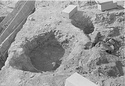
Geometric Well East of Stoa Room 4. Diameter 1.10m; narrows at bottom. Rough-cut, with irregular footholds north-south and east-west sides. Little water; no use fill Estimated Grid ... 725-700 B.C ... Geometric Well East of Stoa Room 4. ... Rough-cut, with irregular footholds north-south and east-west sides. Little water; no use fill |
Well East of Stoa Shop 14. Coins:
31 October 1949 #1-#2 ... 1st c. A.D ... Well East of Stoa Shop 14. |
East Building, pit in footing trench. Coins:
20 April 1959 #5-#6 ... 2nd c. A.D ... East Building, pit in footing trench. |
Patch of undisturbed filling over bedrock (at east edge of Kolonos Agoraios) ... Third quarter of 4th c. B.C ... Patch of undisturbed filling over bedrock (at east edge of Kolonos Agoraios). |
North of east branch of Great Drain. Coins:
21 June 1973 #1 ... 4th c. A.D ... North of east branch of Great Drain. |
Northern Manhole to Water Channel [R 9-10], East of Shop 14 ... 2nd c. B.C ... Northern Manhole to Water Channel [R 9-10], East of Shop 14 |
Cut to east of Exedra. Accumulated road packing between the Stoa of Zeus and the early altar to the east, various levels and dates, as late as early as 6th c. B.C. and as late as 5th c. A.D ... 15-17 April 1935 ... Cut to East of Exedra |
Cut down through the west back foundation of the Royal Stoa immediately to the east of the 'Cave' ... Byzantine ... Cut down through the west back foundation of the Royal Stoa immediately to the east of the 'Cave'. |
Cistern System #3: East Chamber at 69/Λ, joined by a crooked passage to 69/ΛΣΤ. Under the southwest corner of the Hellenistic Building to the north of the Temple of Hephaistos ... 175-125 B.C ... Cistern System #3: East Chamber at 69/Λ, joined by a crooked passage to 69/ΛΣΤ. |
Diameter of top of well 0.80m.
An early well east of Roman Building, north of Temple of Ares and thus in the region of the Mycenaean cemetery. Sherds almost entirely Mycenaean with nothing later and a ... Mycenaean ... An early well east of Roman Building, north of Temple of Ares and thus in the region of the Mycenaean cemetery. |
Well East of Circular Building, at 25/ΙΗ.
Well dug originally in 5th c. B.C. and probably had POU fill. In 2nd c. A.D. the shaft was intersected by a horizontal vaulted brick tunnel belonging to the Brick ... 5th c. B.C.(?) ... Well East of Circular Building |
Undisturbed filling to E of Archaic Temple in Eleusinion; fill consisted of a layer of working chips of Kara limestone above a layer of mud brick ... Late 6th c. B.C. and earlier ... Fill East of Archaic Temple |
Well at 53/ΙΗ, east of the east Stoa Plateia. Diameter 1.40-1.50m. Shaft worked with chisel, tapers toward bottom. Plentiful water. Uniform fill with field-stones, perhaps including period of use ... 775-725 B.C ... Well at 53/ΙΗ, east of the east Stoa Plateia. |
Found while cleaning wall running east-west over 57. Contained late glazed pottery ... Byzantine ... Found while cleaning wall running east-west over 57. |
Well East of Stoa Room 6 (well with Siana Cup); scanty dumped filling.
No water. Well never used. Estimated Grid ... 600-550 B.C ... Well East of Stoa Room 6 |
Well East of Stoa Room 11; no appreciable change in pottery top to bottom; dumped fill of Augustan times. Coins:
4 May 1950 #1-#3
15 May 1950 #1 Estimated Grid ... Late 1st c. B.C.-early 1st c. A.D ... Well East of Stoa Room 11; no appreciable change in pottery top to bottom; dumped fill of Augustan times. |
Hellenistic filling at NE corner of section. Estimated Grid ... Hellenistic ... Hellenistic Fill at North East Corner |
Early Roman fills E of Stoa (Room 17, Rooms 13-16) xx ... Early Roman ... Early Roman Fills East of Stoa |
Geometric Well East of Stoa Room 10 Pottery mended May 1950, in two tins. Nothing discarded. Slight disturbance throughout became of proximity of Roman well (p. 1252). Estimated Grid ... 725-700 B.C ... Geometric Well East of Stoa Room 10 |
Mycenaean well under East Building Terrace steps (No catalogued pots). Rectangular in shape, 0.90x0.60m.
Abutting against the back of the East Building Terrace steps to the south. Yielded much thrown bedrock ... 14 July 1967 ... Mycenaean Well Under East Building Terrace Steps |
Thra (ΘΡΑ) Well (East of Stoa Room 2). Heavy dumped filling, including figured, black and plain wares, and also a quantity of animal bones, mostly skulls of oxen. On many of these the horns had been sawn ... Ca. 520-480 B.C ... ΘΡΑ Well East of Stoa Room 2 |
Unstratified pit below east part of Odeion Cavea (Trench K).
Brann Well or Pit O. Estimated Grid ... To ca. 725 B.C ... Unstratified pit below east part of Odeion Cavea (Trench K).
|
Well (diameter 1.10m).
Neatly cut. Footholds on east and west at intervals of ca. 0.50m. Plentiful water ... Late 8th - Early 7th c. B.C ... Footholds on east and west at intervals of ca. 0.50m. |
Mycenaean Tomb to E of Stoa Shop 19 (ΣΑ 2).
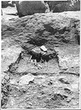
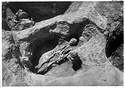
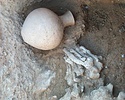
Found while digging just east of Stoa Shop XIX, when came upon some bones, Mycenaean sherds and a pot. As the excavation was enlarged the legs of two skeletons ... Myc. III A:2 (2nd half of 14th c.) ... Chamber Tomb to East of Stoa Shop 19 |
| Well in East Colonnade of Roman House H. Diameter 0.80m, lined with field stones set in mortar. used as a cistern as well.
No useful pottery dates. Capital from colonnade A 3866 and part of shaft found ... 29 July 1970 ... Well in East Colonnade of Roman House H |
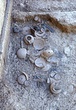
Deposit of jewelry in hypocaust area (92/ΙΗ) of Bath to East of Poros Building. Coins:
8 April 1948 #12-#47 ... 2nd-3rd c A.D ... Deposit of jewelry in hypocaust area (92/ΙΗ) of Bath to East of Poros Building. |
Found while excavating Stoa Pit E in 1933. See also I 849 (Ε 329) found in the North Well in Stoa Pit E (Deposit H 9:1). Fragment Ε 496 of this inscription, listed with the finds of H 10:6, is likely from ... 8-10 May 1933
17 May 1935
18-26 May 1937 ... Well in Metroon Porch to East of Room II |
Rectangular pit over bedrock in north part of E. Building. Broken jars and household basins with a few black glazed and black-figured fragments (uninventoried). The figured pieces indicate the lower limit ... Late 6th-ca. 480 B.C ... Rectangular Pit over Bedrock in North part of East Building |
| Cut in bedrock (P.L. 0.50m, W. 0.57m). Head at east, looking west; skull stood upright when found. Lower part of skeleton missing. PD 435 ... 750-725 B.C ... Head at east, looking west; skull stood upright when found. |
Mycenaean burial, disturbed (Piers 12-13 east). Plan unclear.
Bones discarded.
It was found in the trench for the east stylobate of the Square Building. It was so badly disturbed by the Classical builders ... Myc. IIIA:2 ... Mycenaean burial, disturbed (Piers 12-13 east). Plan unclear.
... It was found in the trench for the east stylobate of the Square Building. |
Filling over and behind blocks of E. wall of Great Drain at 10-15/Α-Γ. Coins:
10 May 1954 #1-#2 ... 3rd c. B.C ... Filling over and behind Blocks of East Wall of Great Drain |
Dumped debris filling east of East Building, badly shattered. There is a small amount of disturbance from the filling immediately above, but the bulk of the pottery is consistent, and very close to that ... Ca. 470-460 B.C ... Dumped debris filling east of East Building, badly shattered. |
Deposit alongside Greek House I, perhaps giving the construction date of the second phase. Deposit list title it as : outside of east wall of Roman House H ... Last quarter of the 4th c. B.C ... Deposit list title it as : outside of east wall of Roman House H. |
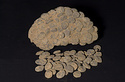
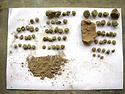
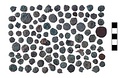
| Laura Gawlinski ... Coin hoard of Athenian tetradrachms. Dug into fill under floor (floor level not preserved) on east side of Strategeion near the NE corner of room formed by the eastern poros block wall and an east-west ... Second half of 4th c. B.C ... Dug into fill under floor (floor level not preserved) on east side of Strategeion near the NE corner of room formed by the eastern poros block wall and an east-west polygonal crosswall. The hoard describes an oval with its widest point running roughly east-west (0.211m), narrow dimension roughly north-south (0.140m) Forty-six found loose, the remainder fused together in cone-shaped mass, point at bottom, weight 6.280 kg (estimated 400 coins).
|
Well at edge of east slope of Kolonos Agoraios. Essentially uniform fill of second half of 8th c. B.C. but some earlier material. Thrown out from destroyed graves ... Early Geometric to third quarter of 8th c. B.C ... Well at edge of east slope of Kolonos Agoraios. |
Pyre at N/9-6/1,2, layer 11a.
No formal limits, apparent limits about 0.30-0.40m N-S; 0.50-0.60 E-W (cut into by trench at east) ... Late 575-550 B.C ... No formal limits, apparent limits about 0.30-0.40m N-S; 0.50-0.60 E-W (cut into by trench at east). |
Filling over drain from East Room of Archaic Fountain House. Lot T 16, fill e.
Τ 1567 (SS 11587) and Τ 1734 (P 22538) from upper disturbed fill (p. 2448) ... Late 5th. into 4th c. B.C ... Filling over drain from East Room of Archaic Fountain House. |
"Red earth": Herulian destruction debris over Roman House and east of cistern B. Coins:
30 May 1935 #1-#8
31 May 1935 #1-#15 Sherds stored in container Lot ΠΘ 4b ... 27 May 1935
31 May 1935
3 June 1935 ... "Red earth": Herulian destruction debris over Roman House and east of cistern B. |
Firm fill over bedrock on east edge of section, north of the early (Archaic) peribolos wall. Uncatalogued material: 10 sherds, 30 fragments of plemochoai. Deposit created by Margie Miles, 4 inventoried ... 3rd quarter 4th c. B.C ... Firm fill over bedrock on east edge of section, north of the early (Archaic) peribolos wall. |
Channel J (in ΗΗ)
Cutting that probably originally held a drain. Packed with amphoras and other coarse pottery. It tapped the poros aqueduct wall just East of our explanatory trench at the East end of ... 1st c. B.C. - early 1st. A.D ... It tapped the poros aqueduct wall just East of our explanatory trench at the East end of ΗΗ. |
| Includes finds from layer II and III of cistern passage. Coins:
1 April 1937 #1 (east end of passage)
14 April 1937 #2-#8
15 April 1937 #1-#7
16 April 1937 #1 ... Second half 1st c. A.D ... Coins:
1 April 1937 #1 (east end of passage)
14 April 1937 #2-#8
15 April 1937 #1-#7
16 April 1937 #1 |
Well at the southeast corner, almost on the line of the east-west street. Upper Fill: Late Roman dumped fill.
Lower Fill: Dark Age: ca. 7th c. A.D.
Coin
30 March 1939 #34 ... 7th-Late 6th century ... Well at the southeast corner, almost on the line of the east-west street. |
Cistern System in East Portico.
Drawshaft with two blind tunnels, in court of House of the Greek Moisaic; partially excavated by Dorpfeld. No legible coins or amphora handles. Coins:
26 June 1964 # ΔΕ3 ... 2nd c. B.C ... Cistern System in East Portico.
Drawshaft with two blind tunnels, in court of House of the Greek Moisaic; partially excavated by Dorpfeld. |
| N.A. Doenges Evelyn Lord Smithson ... "Near or in Grave" (width 0.50m)
Grave to the east of the southeast corner of the great court of the Gymnasium. Shallow and superimposed on Well N 11:5. It is a simple cist oriented north and south, with ... 750-725 B.C ... "Near or in Grave" (width 0.50m)
Grave to the east of the southeast corner of the great court of the Gymnasium. ... A number of small field-stones along the east may have come from a lining; the pots were found among these. ... Hesperia 22 (1953), p. 39: noted as grave to the east of the southeast corner of the great court of the Gymnasium. |
Exploratory excavation trench between east front of Hellenistic Metroon and Great Drain.
Cf. Hesperia Suppl. 4 (1941), p. 106.
Cf. also Metroon Drain Cut I 9:1 and F-G 12:1 and H 12:9 ... 8th-6th c. B.C ... Exploratory excavation trench between east front of Hellenistic Metroon and Great Drain.
|
Just east of Building II near its south end. The tiles were in place.
Upper filling (to 3.00m.) of Hellenistic-Byzantine dump all discarded.
POU fill a gradual accumulation of typical Justinianian ware ... 6th c. A.D. POU-7th c. A.D ... Just east of Building II near its south end. |
Well at 71/ΛΒ (diameter ca. 1.10m) near the east wall of the entrance porch.
Narrows toward bottom, collapsed at top. Six footholds preserved at south, three at north, spaced at ca. 0.50m. Uniform fill ... Late 8th in early 4th c. B.C ... Well at 71/ΛΒ (diameter ca. 1.10m) near the east wall of the entrance porch.
|
| Mycenaean Grave F.
It seemed to be more as a collection of bones and offerings, presumably swept aside to make room for later burials; they are east of and slightly higher than children's graves A and ... Myc. IIIA ... It seemed to be more as a collection of bones and offerings, presumably swept aside to make room for later burials; they are east of and slightly higher than children's graves A and B. |
| Rodney S. Young ... Grave 7 in notebook (E.L. Smithson: Grave XXI: PG). Bones discarded. Disturbed and damaged cremation (originally trench-and-hole), the east end cut away, probably contained the burial urn.
JP
It consisted ... Late Protogeometric ... Disturbed and damaged cremation (originally trench-and-hole), the east end cut away, probably contained the burial urn.
JP
It consisted of a rectangular trench cut through hard-packed fill and slightly into bedrock to a depth of 0.48m. the trench oriented east-west, had a preserved length of 0.70m and a width of 0.60m. ... The preserved east end, built up from redeposited green schist bedrock streaked with reddened earth, may have been a barrier between the destroyed urn-hole and the pyre trench, constructed after the fire had subsided. |
Well at 69/ΛΕ (diameter 0.95m).
Narrows at bottom. Footholds on east and west. Uniform fill. Bones found in the well make it likely that it had cut through a grave, as it was itself overlain by one ... Late 8th c. B.C ... Footholds on east and west. Uniform fill. |
Hellenistic fill, north of Temple of Ares, on either side of wall running east-west over 50/ΙΓ. Mostly coarse pottery including many stamped amphora handles.
Cf. also nb. P XII, pp. 2297-2298. Coins:
13 ... 275-200 B.C ... Hellenistic fill, north of Temple of Ares, on either side of wall running east-west over 50/ΙΓ. |
Includes finds from layer II and III of cistern passage. Coins:
1 April 1937 #1 (east end of passage)
8 April 1937 #8-#10
9 April 1937 #4
10 April 1937 #1-#4
12 April 1937 #1
13 April 1937 #4 ... Late 1st-early 2nd c. A.D ... Coins:
1 April 1937 #1 (east end of passage)
8 April 1937 #8-#10
9 April 1937 #4
10 April 1937 #1-#4
12 April 1937 #1
13 April 1937 #4 |
| Marcie Handler ... Located in the south section of Room E in the Byzantine Building east of the North-South Road. The uppermost 1.5 meters of well lining was built of well-coursed stones (some reused marble blocks) and tiles ... 12th c. A.D ... Excavations | 2001 | Trenches | Handler | Byzantine Building East of the North-South Road | Room E | Well J 2:18 ... Excavations | 2003 | Trenches | Handler | Byzantine Building East of the North-South Road | Room E | Well J 2:18 |
Area I; layer I. Soft, loose destruction fill of Street Drain in front of Greek House δ. Represents closing of drain in preparation for construction of Basilica. Top elevation 55.40m at west, 55.96m at ... 1st c. A.D ... Top elevation 55.40m at west, 55.96m at east. |
| Rodney S. Young ... Grave 4 in notebook (E.L. Smithson: Grave XX: PG). Bones discarded. Grave of older child.
JP
Rectangular pit, cut into bedrock to a depth of 0.26m, approximately 0.97m long and 0.36m wide. Tomb oriented ... Late Protogeometric ... Tomb oriented east-west,head of the deceased to the east. a thin strosis of hard-packed redeposited bedrock mixed with much burned earth and many small stones was described as lying above and surrounding the tomb pit. ... The skull of a child, evidently intact at the time of excavation but described as "soft and decayed" was found at the east end of the pit. |
| Marcie Handler ... The contents of this Hellenistic cistern shaft were excavated in a series of layers: the preserved top of the shaft, six layers in the shaft and the fill within the tunnel. At the bottom of the shaft on ... POU: Mid-3rd c. BC
Dumped fill: after 225 BC ... Excavations | 2007 | Trenches | Handler | Room M | East of Wall 7 | Cistern J 1:7 |
West Chamber of Cistern System #2. This chamber filled earlier than the East Chamber. No stratification but at 3.80m. considerable pottery of the late 5th c. B.C., as in 60/ΛΗ cistern, presumably a portion ... First half of 3rd c. A.D ... This chamber filled earlier than the East Chamber. No stratification but at 3.80m. considerable pottery of the late 5th c. |
Child's burial in south wall of Marble Worker's House.
Bones examined 20 June 1975 and found to be an immature animal, not human (canid-puppy?).
Identified as pyre by SIR. Set into a shallow roughly ovoid ... Late 4th c ... Set into a shallow roughly ovoid pit measuring ca. 0.27m east-west by 0.33m north-south. |
Clearing bedrock on line of early (Archaic) peribolos wall, east of entrance on the south side, west end. Uncatalogued material: 50 sherds, 83 fragments. of plemochoai.
Classical Ware : lekythos; plemochoai ... Early 2nd c. B.C ... Clearing bedrock on line of early (Archaic) peribolos wall, east of entrance on the south side, west end. |
| David Scahill ... At northeast corner of Classical Building II; on south side of dromos of Tomb K 2:5, and separated from it by ca. 0.6m of bedrock. Chamber cut through bedrock. The northeast corner of chamber defined ... LHIII A:1 ... Partially articulated skeleton laid out against the north wall of the tomb, with feet to the east. A courseware pitcher upside down in the north east corner. |
| (Grave XXIX: EG).
Rectangular cutting with remains of charred human bones and both burned and unburned pottery fragments. Bones discarded.
Rectangular trench cut through earth into bedrock, oriented east-west ... Middle Geometric I ... Rectangular trench cut through earth into bedrock, oriented east-west and measuring 1.10m long, 0.70m wide and under 0.30m deep. ... According to the excavator, cremated skull fragments were encountered at the east end of the trench, leg bones near the west end. |
East-West Street (63-64/ΙΣΤ, etc.)
Packing in line of ancient east-west street along Areopagus north slopes.
Lower fills, predominantly late 6th-early 5th c. B.C.
Middle fills, last quarter of the 5th ... Various levels and dates ... East-West Street (63-64/ΙΣΤ, etc.)
Packing in line of ancient east-west street along Areopagus north slopes.
|
| David Scahill ... Beneath toichobate floor level in Room 1 of Classical Building II, against the south ashlar wall, ca. 1.50m. east of the southwest corner of the building. Deposit of broken pyre pots in small pit, 1.00m ... Ca. 325 B.C ... Beneath toichobate floor level in Room 1 of Classical Building II, against the south ashlar wall, ca. 1.50m. east of the southwest corner of the building. |
Furnace Dump from N. Hypocaust in Bath to East of Poros Building. Coins:
26 March 1948 #4-#8
27 March 1948 #1-#3
29 March 1948 #2-#7
1 April 1948 #2-#3
3 April 1948 #14-#15
7 April 1948 #16-#27
8 April ... Second half 3rd c.-first half 4th c. A.D ... Hypocaust in Bath to East of Poros Building. |
Ca. 73-81/Drain. Fillings associated with the construction of the Great Drain South, especially the fill thrown in behind the east wall of the drain at the time of its building.
Cf. A 20-21:1 and B 19:7 ... Ca. 425-400 B.C ... Fillings associated with the construction of the Great Drain South, especially the fill thrown in behind the east wall of the drain at the time of its building.
|
| Rodney S. Young ... Grave 2 in notebook (E.L. Smithson: Grave XV: PG). Urn cremation (trench-and-hole), adult female.
JP
It consists of a roughly rectangular pit or trench cut into bedrock to a depth of 0.35m., measuring ... Late Protogeometric ... The trench was oriented east-west, urn-hole to the east. |
| Laura Gawlinski ... Ovoid pit cut into bedrock or sterile fill just north of preserved floor surfaces in the so-called Strategeion. Length (west-east) 2.6m; widens at 1.25m from the east scarp so that at west pit is 0.75m ... 4th B.C ... Length (west-east) 2.6m; widens at 1.25m from the east scarp so that at west pit is 0.75m wide, at east 0.85m wide. May continue slightly into east scarp.
Uncovered directly under smaller pit of marble chip debris (see Lot Γ 383; Basket 4, p. 3985). |
Exploration in the area between the east front of the Hellenistic Metroon and the Great Drain, from accumulated road metal of early north-south road.
For levels in the same road further south, see F-G ... 575-525 B.C ... Exploration in the area between the east front of the Hellenistic Metroon and the Great Drain, from accumulated road metal of early north-south road.
|
Well east of Geometric Grave. The upper part collapsed into a pit, cut into by Middle Geometric grave I 18:1 and by a Byzantine wall. Some evidence for period of use; little pottery. At the top a few Geometric ... Early Protogeometric ... Well east of Geometric Grave. |
| Initially was recorded as disturbed saucer grave, but identified as pyre by SIR.
Found by gardener washing out of scarp during the winter rains. The location is just south of an east-west road; there ... 1962 ... The location is just south of an east-west road; there were traces of houses in this general area. |
First trial east Stoa colonnade, N. of S. wall III, layer 12.
Note quantities of cattle bones, the knuckles sawn off and many worked bits. Evidently a bone implement factory near by. [nbp. 2139] Coins: ... Late 3rd c.-earliest 4th c. A.D ... First trial east Stoa colonnade, N. of S. wall III, layer 12.
|
Mycenaean Tomb under Valerian wall (Burial 12).
It was impossible to fix the limits of the tomb in any direction, since at the north and south it was cut by the wall, an operations could not be extended ... Myc. III B ... It was impossible to fix the limits of the tomb in any direction, since at the north and south it was cut by the wall, an operations could not be extended to the east and west, owing to the rapid flow of water from the surface of bedrock. |
| Mike Laughy ... This pyre was found within an otherwise mostly sterile fill directly under a white floor surface in the southern section of Area IV. It was located ca. 0.50m. east of a similar deposit, Pyre J 2:25. The ... 4th c. B.C ... It was located ca. 0.50m. east of a similar deposit, Pyre J 2:25. The pots were mixed with heavy concentrations of charcoal and found across an area measuring 0.47-0.50m, east to west, 0.31-0.43m, north to south.
|
Early Roman pit at P/3-6/6,7
Layer 4a in Room 6 of Greek House δ, area P/2,3-6/6,8.
Pit in NW corner of Room 6 bounded by walls of Room to North and West, cut into preexisting layers to east, cutoff by ... 17 May 1971 ... Pit in NW corner of Room 6 bounded by walls of Room to North and West, cut into preexisting layers to east, cutoff by Byzantine pithos to South. ... Top elevation: 55.64m (w); 55.59m (e)
Depth: 0.55m
East-West Width: 1.37m
Preserved North-South length: 1.45m max. |
| Pyre against north face of polygonal wall, Room 2, Classical Building II. No floor preserved above, but the pyre is below floor level 51.820masl, preserved just to the east and above patchy floor with ... Ca. 275-260 B.C ... No floor preserved above, but the pyre is below floor level 51.820masl, preserved just to the east and above patchy floor with plaster at ca. 51.70 |
Middle Stoa Building Fill (East End) (Inside building and to South) Cf. H-I-J 12-13 (Θ, ΜΣ) and H-I-J 14 -15 (Κ) (unsolved)
This deposit is not definitive and must be considered with the above deposits ... Middle Stoa Building Fill (East End) (Inside building and to South) Cf. |
East (service) courtyard. A break ca. 540 was followed by an accumulation of nearly a meter of snail shells, and on top a small amount of pottery running down to the end of the 6th century. Coins(?): cf ... POU mid 3rd to late 6th c ... East (service) courtyard. |
East of Classical Building II backwall, above Mycenaean chamber tomb K 2:5. Rough circular pit of reddish brown fill cut into geometric fill that extends down inside tomb. Some evidence of burning on pottery ... Ca. 460 B.C ... East of Classical Building II backwall, above Mycenaean chamber tomb K 2:5. |
| A flask-shaped storage pit or cellar, cut in the rock at the south edge of the levelled top of Kolonos Agoraios. Filled late in first quarter of 6th. c. B.C. (2.95m from east to west by 2.70m from north ... First quarter 6th. c. B.C ... B.C. (2.95m from east to west by 2.70m from north to south).
|
| Marcie Handler ... The Pyre was revealed in a layer of 4th c. fill in the north end of Room 6, just south of Wall 8. Room 6 is defined by the street wall (Wall A) on the west, Wall 7 on the east, Wall 9 on the south (preserved ... 4th c. B.C ... Room 6 is defined by the street wall (Wall A) on the west, Wall 7 on the east, Wall 9 on the south (preserved only as a stub on the east side of the area), and possibly Wall 8 or Wall 6 on the north.
2.5 meters SW of the pyre, a patch of floor surface at J/10-1/20 at 52.188 masl. was found. |
| Mycenaean Grave at SE corner of Pier 12 (Burial 9).
There are no traces of dromos, which must have been located at the north and have been cut away by the trench four the south stylobate of the Square ... Myc. III A:1 ... The dimensions of the chamber are 1.60m east-west by a preserved length of 1.40m north-south. ... The two skeletons lay along the east side, more or less in order, with the bones resting directly on the bedrock floor |
| Marcie Handler ... Fill within the drain from the basin on the west side of Roman Room B through Wall A.
After we removed the fill within the basin on the west side of Roman Room B (BZ XXVII p. 5325), we began excavating ... Late Roman ... After we removed the fill within the basin on the west side of Roman Room B (BZ XXVII p. 5325), we began excavating in the cutting on the east face of a conglomerate block that is part of Wall A. |
| Marcie Handler ... Continued from 2000 season, 10-12 July 2000; BZ XXIII p. 4472.
The hoard was originally excavated during the 2000 season (Lot BZ 1049, 5th-6th centuries AD), from a higher elevation through a gap in the ... 10-12 July 2000
21-22 July 2003 ... Excavations | 2003 | Trenches | Handler | Byzantine Building East of the North-South Road | Room F | Coin Hoard J 1:2 | Fill |
One of two late wells [the other at 59/ΙΗ] cutting the line of the east wall of the peribolos and the line of the Byzantine enclosure. The shafts of the two were close together and in their upper parts ... Turkish ... One of two late wells [the other at 59/ΙΗ] cutting the line of the east wall of the peribolos and the line of the Byzantine enclosure. |
Well at 40/Λ, in the "plataia" ca. 600m north of the terrace wall and ca. 10m east of the Valerian wall. Top diameter of 1.00m, bottomm diameter 0.95m
The shallowness of the shaft, and the fallen condition ... 550-500 B.C ... Well at 40/Λ, in the "plataia" ca. 600m north of the terrace wall and ca. 10m east of the Valerian wall. |
| "Perhaps a cremation burial ... " nbp. 811. "Sacrificial pyre, disturbed," GRE, deposit nb.
In room on east side of building. Concentration of artifacts, fragments of bone, and abundant cinders in stratum, ... Early 3rd c. B.C.-Ca. 250 B.C ... In room on east side of building. |
Pit in Tholos Trench V (below Layer e).
In plan it would seem to have been oval, though its east end is c/../ by the south wall of the North Archaic Home. Its N-S width is 1.25m, its E-W length is 1.40m ... 7th-early 6th c. B.C ... In plan it would seem to have been oval, though its east end is c/../ by the south wall of the North Archaic Home. |
Mycenaean Grave inside NW corner of N extension of Stoa.
It was set deeply down, ca. 1.50m below the surface. Excavation revealed a single skeleton, extended, with head to east, and legs bent up at the ... Myc. III B ... Excavation revealed a single skeleton, extended, with head to east, and legs bent up at the knees, the arms folded over the abdomen. |
Laura Gawlinski ... Pebble floors of Roman date covered the northern half of a 6x6m square trench in ΕΛ, bounded to the west by the post-Herulian Wall and to the east by a wall from Byzantine Building D (Wall A) to the east ... Hellenistic/ 220-150 B.C ... Pebble floors of Roman date covered the northern half of a 6x6m square trench in ΕΛ, bounded to the west by the post-Herulian Wall and to the east by a wall from Byzantine Building D (Wall A) to the east. |
|
|