|
|
| Excavation and Cleaning along the East Side of the Great Drain, 1951 ... R. C. Wood ... There had been four major Byzantine dwelling units in the northern part of section Ε. Two of them had been removed during earlier campaigns. Excavations manage to establish the outline of the four houses, ... 9 Apr-7 Jul 1951 ... There had been four major Byzantine dwelling units in the northern part of section Ε. ... Excavations manage to establish the outline of the four houses, dating from the 10th to the 13th centuries A.D., before cleared away to expose Roman levels.
... Two monument bases that had stood along the west side of the Great Drain were found beneath the Byzantine debris. |
| Section ΜΜ
Summaries for 1936 ... Homer A. Thompson ... Three main ancient features were excavated within Section ΜΜ: the North Stoa, the South Building and the ancient East-West Street passing between the two buildings. After the destruction of the buildings, ... 10 Feb-25 May 1936 ... During Byzantine times, the area was covered with large buildings, presumably private houses. |
| Preliminary Report on the 1999 Excavation Season ... John McK. Camp II ... Most of the work this season was concentrated in the northern half of Section ΒΖ where the Byzantine levels were further explored. Street walls along both sides of the north-south road were revealed and ... 7 Jun-30 Jul 1999 ... Most of the work this season was concentrated in the northern half of Section ΒΖ where the Byzantine levels were further explored. Street walls along both sides of the north-south road were revealed and part of three houses were uncovered. Several built pithoi were found within the houses, representing impressive storage capacity. |
| Section Χ 1937 ... Margaret Crosby ... The area signified as Section Χ lays outside the Agora proper and no signs of any public buildings were found. The area seems to have been used for private houses from the end of the 6th c. B.C. Apart ... 25 Jan-18 May 1937 ... The area seems to have been used for private houses from the end of the 6th c. ... No traces of walls of the Hellenistic period had survived but two wells and four cisterns show the existence of private houses in the area during this period.
... All traces of post classical habitation had been destroyed by the Turkish and modern houses, except for a Byzantine well. |
| Section ΛΛ 193
Excavation Summary ... Dorothy Burr Thompson ... Excavations in Section ΛΛ revealed that the original contour of Kolonos Agoraios had been much sharper than in modern times. No traces of early graves were found in the area; first sign of habitation is ... 1 Feb-23 Jun 1937 ... The area was probably covered with houses of which five establishments were well preserved, several others less preserved.
In the early 3rd century the easternmost houses went out of use to leave space for the Hellenistic Building.
... In the Byzantine period blocks of houses were set over the whole area, and this settlement, when combined with those of ΜΜ and ΚΚ, present interesting material for the study of medieval Athens. |
| Section Υ: 1958 Excavation Report ... Dorothy Burr Thompson ... Two areas at the north foot of the Areopagus were uncovered. The first area did not yield much of interest due to modern disturbances. Excavations of a well, three pits and a water channel produced however ... 3 Mar-3 May 1958 ... Scanty remains of some houses were excavated: the South House, the North House, and the Southeast Houses (I and II) which was a complex of ten rooms. The investigation led to the conclusions that the houses were laid out on a city grid system with alleys dividing them, drains were constructed under the houses, and wells provided drinking water. They were modest houses and built approximately at the same time, probably shortly after 479 B.C. |
| Agora Excavations Preliminary Report - Summer 2014 ... John McK. Camp II ... Excavations in 2014 were carried out in three sections: ΒΘ, ΒΓ and ΒΖ.
In Section ΒΘ, overlying the Painted Stoa, the Byzantine houses of the 11th century A.D. were further exposed in the western part ... 9 Jun-1 Aug 2014 ... In Section ΒΘ, overlying the Painted Stoa, the Byzantine houses of the 11th century A.D. were further exposed in the western part and two more pithoi were found. The eastern half was dug deeper; a pithos discovered at a lower level suggests an earlier phase of the Byzantine settlement. |
| Athenian Agora
Excavation Summary for 2021 ... John McK. Camp II ... Excavations continued in sections ΒΖ and ΒΘ in and under the Classical Commercial Building, the Painted Stoa, and the orthostate enclosure suggested to be the Leokoreion.
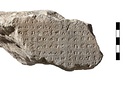
In section ΒΖ the goal was to ... 14 Jun-6 Aug 2021 ... In section ΒΖ the goal was to find out more about the later Archaic remains, perhaps houses or shops, underlying the Classical building. ... In Section ΒΘ West, two trenches were opened to examine part of the floor of the Stoa Poikile beneath the late Byzantine houses. In the western trench, fragments of a Roman inscription were found. |
| Preliminary Report on the 2003 Excavation Season ... John McK. Camp II ... Excavations in 2003 were carried out largely in the northwest corner of the Agora known as Section BZ. The area was divided into two parts: the north-south road and areas to the west, and east of the road ... 13 Jun-25 Jul 2003 ... After several years of exploring the Byzantine houses of the 10th century A.D. which overlay the area, the foundations were stripped away and substantial progress into the underlying Roman remains were made. |
| Section Ω 1938 ... M. Crosby ... Section Ω lies in the east end of the north slope of the Areopagus, well to the southeast of the market square proper. Excavation showed, as expected, that the area was a residential district throughout ... 16 Jan-17 Jun 1938 ... Not until the end of the 4th or early 5th century A.D. are there any traces of buildings other than private houses. Part of the area was covered by a mass of destruction debris from the 7th or 8th century A.D., and it was probably not built up in Byzantine times; the Turkish and modern houses rested directly on the late Roman fill at the north and southeast, on Classical and Hellenistic in the center, and on bedrock in the southwest. |
| Section Υ
1937 Excavation Summary ... Rodney S. Young ... Section Υ had suffered from modern leveling operations and in some parts there were no visible antiquities. In the southeast corner were traces of Proto-Geometric grave cuttings. Excavation revealed the ... 1 Oct 1936-24 Apr 1937 ... Excavation revealed the foundations of a large rectangular structure, probably the court of a Byzantine house still beneath modern houses. ... The well was excavated and objects from Byzantine and Roman periods were found. ... A rectangular stone structure turned out to be a Byzantine tomb containing thirteen skeletons. |
| Preliminary Report on the 2008 Excavation Season ... John McK. Camp II ... Excavations took place in three sections, two north of Hadrian Street (ΒΗ and ΒΘ) and one in the old area south of the Tholos (Γ).
In Section ΒΗ, layers in, over and behind the building identified as the ... 10 Jun-1 Aug 2008 ... Behind the back wall a small fragment of a large terra cotta pipe was found in situ in middle Byzantine layers. Layers contemporary with the Stoa were not reached this season. ... In Section ΒΘ, a new section was opened up after the demolition of two houses. Mostly late fills were dug but the top of Byzantine walls came to sight in some places, as was large worked blocks that may have come from one or several Classical buildings.
... Some fill contained pottery of the 8th and 7th centuries B.C., perhaps indicative of earlier houses or disturbed burials. |
| Section ΝΝ
Season of 1939 ... Rodney S. Young ... Section ΝΝ lies at the mouth of the valley between Pnyx and Areopagus, which was the important thoroughfare from the Agora to the Pnyx and to the southern parts of the city, as well as to the Piraeus Gate, ... 26 Sep 1938-24 Jun 1939 ... The whole section was cleared down to ancient or Byzantine levels. Extensive remains of private houses and a bath of the Roman period were discovered, as well as walls of houses from earlier periods. |
| ΚΚ Excavation Report 1936 ... Dorothy Burr Thompson ... Section ΚΚ, the area inside the modern fence around the so-called Theseion, was cleared to bedrock in order to determine the entire history of that portion of Kolonos Agoraios. Excavation revealed that ... 10 Feb-13 Mar 1936 ... Then simple houses and workshops, chiefly dealing with metal, were built. ... By the 10th-11th A.D. centuries the flourishing settlement included sizable houses and a monastery, which fell into disuse after 1204. Late Byzantine remains were scanty. |
| Agora Volunteer Report 2017 ... John McK. Camp II ... Excavations took place in three sections, ΒΘ, ΒΖ and ΟΟ, covering a time span from the 14th century B.C. to the 12th century A.D.
In Section ΒΘ work continued in later layers over and in front of the Stoa ... 12 Jun-4 Aug 2017 ... In ΒΘ West, more of the remains of the Middle Byzantine settlement were explored; in ΒΘ East, deeper fills were excavated. ... In Section ΟΟ the investigation of the architectural remains of houses and/or industrial establishments continued. |
| Preliminary Report on the 2009 Excavation Season ... John McK. Camp II ... Excavations were conducted in four sections: Γ, ΒΘ, ΒΗ and ΒΖ.
In Section Γ, the investigation of the Classical buildings south of the Tholos continued with the aim to find out if they were civil, commercial ... 8 Jun-31 Jul 2009 ... It was clarified that the complex consists of three houses grouped around a central courtyard. ... No architecture is associate with the fills which indicate that the area was a dumping ground outside of the inhabited area. Byzantine pottery started to emerge by the end of the season. ... In the eastern part of section ΒΘ, rubble walls, presumably of modest houses of the 10th century A.D., were uncovered. |
| Section Φ Season of 1937 ... Eugene Vanderpool ... In antiquity the area included in Section Φ lay outside the Agora proper and were apparently occupied only by houses and small buildings. The earliest period of which any considerable remains were found ... 25 Jan-17 Jun 1937 ... In antiquity the area included in Section Φ lay outside the Agora proper and were apparently occupied only by houses and small buildings. ... Numerous traces of dark age habitation were found, but few from the Byzantine period, and some from the Turkish period. |
|
|