|
|
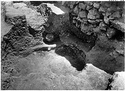
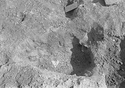
| Pocket with burning at 60/ΚΗ. "Is this perhaps a disturbed pyre burial." [Nbp. 2928].
Identified as pyre by SIR.
Near north end of corridor, beside its west wall. Concentration of artifacts, tiny scraps ... 4th c. B.C ... Pocket with burning at 60/ΚΗ. "Is this perhaps a disturbed pyre burial." |
| Pit with traces of burning ... Probably 3rd qtr. 5th c. B.C ... Pit with traces of burning. |
Pit 6 in Grave area. South cut, Metroon Section. Pit with burning ... Late 5th. c. B.C ... Pit with burning. |
Shallow pit containing pottery, burning and tiny fragments of bone. A dumped group of pottery in an amphora pit, ca. 1.00 m. in diameter, 0.60m. in depth. Many tiny fragments of bone were in the fill ... 375-325 B.C ... Shallow pit containing pottery, burning and tiny fragments of bone ... Many tiny fragments of bone were in the fill and a great deal of burning. |
Layer 7 in South Peristyle of court of Roman House Ε. Irregular cutting in bedrock with sand, gravel, fallen bedrock. Some burning ... 275-250 B.C ... Irregular cutting in bedrock with sand, gravel, fallen bedrock. Some burning. |
Pit on north slope of Kolonos Agoraios. Traces of burning in the dirt fill; mixed in with this many fragments of fine pottery ... Ca. 450-420 B.C ... Traces of burning in the dirt fill; mixed in with this many fragments of fine pottery. |
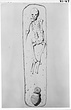
| Child grave. Grave 21 in notebook. No burning. No offerings. Covered by a 5th c. filling disturbed in Turkish times. Neg. ΚΚ 83, shows skeleton. Possibly discarded? ... 27 March 1936 ... Grave 21 in notebook. No burning. No offerings. |
Deposit of black glazed table ware found with a mass of bones, iron waste and burning. Coins (from above Hellenistic/associated floor):
7 April 1948 #10-#11 ... 375-325 B.C ... Deposit of black glazed table ware found with a mass of bones, iron waste and burning. |
Red fill with burning over south part of Heliaea. Post Herulian Metal- Worker's establishment. Coins:
20 May 1953 #1-#2
4 May 1953 #1 P 30199 (Κ 4282), B 1544-1546 (Κ 4281, Κ4283-4284) catalogued on May ... Late 3rd. c. A.D ... Red fill with burning over south part of Heliaea. |
Indicated as "Grave 6" in notebook but recognized as not a grave: "probably a rubbish pit" [deposit notebook summary]. Concentration of pottery, burning, animal bones, snail shells and seashells, probably ... Late 4th-early 3rd c B.C ... Concentration of pottery, burning, animal bones, snail shells and seashells, probably a refuse pit [Agora XXIX, p. 453). |
| Grave (?). Identified as pyre by SIR.
Pyre pots dispersed in fill over a pebble floor, with pottery ranging from the 5th c. B.C. to 3rd c. A.D. (lot ΑΑ 168), and lying directly below modern fill. No burning ... 400-350 B.C ... (lot ΑΑ 168), and lying directly below modern fill. No burning or bone was recorded. |
Pit at 57/ΚΑ; small pit on the lower north slope of the Areopagus, measuring 1.05x0.80mx0.80m deep. There were traces of burning and a few bones in it, since none of them are recognizably human it is probably ... 480 - 470 B.C ... There were traces of burning and a few bones in it, since none of them are recognizably human it is probably a refuse pit rather than a grave. |
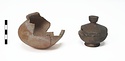
| Disturbed pyre containing only a pyxis and a chytridion.
No notebook account of excavation exists. The pyre may have been located at the edge of an ancient road. There is no record of bone or burning ... 350-325 B.C. (?) ... There is no record of bone or burning. |
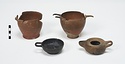
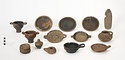
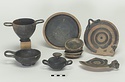
| A compact group of four complete vases and a lamp, found on a house floor; possibly the remains of a sacrificial pyre but without evidence of burning or the characteristic votive vases.
Layer II, "nest ... 425-400 B.C ... A compact group of four complete vases and a lamp, found on a house floor; possibly the remains of a sacrificial pyre but without evidence of burning or the characteristic votive vases.
... The surfaces of the lamp and the Corinthian skyphos show traces of burning. Neither burning nor bone is recorded (Young has not identified as pyre probably because of the early date, which would have made its burial after the abandonment of the house impossible). |
| Margaret Crosby ... Grave, disturbed.
Rectangular cutting in bedrock 1.70m long and 0.60m deep. The north half was cut away by a modern cellar wall and only 0.20-0.10m of fill was left. A the bottom there was a thick layer ... 510 - 490 B.C ... A the bottom there was a thick layer of burning. also present fragments of long bones and ribs, probably animal. |
| Initially was recorded as disturbed saucer grave, but identified as pyre by SIR.
Found by gardener washing out of scarp during the winter rains. The location is just south of an east-west road; there ... 1962 ... There are signs of burning on some pottery. |
| Grave 14 in notebook.
Length of shaft 2.12m; width 0.46m; depth from cover 0.60m. Man's skeleton stretched NE-SW with head at NE. Offering at foot of shaft, with the skyphos in the mouth of the pitcher ... 750-725 B.C ... No signs of burning. On the NE edge of the cover slabs was a small flat stone, perhaps to support a grave marker. |
From disturbances in original floor of Tholos with ash and burning. Probably reflects the military and political conditions of 307 B.C.
The broken pottery, both that left lying on the floor of the building ... Ca. 340-295 B.C ... From disturbances in original floor of Tholos with ash and burning. Probably reflects the military and political conditions of 307 B.C.
|
| Small pit (in Layer I) = Grave ("Pyre") Identified as pyre by SIR.
Pottery and burning ("pit filled with black") in pit slightly west of Panathenaic Road, dug into layer I (lot AA 180, much earlier 6th ... 275-250 B.C ... Pottery and burning ("pit filled with black") in pit slightly west of Panathenaic Road, dug into layer I (lot AA 180, much earlier 6th c. material with later disturbances), and directly under post-antique deposits. |
East of Classical Building II backwall, above Mycenaean chamber tomb K 2:5. Rough circular pit of reddish brown fill cut into geometric fill that extends down inside tomb. Some evidence of burning on pottery ... Ca. 460 B.C ... Some evidence of burning on pottery and in fill. |
| In room A. Concentration of artifacts and burning in stratum, no pit discerned. The pyre lay below a Late Hellenistic fill with a smooth earth surface. It is described as a black patch of earth with sherds, ... 350-250 B.C ... Concentration of artifacts and burning in stratum, no pit discerned. ... The pottery shows traces of burning. No bone was recorded. |
| Pyre in House C, Room 12 (RSY=Pyre 9) in the industrial area west of the Areopagus.
Notebook refers to House N.
Beside west wall of room 12. Pottery, burnt bone, and cinders in a roughly round pit; disturbed ... Ca. 250 B.C ... The fire-hardened floor of the pit suggests burning in situ; the pottery also shows signs of burning. |
| Burned deposit: Middle Terrace, south of Archaic cemetery.
RSY: Pyre 10.
Pottery, burnt bone, charred logs, and heavy burning, recovered by tunneling under the cement floor of a Late Hellenistic workshop, ... Ca. 325-300 B.C ... Pottery, burnt bone, charred logs, and heavy burning, recovered by tunneling under the cement floor of a Late Hellenistic workshop, between two lekanai set into the ground and functioning with the cement floor. |
| Shallow pit below layer I in Stoa Shop VI (Pyre)
Diameter 0.90; D. 0.15m Under shop VI of the Stoa of Attalos Pottery, ash, burning and packing of small stones in pit in stratum. The pyre was covered by ... Ca. 350 or 325 B.C. ? ... Shallow pit below layer I in Stoa Shop VI (Pyre)
Diameter 0.90; D. 0.15m Under shop VI of the Stoa of Attalos Pottery, ash, burning and packing of small stones in pit in stratum. ... One pot shows signs of burning. No bone was recorded. |
| Pyre in cut in E-W street, layer 7 (Pyre 14). North edge of Piraeus street, west of the Great Drain Bridge, in the area west of Areopagus.
RSY-Pyre.
Pottery, a little burnt bone, and patches of charcoal ... 250-240 B.C ... Possibly, however, marbleworking took place just outside a house to the north, against the wall of which these layers run. hardened earth beneath the pyre indicates burning in situ. The pottery shows signs of burning. |
Cistern at 53/ΝΕ, bottle-shaped, stucco-lined, in the east aisle of the peristyle of Roman House H (courtyard of Greek House G, just west of andron).
Lower diameter 2.73m.
Homogenous fill all apparently ... Into early 2nd century B.C ... Homogenous fill all apparently deposited at one time, traces of burning on much of the pottery. |
Well A (depth 10.20m, diameter 1.04m, water level 4m) outside the SW corner of the market square, to the east of the north-south road.
At the bottom of the well were scanty remains probably from a period ... Ca. 425-375 B.C ... At the bottom of the well were scanty remains probably from a period of use, but without whole water jars; above this lay a heavy deposit of mud, containing little pottery; the dumped filling in the top of the well was extremely fragmentary and carried considerable traces of burning. |
| Pyre in Room 8 of Roman House H. Concentration of artifacts, bone, and flecks of carbon in stratum, no pit discerned. the pyre lay within a red fill apparently contemporary with it, but with some later ... 300-290 B.C ... The pottery shows traces of burning. |
Filling under North-South Road surface, apparently to raise the level of the road as thickness of fill varies depending on height of road. Fill sits on earliest, cobbled road layer. The road surface set ... Mid-6th c. B.C ... Some traces of burning. Much of the pottery is decorated with black figure. |
| Pyre in House C, Room 8 (RSY=Pyre 6).
Near east corner of room 8. Artifacts, burnt bone, burnt sticks, and large cinders in a shallow pit dug into surface of layer 3, and covered by layer 2. Some cinders ... 350-325 B.C.-end of 4th c. B.C ... The hard baked floor of the pit indicated burning in situ, with charred sticks 0.06 and 0.10m in diameter preserved; some of the pottery is burnt. |
Greek House J, under room 8 of Roman House H.
Typical though very fragmentary pyre pottery lay dispersed in a stratum over bedrock with pottery ranging from the 5th to the mid-3rd c.
In same general area ... Early 4th c. B.C.? ... There is no record of burning or bone. |
| Rubbish Dump in mouth of abandoned well in Tholos Trench F, Kitchen. Filled with ash, charcoal, broken pottery, roof tiles.
Also from Trench L.
13 March 2014 by Ann Steiner
The deposit has four components ... Ca. 425-400 B.C ... Component 1: At the top is an extensive oval-shaped pit, c. 3.20 by 1.60, distinguished by signs of burning: the Tholos Kitchen Dump: Lots Ζ 271-287 (425-400 B.C.E.)
Component 2: The second segment, moving downward, includes the top-most curb stones of a collapsed well together with ceramic material all jumbled up with the roof tiles from the Tholos, but with no signs of burning: Lots Ζ 687-690 (late 6th-late 5th c. ... well shifts into area of well shaft, both at just above the top-most curbing stones (Lots Ζ 687-690) but below the burning that signifies bottom of Kitchen Dump and below those curbing stones (Lots Ζ 686; 691-693).
|
Accumulated debris on the west side of the market square.
Related layers added 1999/2000 (JWH), e.g. "Gravelly layer above burning", "Clearing Classical floor", "Lowest level above bedrock", "Below burning", ... First half of 5th c. A.D ... "Gravelly layer above burning", "Clearing Classical floor", "Lowest level above bedrock", "Below burning", etc.
... Coins:
4 March 1933 #1-#4
8 March 1933 #1-#2
9 March 1933 #1-#12
10 March 1933 #1-#9 and #10-#12
11 March 1933 #1-#17 (Below burning)
13 March 1933 #1-#3 and #4-#7 and #8
14 March 1933 #1-#3
15 March 1933 #1-#4
16 March 1933 #1-#29 (above burning) and #30-#44 and #45-#48
17 March 1933 #1-#68 and #69-#88
18 March 1933 #1-#14 (above burning) and #15-#17
20 March 1933 #36-#50 and #51-#53
21 March 1933 #1-#51 and #52-#59
22 March 1933 #45-#92 and #106-#108
23 March 1933 #1-#12
24 March 1933 #1-#20
28 March 1933 #1-#29
31 March 1933 #1-#7
1 April 1933 #3-#13
3 April 1933 #1-#3 and #4-#7
5 April 1933 #22
10 April 1933 #3-#27 (SE corner of Dorpfeld's Stoa Bas.)
11 April 1933 #1-#38
12 April 1933 #38-#39 (SE corner of Dorpfeld's Stoa Bas.)
20 April 1933 #7-#14
21 April 1933 #13-#17
22 April 1933 #6-#20 (#19, #20 from dump)
24 April 1933 #2-#6
25 April 1933 #2-#4
26 April 1933 #1-#3
27 April 1933 #1-#7 and #8-#12
28 April 1933 #1-#6
3 May 1933 #5-#123
4 May 1933 #1-#21 and #22-#42
5 May 1933 #1-#22
6 May 1933 #1-#2
8 May 1933 #26
9 May 1933 #5-#6
12 May 1933 #1-#73
13 May 1933 #1-#9
15 May 1933 #1-#22
16 May 1933 #1-#13 and #17-#18
17 May 1933 #6-#16 and #17-#19 and #20-#32
18 May 1933 #1-#10 (Lowest layer above class. floor)
19 May 1933 #1-#15 and #16-#19
20 May 1933 #1-#21 and #22-#29
22 May 1933 #1-#62
23 May 1933 #1-#34 and #35-#36
24 May 1933 #1-#6
27 May 1933 #1-#25 and #26-#28
29 May 1933 #1-#31 and #32-#33
30 May 1933 #1-#5 and #6-#11
31 May 1933 #1-#5 and #6-#8
1 June 1933 #1-#15 and #19-#22
2 June 1933 #16-#33 and #35-#37
3 June 1933 #1-#9
5 June 1933 #1-#22 and #23-#25 and #27-#28
6 June 1933 #1-#3 and #9-#11 and #12
7 June 1933 #29 (disintegrated)
8 June 1933 #24
9 June 1933 #1-#2
15 June 1933 #9-#13 |
| Identified as Pyre by SIR.
Debris filling of the middle of the 4th c. B.C. including the remains of a sacrificial pyre.
Objects dispersed in red-clay fill uncovered in removal of modern staircase. A broken ... 4th c. B.C. disturbed ... The excavator recorded" some indications of burning" within the fill, and some of the pottery is burnt. |
| Pocket, identified as sacrificial pyre by SIR. Possibly disturbed. Outside south wall of building. Concentration of pottery in a small pocket below a "Hellenistic" fill. There is no mention of bone or ... First quarter 4th c. B.C ... There is no mention of bone or burning, but some of the pottery is burnt. |
Eugene Vanderpool ... Disturbed burial: Pocket in bedrock (Grave 11: PG). In some records as Grave XI. No remains. No cutting or traces of burning nearby
The coin listed here was found "cleaning bedrock", presumably at the ... Developed to Late Protogeometric ... No cutting or traces of burning nearby
The coin listed here was found "cleaning bedrock", presumably at the time the disturbed burial was found [5 March 1934 #5).
|
| Artifacts, burnt bone, ash, cinders and charcoal in pit in bedrock. The pyre lay directly under mosaic floor A. the deposit is not badly disturbed, however, and it is possible that it was laid immediately ... Early second quarter of 4th c. B.C ... The pyre was probably burnt in situ; pots rested on a thick layer of burning, and fragments of burnt earth were found in the pit. some charcoal as large as ca. 0.03m in diameter is preserved, and bits of burnt matter were found in the lekanis. |
| Pyre in House T, Room 2 through floor of second period (RSY=Pyre 5) in the industrial area west of the Areopagus.
4th. c. BC.
Concentration of artifacts, burnt bone, and charcoal in floor makeup consisting ... 375-350 B.C ... The artifacts rest on a heavy layer of charcoal and ash, with burnt bone throughout, suggesting burning in situ. |
| Pyre in House T (= House D), Room 2 (5th c.) and fill east of pyre.
Earlier than the other pyres of this house.
Pottery, slivers of burnt bone, and heavy deposit of carbonized material and cinders in ... Ca. 420-410 B.C ... Pottery, slivers of burnt bone, and heavy deposit of carbonized material and cinders in pit in floor sequence, with some pottery and burning found outside pit. |
| Contents of Pithos Y; probably belonging to sacrificial pyre III.
In northern corner of courtyard. Characteristic pyre pottery in fill of one of two pithoi set into the floor of the courtyard as part ... 400-350 B.C ... The date of the pyre puts it near the beginning of phase 3 of the house, so it could have originally been buried in connection with renovations that inaugurated that phase. there is no record of burning. |
| Pyre in Horos Terrace Trench, East end, set into Strosis 5.
In room 1 (court), near north wall. Concentration in stratum, no pit discerned; described as a "little nest of pots" within layer V (Lot ΜΣ ... 350-325 B.C ... No evidence of burning or bone was recorded. |
| Pyre in north central room of house, measuring 0.50m east-west by 0.35m north-south. Pottery, bone, and burnt material in pit dug into layer IIb (crushed bedrock floor: lot Ω 464, 4th c.) and covered by ... 350-325 B.C ... There were extensive traces of burning, and teh pottery has been burnt. |
| Homer A. Thompson ... Cremation burial (trench-and-hole) under S. edge of E-W Street, northern burial. In some records as Grave XLVII.
The western part of the offering trench of the tomb was lost to a Turkish cess pit, and ... Middle Geometric I ... What survived was the south and east section of the original grave, including a strip of the pyre trench, reddened from burning to a depth of 0.05m, and below it a shallow urn-hole, roughly square, ca. 0.60m to the side, cut through earth almost to the level of bedrock, to a depth of about 0.30m.
The urn-hole was dug only deep enough to accommodate the cinerary urn to its shoulder; the burning suggests a north-south orientation with the cinerary urn at the south or southeast corner.
|
| Rodney S. Young ... Grave 19 (In some records as Grave VIII). No remains, no burned matter or traces of burning.
JP
A small cutting with a single offering. The pit may have been for a simple child/infant inhumation, with ... Early Protogeometric ... No remains, no burned matter or traces of burning.
JP
A small cutting with a single offering. |
| Rubbish Pit . Pit cut through a house floor. In courtyard, beside door to room 3. Artifacts, bone and scattering of large cinders in roughly rectangular pit dug through floor bedding and covered by red, ... 325-300 B.C ... Although the contents included chicken bones and carbonized matter along with pottery, the evidence indicates that the burning did not take place on the spot but was dumped in from elsewhere. |
| Disturbed Pyre at 59/ΚΗ (ΚΖ), in the area of the Poros Building west of the Areopagus.
Against east wall of room 5 west. concentration of artifacts, ash, carbon and a few bones in stratum, no pit discerned ... 3rd c. B.C ... The concentration of burning, burnt bone, and pottery suggests a pyre. |
Packing under cobblestones 7 or 8 meters west of the Temple of Hephaistos. A similar filling found in a small hole in bedrock three or four meters north of the Temple. The high quality of the pottery from ... Ca. 500-440 B.C ... The high quality of the pottery from this deposit and the fact that some of it shows signs of burning has suggested that it might have come from a sanctuary destroyed by the Persians. |
| Rodney S. Young ... Grave 4 in notebook (E.L. Smithson: Grave XX: PG). Bones discarded. Grave of older child.
JP
Rectangular pit, cut into bedrock to a depth of 0.26m, approximately 0.97m long and 0.36m wide. Tomb oriented ... Late Protogeometric ... The recorded depth of 0.26m is below the surface of the hard fill. within the actual tomb pit there were no signs of burning.
The skull of a child, evidently intact at the time of excavation but described as "soft and decayed" was found at the east end of the pit. |
| Grave V, under room 18 in House 3, plus burned deposit at 94/IΘ. Identified as sacrificial pyre by SIR on Agoraios Kolonos:
In southeast corner of house 3. 35 artifacts, bone and charred material in pit, ... Ca. 300-275 B.C ... The size and constitution of the pyre, along with two foci of burning, suggest the assemblage may represent the remnants of two different pyres. |
| Pyre(?) in House N, S.W. Room. (=House C, Room 10)
In room 10. Vessels from an earlier pyre were found dispersed in the makeup of the latest "floor" in the room, with tile fragments trodden into its surface ... First quarter of the 4th c. B.C ... Some of the pottery shows signs of burning. No bone was recorded |
| Pyre in House N, room 2, layer 5 (RSY=Pyre 8).
Near northern corner of room 6. Artifacts, bone, burnt logs, and cinders in square pit dug from level of layer 5, through layers 5 and 6; thin clay floor ... 325-300 B.C ... The edges and bottom of the pit were reddened, indicating burning in situ. Wood cinders and logs mixed with bones lay below the pottery. |
| Disturbed pyre dispersed in fill of Room 5, House D.
Pyre pots in very fragmentary condition were noticed by Barbara Tsakirgis in later analysis of pottery that had been excavated in 1938; no mention of ... 14 June 1938 ... B.C. remodeling. some of the pottery exhibits burning. |
| Pyre /Burial (?) disturbed, in the area of the Poros Building west of the Areopagus. In northeast corner of room 4 west.
Concentration of artifacts, tiny slivers of bone, and burning in a layer of fill ... Early 4th c. B.C ... Concentration of artifacts, tiny slivers of bone, and burning in a layer of fill 0.25m thick below a pebble mosaic (ΟΟ 651). |
| Mycenaean Grave to W of Pier 12 (Burial 11).
The northern part of the tomb had been cut away by the foundation trench for the south stylobate of the Square Building that preceded the Stoa, and the dromos, ... Myc. IIB-IIIA:1 ... Beneath the skull were slight traces of black, either from burning or from the decay of organic matter.
|
| Pyre 2 in Central House, Room X, under strosis 9. Signs of burning, carbonized food, animal bone.
In room south of courtyard. concentration of artifacts, bone, and charred material in floor makeup, no ... 290-275 B.C ... Signs of burning, carbonized food, animal bone.
|
| Rodney S. Young ... Grave 6 in notebook (E.L. Smithson: Grave XXII: PG). Bones discarded. Urn cremation (trench-and-hole).
JP
Roughly rectangular trench cut through hard earth into bedrock to a depth of about 0.35m, approximately ... Late Protogeometric ... The ground around the mouth of the trench, its rims and walls, were reddened and baked hard by burning in situ. The urn-hole (diameter ca. 0.34m and about 0.35m deep- was evidently cut after the fire had subsided, not quite deep enough to conceal the full height of the cinerary urn below the floor of the trench. |
| Rodney S. Young ... Grave 7 in notebook (E.L. Smithson: Grave XXI: PG). Bones discarded. Disturbed and damaged cremation (originally trench-and-hole), the east end cut away, probably contained the burial urn.
JP
It consisted ... Late Protogeometric ... The east end where the cinerary urn would have originally been located in an urn-hole, was almost completely cut away by the Hellenistic water channel that skirted the tomb to the south. evidence of heavy burning, in the form of reddened earth, was noted on the ground around the mouth, rim, floor and three sides of the trench. |
| John Travlos ... (Grave XXXII: EG) Urn cremation (trench-and-hole). Published as cremation burial of a warrior.
The tomb was probably originally oriented north-south, with the urn-hole at the south end. The north side ... Transitional Early Geometric II-Middle Geometric I ... The animal remains included fragments from an immature pig, an adult dog, and an unidentified mammal, the latter the only fragment showing clear signs of burning. |
| Pyre in House N, room 4 (RSY=Pyre 7), in the industrial area west of the Areopagus.
Pottery, mall pieces of calcined bone, log, wood cinders, and charcoal in diamond-shaped pit in floor sequence. The pyre ... Late 4th-early 3rd c. B.C ... Reddening of the floor of the pit indicates burning in situ.
This is one of the largest pyres (more than one pyre lekanis, four chytridia, four ribbon-handled plates, all of them made up of two pairs). |
| Dorothy Burr Thompson ... Child's Grave (E.L. Smithson: Grave XXVIII: G).
Cf. Container Lot ΣΤ 165 (fill over geometric grave).
Neat, rectangular, unlined trench, cut into bedrock to a preserved depth of 0.20m,below the level ... Early Geometric I ... Slight traces of carbonized matter were noted at the southeast end near the cranium, with small specks of carbon throughout the earth fill,but no substantial traces of burning or any burnt pots. |
| Margaret Crosby ... Grave 1 (Grave XXVI: EG) Urn cremation (trench-and-hole), adult male?
[JP]
Boots or Booties Grave. Near the west branch of the Great Drain, about 100m to the southwest of the Agora horos inscription ... Early Geometric I ... There were no traces of burning on the bottom or the sides of the pit itself, which was in any case too small to have held the pyre. |
|
|