|
|
Filling associated with construction of Poros Building. A small amount of fragmentary pottery found in the clay filling of the original floor; perhaps deposited as late as ca. 425-400 B.C. Cf. 18:4 and ... Ca. 475-450 B.C. or later ... Filling associated with construction of Poros Building. A small amount of fragmentary pottery found in the clay filling of the original floor; perhaps deposited as late as ca. 425-400 B.C. Cf. 18:4 and C 18:7. |
Pit (Well?) under Building A, Room 2. Coins:
9 May 1949 #1-#2
11 May 1949 #4
12 May 1949 #3 (not a coin, bronze fragment in lotted metal tins ΠΠ 295). Estimated Grid
Remains of coloring matter found with ... Hellenistic-Early Roman ... under Building A, Room 2 ... Estimated Grid
Remains of coloring matter found with 4th c. sherds. |
Well M: EG, under the south court of the Poros Building.
Hesperia 20 (1951), p. 144 (noted) ... Middle Geometric |
Construction filling of the Poros Building west of the Areopagus. Patch of stony fill beneath the courtyard. Accumulation of the second quarter of the 5th c., deposited in the last quarter ... Ca. 475-450 B.C. and later ... Construction filling of the Poros Building west of the Areopagus. ... Accumulation of the second quarter of the 5th c., deposited in the last quarter. |
Fillings below the courtyard floor of the Poros Enclosure west of the Areopagus. The lowest layer, over bedrock, is of the archaic period and may have accumulated on the spot before the start of building ... First half of 5th c. B.C. |
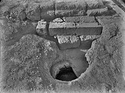
This is associated with Building A. It had a circular marble well-head with a rectangular well slab beneath. The construction throughout was of well tiles. It produced little to a depth of -8.60m. Between ... 4th c. A.D ... This is associated with Building A. It had a circular marble well-head with a rectangular well slab beneath. ... Between this point and bottom at -9.70m it produced quantities of pitchers and amphorai, many complete, of the 5th-6th c. A.D. |
House R, fill under drain tiles and fillings associated with house K in industrial area, including what was C 19:15, plus C 19:16 and
C 19:17.
a) House built as dwelling in second half of 5th.c.
b) Used ... Ca. 5th and 4th c. B.C ... House R, fill under drain tiles and fillings associated with house K in industrial area, including what was C 19:15, plus C 19:16 and
C 19:17.
a) House built as dwelling in second half of 5th.c.
b) Used as marble-workers' shop from beginning of 4th. c. to near middle of century. Rebuilt as an industrial establishment about middle of 4th. c.
c) Area built over in Hellenistic times.
A small amount of material can probably be associated with the original period of the house (cont. 662) and at some points where the excavation was carried to bedrock pottery of the 6th c. was found. Most of the material comes however from the second and third phases noted above: either the marble-workers' shop, or the heavy filling of dumped earth and marble chips thrown in over the area when the level was raised for the remodelling of the building at about the middle of the 4th c. |
Well at SE corner of Court of Late Roman Building (Trench C). Estimated Grid ... 12th c. A.D ... Well at SE corner of Court of Late Roman Building (Trench C). |
See I 870, a piece of which was found in disturbed red fill in Β' southeast of Tholos.
Although apparently from the same context as P 5339 (tins 24-26, undisturbed fill), P 5336-P 5338 are recorded from ... 27 February-8 April 1935 ... c) Building fill in disturbed places |
Casting pit near SE corner of Poros Building, Room C 3. Combined with D 18:4 ... 1st c. B.C.-1st c. A.D ... Casting pit near SE corner of Poros Building, Room C 3. |
From kiln in house of 7th c. B.C. (=Building A), to southeast of Tholos. Tholos Trench U, furnace ... 675-625 B.C ... From kiln in house of 7th c. B.C. (=Building A), to southeast of Tholos. |
Well at 56/ΚΖ, just south of the south wall of the northern Late Roman Building ... Second half of 2nd c. - early 3rd c. A.D. |
Fillings immediately antedating the building of the Stoa.
Cf. Hesperia 6 (1937), p. 20 and the debris of a pottery works behind the Stoa (H 7:1). |
Fillings in and to the north of Building A/Poros Building/Greek Building ("Strategeion"), the accumulation mostly a late archaic dump, but not deposited till near the middle of the century. Most of the ... First half of 5th c. to ca. 460-450 B.C ... Fillings in and to the north of Building A/Poros Building/Greek Building ("Strategeion"), the accumulation mostly a late archaic dump, but not deposited till near the middle of the century. ... These, too, are now incorporated into this building fill deposit, per the pottery lots on p. ... Subdivisions:
.1=a) Undisturbed filling of the building.
.2=b) Undisturbed filling to north of the building.
.3=c) Building fill in disturbed places. |
Well East of Circular Building, at 25/ΙΗ.
Well dug originally in 5th c. B.C. and probably had POU fill. In 2nd c. A.D. the shaft was intersected by a horizontal vaulted brick tunnel belonging to the Brick ... 5th c. B.C.(?) ... Well East of Circular Building, at 25/ΙΗ.
Well dug originally in 5th c. B.C. and probably had POU fill. In 2nd c. A.D. the shaft was intersected by a horizontal vaulted brick tunnel belonging to the Brick Shaft system and the earlier fill above the line of the proposed tunnel floor was dug out. After construction of tunnel the old well shaft was filled up again, this time with a Roman dumped filling of second half of 2nd c. A.D. |
A strosis into which were set the foundations of house of 7th c. B.C. to SE of Tholos (=Building A and Trench W, layers h + i) ... 8th-7th c. B.C ... A strosis into which were set the foundations of house of 7th c. B.C. to SE of Tholos (=Building A and Trench W, layers h + i). |
| "Perhaps a cremation burial ... " nbp. 811. "Sacrificial pyre, disturbed," GRE, deposit nb.
In room on east side of building. Concentration of artifacts, fragments of bone, and abundant cinders in stratum, ... Early 3rd c. B.C.-Ca. 250 B.C ... In room on east side of building. Concentration of artifacts, fragments of bone, and abundant cinders in stratum, no pit discerned. The pyre was found while excavating an undated red fill that lay over the 5th c. building fill. It cannot be related to any event in the life span of the building. |
South Stoa II Construction Fill.
About 85 stamped amphora handles, many with parallels in building fills of Middle Stoa and Stoa of Attalos. Fragments of long-petal bowls confirm date after mid-2nd c ... To ca. 140 B.C ... About 85 stamped amphora handles, many with parallels in building fills of Middle Stoa and Stoa of Attalos. Fragments of long-petal bowls confirm date after mid-2nd c. Types 25 A', 33 A, 35 B, and 44 A lamps. |
Excavations in Byzantine Building ... 2nd quarter 4th c. B.C. |
Ash and Carbon Dump in Corridor directly behind Room C of Brick Building.
This material comprises what appears to have been a household dump associated with the period of use of the Brick Building, but ... To mid-2nd century ... Ash and Carbon Dump in Corridor directly behind Room C of Brick Building.
This material comprises what appears to have been a household dump associated with the period of use of the Brick Building, but probably dating just prior to its abandonment, since it included a a few roof tiles, presumably from the demolition of the Brick Building. The dump is located in the corridor between the back wall of the Brick Building and the retaining wall behind the building , immediately east of the line of the dividing wall between Rooms B and C [City Grid: Q/18-11/2] |
| A well at the northeast corner of Classical Building, behind back wall. Dumped fill appears to have occurred as a single event as there are joining sherds throughout.
POU date ca. first half 5th c. B.C.; ... 5th c. B.C ... A well at the northeast corner of Classical Building, behind back wall. ... POU date ca. first half 5th c. B.C.; pottery in fill spans ca. last quarter 6th c.-430 B.C.; out of use ca. 430 B.C ... Pottery primarily of the mid 5th c. with the latest sherds dating to just before the last quarter of the century. |
Pit in House N, Room 2 (RSY, House C). Filling thrown in behind the west wall of the Great Drain South at the time of the building of the drain and the extension of House C.
Cf. Hesperia 20 (1951), pp ... Ca. 430-410 B.C ... Pit in House N, Room 2 (RSY, House C). Filling thrown in behind the west wall of the Great Drain South at the time of the building of the drain and the extension of House C.
|
| Susan I. Rotroff ... Grave 2 (bis). Cut into by builders of I 5:2. No remains.
Possible contents in I 4-5:1 Layer C (= layer 6, lower building fill), catalogued as ΒΓ 2065 - ΒΓ 2125 ... Middle Helladic or later Bronze Age (date uncertain) ... Possible contents in I 4-5:1 Layer C (= layer 6, lower building fill), catalogued as ΒΓ 2065 - ΒΓ 2125. |
| Classical Building II, Layer 7B ... 1st c. A.D. |
Filling on original floor of Primitive Bouleuterion = Building D.
Metroon pit η. H 10:2 is also contemporary with the construction of the building ... Third quarter 6th c. B.C. |
East Building, pit in footing trench. Coins:
20 April 1959 #5-#6 ... 2nd c. A.D. |
Unfinished well in corridor of Poros Building ... Third quarter 5th c. B.C. |
Pithos in NW corner (room) of Poros Building. Marble chips ... Mid-4th c.? |
Building Fill NE of Circular Building 13-17/ΚΓ-ΚΣΤ (Roman Group H)
and Connecting Cut NE of Circular Bldg ... First half 2nd c. A.D. |
Chamber of water system with one blind tunnel and two cisterns connected by tunnel. Pottery consistent throughout, late Hellenistic. Late 2nd c. B.C.
Ten stamped amphora handles. Most of bowls long-petal ... 100-75 B.C. |
Dug as Tholos Trench V, Room E, burnt filling of plundered wall trench of S wall of court. See also lot Ζ 484 ... Late 6th c. B.C. |
Catch Basin in Building P, Room 7. Coins:
26 April 1948 #20-26 ... 3rd. c. A.D. to pre-Herulian |
Trench for foundation of south stylobate of Square Building (between Piers 12-13) ... Late 3rd-early 2nd c. B.C. |
| Royal Stoa, N. Annex building fill, N Trench, Layer 7 ... 4th quarter of 5th c. B.C. |
Pithos at NE corner of Byzantine Building. Coins:
20 May 1938 #1, #3 ... Late 11th-Early 12th c. A.D. |
Fill against back wall foundations of Royal Stoa I/6,9-4/8,14. Dug separately, these many fills contain material which joined horizontally and vertically all along back wall of Royal Stoa. Fill seems to ... 2nd/3rd quarters of 5th c.-420s |
Tiled Well in Square Building Foundations, equipped with evenly spaced hand-holds, with a good supply of water. There was no period of use represented and the dumped fill consisted mostly of chunks of ... Third quarter of 4th c. B.C. |
North of Eleusinion: Fill in Room 3 of Roman Building. 614 sherds (6 miniature shapes, 20 intrusive sherds).
Objects : terracottas; loom weights; spindle whorls; disks; handmade tray; lamps.
Early ware ... First half of 6th c. B.C.-Mixed Fill to ca. 480 B.C ... North of Eleusinion: Fill in Room 3 of Roman Building ... Some 2nd half of 6th c. B.C. intrusions; much Mycenaean and Middle Helladic; 4th c. |
Drain in corridor of Poros Building. Deposit is from the period of use of the drain. Cf. also containers 140 and 602 ... Late 5th-early 4th c. B.C. |
| Sacrificial pyre in Poros Building, NW Room (RSY= Pyre 1).
Against east wall of room 5 west. artifacts, bone, carbon and ash in pit in floor sequence. the pyre lay below a floor covered with marble dust, ... Middle of 4th c. B.C. |
Figurine Deposit in Roman Building 4, Room 20, strosis 1. Coins:
13 April 1937 #1 ... To 4th c. A.D. |
| Investigations in the area of Archaic Temple Added by E.V June 1963 ΕΛ 324-331. In the annual report for 1959 both the building of the temple itself, and the red limestone addition are dated in the early ... First half of 6th c. B.C. - early 5th c. B.C ... In the annual report for 1959 both the building of the temple itself, and the red limestone addition are dated in the early 5th c. : to ca. 490 B.C. |
Middle Stoa Building Fill (with filling to S) (See also Κ: H-I-J 14-15 and Λ: K-M 13-14)
This deposit is not definitive and must be considered with the above deposits before details are entered into database; ... To ca. 180 B.C ... Middle Stoa Building Fill (with filling to S) (See also Κ: H-I-J 14-15 and Λ: K-M 13-14)
This deposit is not definitive and must be considered with the above deposits before details are entered into database; left for later in the interest of time (Dec 2007/pf)
Date based on Grace's analysis of ca. 1500 stamped amphora handles in fill. ... Five fragments of long-petal bowls and one fragment of figured bowl of M Monogram Class come from disturbed area of fill at west end of building. Otherwise bowls similar to those in other deposits of early 2nd. c. |
Double Well by Entrance to Square Building (Well B)
Wall A (R 9:2) was Late Geometric or transitional well, into one-half of which a bothros had been sunk in Turkish times (16th c. A.D.)-R 9:3.
This bothros ... ca. 17th century A.D ... Double Well by Entrance to Square Building (Well B)
Wall A (R 9:2) was Late Geometric or transitional well, into one-half of which a bothros had been sunk in Turkish times (16th c. |
Deposit of jewelry in hypocaust area (92/ΙΗ) of Bath to East of Poros Building. Coins:
8 April 1948 #12-#47 ... 2nd-3rd c A.D. |
North of Eleusinion: Loose fill in pit outside Roman Building. 14 inventoried items, 22 objects, 325 sherds.
Objects : terracottas; handmade object; large figurine; lamps.
Early ware : Gray Minyan; Mycenaean; ... 6th c. B.C. and earlier. |
Kernos Deposit (?): below floor of Building A, over and in cutting at 33/ΚΗ P 30162-P 30172 added on 4 May 1973 ... 4th c. B.C. |
Fillings associated with reuse of walls in north part of area.
Red fill under and in North Building ... 5th c. B.C. with Hellenistic/ Roman disturbance as late as 3rd c. A.D. |
| Pit and drain at SE corner of Apollo Temple. Antedates building of Apollo Temple which was assigned to a date 'late in the third quarter' ... 3rd quarter 4th c. B.C. |
Construction fill below floor of Brick Building.
Areas involved:
a) Western portion of Room A: packing below floor.
b) Room B: packing below floor of northern,larger room.
c) Fill over water channel in ... First quarter 2nd century, before its end ... Construction fill below floor of Brick Building.
Areas involved:
a) Western portion of Room A: packing below floor.
b) Room B: packing below floor of northern,larger room.
c) Fill over water channel in smaller, southern room B; channel discovered by builders of Brick Building,rebuilt by them and covered over.
d) Foundation trench of earlier building beneath Brick Building, filled and covered by builders of Brick Building.
e) "Apparently from below floor of building" (nb.p. 1282).
... It was believed to antedate the construction of the building since the wall of the building seemed to cut it. However, HAT digging in the same area in 1950 (p. 2245), describes what appears to be the same stratum (he does not specifically mention the earlier excavations) as lying on the floor of Brick Building here. The material dug in 1936 should be used with caution. |
Pit with marble chips (disturbed); working chips of the Hephaisteion construction. A few vases apparently contemporary with the building of the temple ... 5th c. B.C. to ca. 450 but disturbed. |
Well on lower slopes of Areopagus.
Diameter ca. 1.50m. Dumped filling of 8th c. at the top. Fill mostly Geometric but containing bits of later (even Roman) pottery. Perhaps cleaned out and refilled with ... 730-700 B.C ... Dumped filling of 8th c. at the top. Fill mostly Geometric but containing bits of later (even Roman) pottery. Perhaps cleaned out and refilled with its own contents at the time of building of Roman house over it. |
| David Scahill ... Burial in Geometric well (J 3:8), in Classical Building II, Room I, next to south ashlar wall. "No grave goods!"
ADDENDA: J. Papadopoulos later associated P 34449 and P 34450 to that grave. (Cf. Agora ... Geometric ... Burial in Geometric well (J 3:8), in Classical Building II, Room I, next to south ashlar wall ... AA 362 a, b, c |
| Pocket, identified as sacrificial pyre by SIR. Possibly disturbed. Outside south wall of building. Concentration of pottery in a small pocket below a "Hellenistic" fill. There is no mention of bone or ... First quarter 4th c. B.C. |
| Anne McCabe ... Adjacent to the SW face of Byzantine Wall 14. The circular cutting, 0.90m in diameter, appeared at 53.504m under a layer of loose rubble (Lot 481). Wall of the well roughly built, consisting at the top ... 11-19 July 2006
24 June-21 July 2009 |
Trial cut at 26/ΙΣΤ-ΙΖ, Layer I; Circular Building, 22m south of Eleusinion. P 30171, P 30172, L 5818 added on 7 May 1973 ... 4th c. B.C. |
Just east of Building II near its south end. The tiles were in place.
Upper filling (to 3.00m.) of Hellenistic-Byzantine dump all discarded.
POU fill a gradual accumulation of typical Justinianian ware ... 6th c. A.D. POU-7th c. A.D. |
Fillings behind retaining wall and in road.
SW Building, rooms 3, north, south. Coins:
13 March 1934 #1, #2
14 March 1934 #37
15 March 1934 #37-#38
24 March 1934 #31 ... 6th c. B.C. and earlier |
House N, Room 4: Fillings in and over floors (Layers 7 and 8). Lower level probably antedating the building of the Great Drain in this area; the upper level apparently contemporary with remodeling of the ... 425-400 B.C ... Lower level probably antedating the building of the Great Drain in this area; the upper level apparently contemporary with remodeling of the house at the time of drain construction.
... Hesperia 20 (1951), p. 204 = House C, Room 5. |
| Sacrificial Pyre II, Classical Building II.
Found right beneath the stuccoed channel built for sluicing in the 1st c. A.D., and must have been partly disturbed when the channel was constructed. It may ... Ca. 250 B.C ... Sacrificial Pyre II, Classical Building II.
Found right beneath the stuccoed channel built for sluicing in the 1st c. |
| Laura Gawlinski ... Well in courtyard of Early Building I, adjacent to wall of Room B. Tile lined; upper course in situ, lower two collapsed probably in antiquity. Letters inscribed on rims (eta, phi, omicron, theta). Medium ... First quarter of the 4th c. B.C. |
Well G, just south of Room D. It was finally filled in the 6th c. A.D. with some attractive sculpture. Its contents suggest that the building was not used for metal work, but was purely domestic containing ... 3rd-6th c. A.D ... It was finally filled in the 6th c. A.D. with some attractive sculpture ... Its contents suggest that the building was not used for metal work, but was purely domestic containing abundant household pottery, remnants of wood, bone, stone, fruit stones and animal bones, especially of boar and goat. |
From disturbances in original floor of Tholos with ash and burning. Probably reflects the military and political conditions of 307 B.C.
The broken pottery, both that left lying on the floor of the building ... Ca. 340-295 B.C ... The broken pottery, both that left lying on the floor of the building and that swept up into various neighboring deposits, represents the household equipment of the Tholos during the preceding generation (third quarter of 4th c. |
It was impossible to return to the digging of this well either in 1939 or 1940 [due to collapse of stereo] (nbp. 1432).
HAT compares pottery to that of Square Building fill. Coins
26 May 1939 #1 ... Second half of 4th c. B.C. |
| Disturbed pyre in NE stoa area.
In western room of westernmost shop building. A patch of ash i or at the level of layer 2 (lot Ι 189d), partially destroyed by modern wall. Pottery from layer 2 dates ... 400-350? ... In western room of westernmost shop building. A patch of ash i or at the level of layer 2 (lot Ι 189d), partially destroyed by modern wall. Pottery from layer 2 dates at least as late as the early 4th c. (kernos, no kantharoi or rouletted fragments). |
Continuous filling over its mouth and in it to a depth of -7.30m. Clearly the fill thrown in at the time of Archaic Building, to raise the ground level. The last few centimeters of the well represented ... 550-500 B.C ... Clearly the fill thrown in at the time of Archaic Building, to raise the ground level. ... These are surely to be connected with the construction of the building, with thus must be set sometime within the last quarter of the 6th c. |
Furnace Dump from N. Hypocaust in Bath to East of Poros Building. Coins:
26 March 1948 #4-#8
27 March 1948 #1-#3
29 March 1948 #2-#7
1 April 1948 #2-#3
3 April 1948 #14-#15
7 April 1948 #16-#27
8 April ... Second half 3rd c.-first half 4th c. A.D. |
Archaic house with Distyle Porch (= Building J) in southeast of section: packing beneath floors (Layers a and b of Tholos Trench S.Layer b=Beneath original floor dated to ca. 500 B.C.
Layer a=Between original ... 6th-early 5th c. B.C. |
Cistern System #3: West Chamber at 69/ΛΣΤ, joined by a crooked passage to 69/Λ. Under the southwest corner of the Hellenistic Building to the north of the Temple of Hephaistos. Upper fill of early 1st ... 175-125 B.C ... Under the southwest corner of the Hellenistic Building to the north of the Temple of Hephaistos. Upper fill of early 1st c.
E 6:2 (upper fill): Three Knidian amphora handles; type 51 C lamp; long-petal bowls.
... Twenty stamped amphora handles; long petal bowls; figured bowls with thick walls and small indistinct figures must date in second quarter of 2nd c. |
| Sacrificial Pyre = Pit in floor (identified as pyre by SIR); with the characteristic small plates and saucers. "Saucer Grave" at 12/ΚΑ.
Dimensions: 2m (length)x 0.70 (width).
North of north wall of building ... First half 4th c. B.C. |
| Marcie Handler ... Located in the south section of Room E in the Byzantine Building east of the North-South Road. The uppermost 1.5 meters of well lining was built of well-coursed stones (some reused marble blocks) and tiles ... 12th c. A.D. |
A well in House T, Room 2W (Publ. House D), industrial area west of the Areopagus. Lower filling of dug bedrock including a small amount of pottery of the Geometric period. Gravelly filling in collapsed ... 3rd. quarter of 8th. c. B.C ... Gravelly filling in collapsed upper part of well shaft containing a few vases and fragments of the early 5th. c.; the filling in the well antedates the building of the house, shortly before the mid-century. |
| David Scahill ... Behind northeast corner of Classical Building; east wall C. Below Hellenistic levels and early Classical pit. Chamber cut through bedrock, depth ca. 0.90m., diameter ca. 2m., roughly square in shape, angling ... LH III A:1 ... Behind northeast corner of Classical Building; east wall C. ... Possible dromos cutting in northwest corner, running under wall C.
Loose fill of stones and earth filling tomb with large number of geometric sherds ranging early to late Geometric. |
Evidence of stratification into five layers, although joins between the layers. Layer VI added when the construction of the Roman building above required it. No subdivisions assigned.
Flask-shaped cistern ... Early 3rd-late 2nd c. B.C ... Layer VI added when the construction of the Roman building above required it. ... As found, it lay beneath the floor of one of the rooms of a Roman Building. It was 1.10m in diameter at top, 3m at bottom. ... Later intrusion represented by type 50B lamp and of late 2nd to early 1st c. Moldmade bowls with thick walls and small indistinct figures similar to those on bowls in G 5:3 and some examples in Thompson's Group C. |
| Marcie Handler ... It was situated in the NW corner of Room 3 in the Classical Commercial Building, just S of Wall 11, the cross-wall that divides Room 3 from Room 4 to the north. The pyre pots were found surrounded by ... Late 4th c. B.C ... It was situated in the NW corner of Room 3 in the Classical Commercial Building, just S of Wall 11, the cross-wall that divides Room 3 from Room 4 to the north. ... The pyre deposit continued up to the north face of late Roman Wall C, suggesting that these lower courses of Wall C were packed into a narrow trench instead of built up within a wider foundation trench. |
| Pyre /Burial (?) disturbed, in the area of the Poros Building west of the Areopagus. In northeast corner of room 4 west.
Concentration of artifacts, tiny slivers of bone, and burning in a layer of fill ... Early 4th c. B.C ... disturbed, in the area of the Poros Building west of the Areopagus. ... The fill topped by roof-tiles represents tile fall from the late 5th c. B.C. destruction of the building, which if the pyre was found more or less in situ, was in the past by the time the pyre was burnt. |
Classical commercial building, room 3, against south wall. Small fragments of pottery dispersed in fill overlying two floor levels (at 51.897 and 51.941 masl). Five objects of pyre type: ribbon-handled ... 4th c. B.C. |
Cistern-chamber on the northwest side of Kolonos Agoraios, 10 to 12m west of the end of the Hellenistic Building. Dimensions at bottom 2.50m x 2.75m.
The west chamber of a cistern system composed of two ... Use filling early 1st-2nd c. B.C ... Cistern-chamber on the northwest side of Kolonos Agoraios, 10 to 12m west of the end of the Hellenistic Building. Dimensions at bottom 2.50m x 2.75m.
... Dumped filling of early 1st/2nd c. B.C.
.2=Dumped filling second half 1st c. ... Dumped filling of late 1st-early 2nd c. A.D. |
Unfinished well, south of the annex to the Poros Building, west of the Areopagus. The shaft was apparently never used as a well. The lower dumped filling contained a quantity of clean red clay, as if from ... Ca. 350-325 B.C ... Unfinished well, south of the annex to the Poros Building, west of the Areopagus. ... The single lamp is of a type which comes into use in the mid-4th c. B.C. Supplementary upper fillings appear contemporary with the lower fill, but some possibility of disturbance was noted by the excavator. Lower fills, third quarter of 4th c. B.C. Upper fills of same date, possibly disturbed. |
Channel J (in ΗΗ)
Cutting that probably originally held a drain. Packed with amphoras and other coarse pottery. It tapped the poros aqueduct wall just East of our explanatory trench at the East end of ... 1st c. B.C. - early 1st. A.D. |
"Symbolon Pit" (Rectangular Pit in bedrock E of Stoa, Room 5). Preserved depth 0.45m, original depth estimated at ca. 1.65m., the upper part having been cut away by successive building operations in the ... Third quarter of 5th c. B.C. |
| Identified as pyre by SIR.
In room E. Burnt "pocket" found while digging red earth that contained late Hellenistic pottery, including a fragment of Pergamene (discarded). No pit was discerned, but concentration ... 3rd quarter 4th c. B.C. |
Well 12: Archaic.
It lies on a rocky ledge about thirty meters north of the Klepsydra, just east of the Panathenaic street. In spite of its depth, it produced little pottery and its contents were of slight ... 6th c. B.C.? |
| Marcie Handler ... Continued from 2000 season, 10-12 July 2000; BZ XXIII p. 4472.
The hoard was originally excavated during the 2000 season (Lot BZ 1049, 5th-6th centuries AD), from a higher elevation through a gap in the ... 10-12 July 2000
21-22 July 2003 |
Early cutting beside Great Drain: 103-111/Λ-ΛΓ (= "Deep cutting" Pit at 107/ΛΑ).
Abandonment filling in channel for early drain; the fragment of a red figured bell krater, P 17000, probably to be dated ... Ca. 425-395 B.C ... Abandonment filling in channel for early drain; the fragment of a red figured bell krater, P 17000, probably to be dated between 400 and 397 BC, is the latest dated object from the deposit, otherwise a consistent filling of the last quarter of the 5th. c. with some earlier material.
... For other fills related to Early Drain and giving date for building of Great Drain, see B 19:7 and B 19:12. |
| Handler ... Found in an area of disturbed fill north of a floor surface in Room 4 of the Classical Commercial Building. The floor surface (n. 3 on the west side of Room 4) was preserved at 52.503-52.544 masl., and ... 2nd half 4th c. B.C ... Found in an area of disturbed fill north of a floor surface in Room 4 of the Classical Commercial Building. The floor surface (n. 3 on the west side of Room 4) was preserved at 52.503-52.544 masl., and was excavated in Lot ΒΖ 1758 (2nd half of the 4th c. |
Well by Stoa Pier 3.
Mouth was discovered in 1950 (p. 2273). Between first and second POU; no joins between the groups, which were separated by nearly sterile fill. No apparent chronological difference ... Mid-2nd c. B.C. |
| Pocket with burning at 60/ΚΗ. "Is this perhaps a disturbed pyre burial." [Nbp. 2928].
Identified as pyre by SIR.
Near north end of corridor, beside its west wall. Concentration of artifacts, tiny scraps ... 4th c. B.C. |
| Disturbed Pyre at 59/ΚΗ (ΚΖ), in the area of the Poros Building west of the Areopagus.
Against east wall of room 5 west. concentration of artifacts, ash, carbon and a few bones in stratum, no pit discerned ... 3rd c. B.C ... Disturbed Pyre at 59/ΚΗ (ΚΖ), in the area of the Poros Building west of the Areopagus.
... That is how the excavator interpreted it in the notebook, and the lamp and angular kantharos represent two-thirds of the classic pyre assemblage of the mid-3rd c. B.C. |
| Marcie Handler ... The Pyre was revealed in a layer of 4th c. fill in the north end of Room 6, just south of Wall 8. Room 6 is defined by the street wall (Wall A) on the west, Wall 7 on the east, Wall 9 on the south (preserved ... 4th c. B.C ... The Pyre was revealed in a layer of 4th c. fill in the north end of Room 6, just south of Wall 8. ... This pyre is the northernmost pyre found in Section ΒΖ North, and its location suggests that the Classical Commercial Building continues this far north. |
Well at 18/ΜΓ, on the lower north slope of the Acropolis, under the course of the later Panathenaic Way, west of the Archaic Building.
Diameter 0.97m. Water level 8m.
At the mouth of the well and to a ... Late 8th to 675 B.C ... Well at 18/ΜΓ, on the lower north slope of the Acropolis, under the course of the later Panathenaic Way, west of the Archaic Building.
Diameter 0.97m. ... POU: 7th c. (second quarter?) |
Tiled well, ca. 30m south of the Tholos. Associated with Building D. Hellenistic Group A with Late Roman fill in upper 3.00m. Objects A 245 and P 4597 are from fill on floor around well-head, contemporary ... 325-260 B.C ... Associated with Building D. Hellenistic Group A with Late Roman fill in upper 3.00m. ... Upper fill: Presence of moldmade relief bowls indicates date at least as late as last quarter of 3rd c. No coins or stamped amphora handles.
|
Pit in SW corner of Heliaia Peristyle (mint).
The four Athenian imperial coins (Κ-1641 - Κ-1644) belong to the Athenian Imperial Group III, a series that can be very closely dated to the middle of the ... Mid 3rd c. A.D. |
| Laura Gawlinski ... Circular pit uncovered in Early Building II, south of Room E latrine, adjacent to the preserved latrine floor surface. Continues beneath the latrine surface and the western scarp (unexcavated). Fill relatively ... Late 5th c. B.C ... Circular pit uncovered in Early Building II, south of Room E latrine, adjacent to the preserved latrine floor surface. ... This pit seemed to be cut into surrounding harder fills that were also of the 4th c. B.C., including scattered votive deposit G 13:14 above.
|
| In room A. Concentration of artifacts and burning in stratum, no pit discerned. The pyre lay below a Late Hellenistic fill with a smooth earth surface. It is described as a black patch of earth with sherds, ... 350-250 B.C ... It is described as a black patch of earth with sherds, resting on a rough and uneven surface topping a fill that dates largely in the 4th c., to at least 325, with seven Hellenistic sherds perhaps intrusive from the level above. ... Strosis II, on which the pyre rested, covered the walls of Room A, demonstrating that the pyre postdates a change of plan or abandonment of this part of the building, other parts of which survived to the Late Hellenistic period. |
| Shallow pit below layer I in Stoa Shop VI (Pyre)
Diameter 0.90; D. 0.15m Under shop VI of the Stoa of Attalos Pottery, ash, burning and packing of small stones in pit in stratum. The pyre was covered by ... Ca. 350 or 325 B.C. ? ... No contemporary structures, wells, or cisterns were preserved in this area, but it is about 10m south of the mudbrick commercial building that functioned in the second quarter of the 2nd c., and had a predecessor of unknown date. |
Hellenistic fill South of Middle Stoa near NW corner of Heliaea. This fill contained material later in date than that which made up the middle Stoa Building Fill.
Only the coins (and a few amphora handles ... To ca. 140 B.C ... This fill contained material later in date than that which made up the middle Stoa Building Fill.
Only the coins (and a few amphora handles [why only these?]) ... Descriptions on coin envelopes:
Hell fills of middle stoa and s of drain c (lowest);
Hell fill over intermediate strosis + cutting intermed. strosis 22/ΛΒ;
20/ΛΔ Hell fill.
|
| Marcie Handler ... Pyre under floor no. 9 in the center of Room 4. It was adjacent to the southern face of Wall 4, but at lower elevation than the lowest course of the wall foundation (which was found at 52.250 masl.), suggesting ... 375-350 B.C ... It was adjacent to the southern face of Wall 4, but at lower elevation than the lowest course of the wall foundation (which was found at 52.250 masl.), suggesting that the pyre was deposited during a phase of the building that predates Wall 4. ... The oblong pit for Pyre J 2:30 was cut into Floor no 10 (removed in Lot ΒΖ 2122) and was covered by Floor no 9 (removed in Lot ΒΖ 2120), both of which dated approximately to the last quarter of the 5th c. B.C. The top surface of Floor no 10 was found at 51.977-52.072 masl, and the edges of the cutting for the pyre pit were found at virtually the same elevation (51.933-52.003 masl). |
| Well cut into bedrock under late Roman building in ΕΛ. 1.2m in diameter with small cutting of unclear function at south edge about 0.2m wide. Walls cut straight down, tapering near bottom to 0.8m. Footholds ... Late Archaic ... Well cut into bedrock under late Roman building in ΕΛ. 1.2m in diameter with small cutting of unclear function at south edge about 0.2m wide. ... There were 14 layers of fill from two periods-the Roman resurfacing of the area using Hellenistic fill (possibly associated with Deposit T-U 21:1, but not kept as such since floors were damaged in area directly above) and dumped fill from the late 6th/early 5th c. B.C. Much earlier material (Neolithic, etc) mixed throughout.
|
|
|