|
|
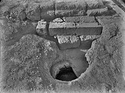
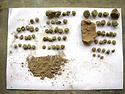
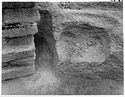
Pit (Well?) under Building A, Room 2. Coins:
9 May 1949 #1-#2
11 May 1949 #4
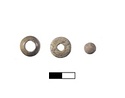
12 May 1949 #3 (not a coin, bronze fragment in lotted metal tins ΠΠ 295). Estimated Grid
Remains of coloring matter found with ... Hellenistic-Early Roman ... under Building A, Room 2 ... Coins:
9 May 1949 #1-#2
11 May 1949 #4
12 May 1949 #3 (not a coin, bronze fragment in lotted metal tins ΠΠ 295). |
From kiln in house of 7th c. B.C. (=Building A), to southeast of Tholos. Tholos Trench U, furnace ... 675-625 B.C ... B.C. (=Building A), to southeast of Tholos. |
Double Well by E. Entrance to Square Building (Well A) (formely a O 8:1) Coin
21 April 1951 #1 (disintegrated) Carefull there is two O 8:1, the actual one is a filling around rubble wall at 35/ KE.
Estimated ... 750 to early 7th century B.C ... Entrance to Square Building (Well A) |
Filling associated with construction of Poros Building. A small amount of fragmentary pottery found in the clay filling of the original floor; perhaps deposited as late as ca. 425-400 B.C. Cf. 18:4 and ... Ca. 475-450 B.C. or later ... Filling associated with construction of Poros Building. A small amount of fragmentary pottery found in the clay filling of the original floor; perhaps deposited as late as ca. 425-400 B.C. |
A strosis into which were set the foundations of house of 7th c. B.C. to SE of Tholos (=Building A and Trench W, layers h + i) ... 8th-7th c. B.C ... A strosis into which were set the foundations of house of 7th c. B.C. to SE of Tholos (=Building A and Trench W, layers h + i). |
Kernos Deposit (?): below floor of Building A, over and in cutting at 33/ΚΗ P 30162-P 30172 added on 4 May 1973 ... 4th c. B.C ... : below floor of Building A, over and in cutting at 33/ΚΗ |
P 5302 may be from disturbed fill ("soft spot", container B 57, nbp. 1246) ... 12 March-6 April 1935
7 May 1935 ... a) Undisturbed filling of the building |
Circular well cut through the old road after it had gone out of use, and filled probably at the time of the building of the drain and building A, and the throwing of fill over the road ... Ca. 430-400 B.C ... Circular well cut through the old road after it had gone out of use, and filled probably at the time of the building of the drain and building A, and the throwing of fill over the road. |
Fillings in and to the north of Building A/Poros Building/Greek Building ("Strategeion"), the accumulation mostly a late archaic dump, but not deposited till near the middle of the century. Most of the ... First half of 5th c. to ca. 460-450 B.C ... Fillings in and to the north of Building A/Poros Building/Greek Building ("Strategeion"), the accumulation mostly a late archaic dump, but not deposited till near the middle of the century. ... A few pieces (e.g. ... Subdivisions:
.1=a) Undisturbed filling of the building.
.2=b) Undisturbed filling to north of the building.
.3=c) Building fill in disturbed places. |
Early cutting beside Great Drain: 103-111/Λ-ΛΓ (= "Deep cutting" Pit at 107/ΛΑ).
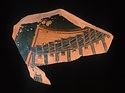
Abandonment filling in channel for early drain; the fragment of a red figured bell krater, P 17000, probably to be dated ... Ca. 425-395 B.C ... Abandonment filling in channel for early drain; the fragment of a red figured bell krater, P 17000, probably to be dated between 400 and 397 BC, is the latest dated object from the deposit, otherwise a consistent filling of the last quarter of the 5th. c. with some earlier material.
... For other fills related to Early Drain and giving date for building of Great Drain, see B 19:7 and B 19:12. |
This is associated with Building A. It had a circular marble well-head with a rectangular well slab beneath. The construction throughout was of well tiles. It produced little to a depth of -8.60m. Between ... 4th c. A.D ... This is associated with Building A. It had a circular marble well-head with a rectangular well slab beneath. ... It produced little to a depth of -8.60m. |
Mycenaean Chamber Tomb W. of Circular Building (at Σ:30/ΛΕ?)
It had been badly disturbed by a fourth-century B.C. pit which cut into the northeast part of the chamber (rectangular, ca. 1.80m by 1.30m) ... Myc. III A 2 ... Mycenaean Chamber Tomb W. of Circular Building (at Σ:30/ΛΕ?)
It had been badly disturbed by a fourth-century B.C. pit which cut into the northeast part of the chamber (rectangular, ca. 1.80m by 1.30m). ... Two skeletons and traces of a third were found. |
South Stoa II Construction Fill.
About 85 stamped amphora handles, many with parallels in building fills of Middle Stoa and Stoa of Attalos. Fragments of long-petal bowls confirm date after mid-2nd c ... To ca. 140 B.C ... About 85 stamped amphora handles, many with parallels in building fills of Middle Stoa and Stoa of Attalos. ... Types 25 A', 33 A, 35 B, and 44 A lamps. |
Double Well by Entrance to Square Building (Well B)
Wall A (R 9:2) was Late Geometric or transitional well, into one-half of which a bothros had been sunk in Turkish times (16th c. A.D.)-R 9:3.
This bothros ... ca. 17th century A.D ... Double Well by Entrance to Square Building (Well B)
Wall A (R 9:2) was Late Geometric or transitional well, into one-half of which a bothros had been sunk in Turkish times (16th c. ... This bothros was lined on the side of the Geometric well by a wall made of rough stones and pink cement, supported by three small round wooden beams. In dark brown fill, it contained many household utensils (spoons, a wooden bowl fragment, a saucepan and an iron knife), quantities of pottery and a fragment of marble capital Balance of pottery discarded. |
| Sacrificial pyre in Poros Building, NW Room (RSY= Pyre 1).
Against east wall of room 5 west. artifacts, bone, carbon and ash in pit in floor sequence. the pyre lay below a floor covered with marble dust, ... Middle of 4th c. B.C ... Sacrificial pyre in Poros Building, NW Room (RSY= Pyre 1).
... The pit extends down into a layer with marbleworking waste. The pyre thus postdates the arrival of the marbleworkers, and may be associated with the 4th century reconstruction of the building. It contained scattered carbon and there was a heavy ash deposit in the chytridion. some of the pottery is burnt; there were also fragments of burnt mudbrick or clay. |
Tiled Well in Square Building Foundations, equipped with evenly spaced hand-holds, with a good supply of water. There was no period of use represented and the dumped fill consisted mostly of chunks of ... Third quarter of 4th c. B.C ... Tiled Well in Square Building Foundations, equipped with evenly spaced hand-holds, with a good supply of water. There was no period of use represented and the dumped fill consisted mostly of chunks of bedrock, with many fragments of pebble mosaic and a few marble chips; the pottery was extremely scanty and very fragmentary. the well had been intentionally filled and carefully covered over a large slab in preparation for the foundations of the Square Building over it. |
RSY Grave A.
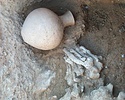
Under the Roman House with three rooms floored with mosaic near the southwest side of the area. The burial consisted of a pot laid on its side over the bedrock, presumably containing a child ... 7 August 1947 ... RSY Grave A.
Under the Roman House with three rooms floored with mosaic near the southwest side of the area. The burial consisted of a pot laid on its side over the bedrock, presumably containing a child. ... The grave had been disturbed in early times by the building of a wall (6th or 5th century B.C.) which in part overlay it; only the part of the pot immediately over the stereo was preserved. it was an amphora with banded body and conventional ornaments on the reserved neck, probably late 8th century. |
Mycenaean well under East Building Terrace steps (No catalogued pots). Rectangular in shape, 0.90x0.60m.
Abutting against the back of the East Building Terrace steps to the south. Yielded much thrown bedrock ... 14 July 1967 ... Mycenaean well under East Building Terrace steps (No catalogued pots). ... Abutting against the back of the East Building Terrace steps to the south. Yielded much thrown bedrock and a few Mycenaean sherds, with a few later intruders at the upper levels. |
Ash and Carbon Dump in Corridor directly behind Room C of Brick Building.
This material comprises what appears to have been a household dump associated with the period of use of the Brick Building, but ... To mid-2nd century ... Ash and Carbon Dump in Corridor directly behind Room C of Brick Building.
This material comprises what appears to have been a household dump associated with the period of use of the Brick Building, but probably dating just prior to its abandonment, since it included a a few roof tiles, presumably from the demolition of the Brick Building. The dump is located in the corridor between the back wall of the Brick Building and the retaining wall behind the building , immediately east of the line of the dividing wall between Rooms B and C [City Grid: Q/18-11/2] |
| Disturbed pyre in NE stoa area.
In western room of westernmost shop building. A patch of ash i or at the level of layer 2 (lot Ι 189d), partially destroyed by modern wall. Pottery from layer 2 dates ... 400-350? ... In western room of westernmost shop building. A patch of ash i or at the level of layer 2 (lot Ι 189d), partially destroyed by modern wall. |
Pit with marble chips (disturbed); working chips of the Hephaisteion construction. A few vases apparently contemporary with the building of the temple ... 5th c. B.C. to ca. 450 but disturbed ... A few vases apparently contemporary with the building of the temple. |
Construction fill below floor of Brick Building.
Areas involved:
a) Western portion of Room A: packing below floor.
b) Room B: packing below floor of northern,larger room.
c) Fill over water channel in ... First quarter 2nd century, before its end ... Construction fill below floor of Brick Building.
Areas involved:
a) Western portion of Room A: packing below floor.
b) Room B: packing below floor of northern,larger room.
c) Fill over water channel in smaller, southern room B; channel discovered by builders of Brick Building,rebuilt by them and covered over.
d) Foundation trench of earlier building beneath Brick Building, filled and covered by builders of Brick Building.
e) "Apparently from below floor of building" (nb.p. 1282).
... Type 48 A lamp. No long-petal bowls ... It was believed to antedate the construction of the building since the wall of the building seemed to cut it. |
Diameter of top of well 0.80m.
An early well east of Roman Building, north of Temple of Ares and thus in the region of the Mycenaean cemetery. Sherds almost entirely Mycenaean with nothing later and a ... Mycenaean ... An early well east of Roman Building, north of Temple of Ares and thus in the region of the Mycenaean cemetery. Sherds almost entirely Mycenaean with nothing later and a few earlier. Maybe the well was used only for ceremonial and funerary purposes. |
Mycenaean Grave W. of Circular Building. Measuring 1.40m by 0.55m and it was covered with a few rough stone covering slabs, under which lay the skeleton of an adult with the head to the north and the knees ... Myc. III A2-B ... Mycenaean Grave W. of Circular Building. Measuring 1.40m by 0.55m and it was covered with a few rough stone covering slabs, under which lay the skeleton of an adult with the head to the north and the knees up. A single offering was placed above the knees.
|
A pit, perhaps a well, extending beneath the foundations of [Building D, the Primitive Bouleuterion] the Hellenistic Metroon. Not completely dug due to its position. A dumped filling so far as dug, apparently ... Ca. 575-525 B.C ... A pit, perhaps a well, extending beneath the foundations of [Building D, the Primitive Bouleuterion] the Hellenistic Metroon. Not completely dug due to its position. A dumped filling so far as dug, apparently thrown in within a very limited period. |
Well T: Middle Helladic. Close to Paved Building. Diameter ca. 0.75-0.80m.
No apparent water, but a thin layer of sand at the bottom ... Middle Helladic ... Close to Paved Building. Diameter ca. 0.75-0.80m.
No apparent water, but a thin layer of sand at the bottom. |
| Pit and drain at SE corner of Apollo Temple. Antedates building of Apollo Temple which was assigned to a date 'late in the third quarter' ... 3rd quarter 4th c. B.C ... Antedates building of Apollo Temple which was assigned to a date 'late in the third quarter'. |
Well East of Circular Building, at 25/ΙΗ.
Well dug originally in 5th c. B.C. and probably had POU fill. In 2nd c. A.D. the shaft was intersected by a horizontal vaulted brick tunnel belonging to the Brick ... 5th c. B.C.(?) ... Well East of Circular Building, at 25/ΙΗ.
Well dug originally in 5th c. ... A.D. the shaft was intersected by a horizontal vaulted brick tunnel belonging to the Brick Shaft system and the earlier fill above the line of the proposed tunnel floor was dug out. After construction of tunnel the old well shaft was filled up again, this time with a Roman dumped filling of second half of 2nd c. |
| Sacrificial Pyre = Pit in floor (identified as pyre by SIR); with the characteristic small plates and saucers. "Saucer Grave" at 12/ΚΑ.
Dimensions: 2m (length)x 0.70 (width).
North of north wall of building ... First half 4th c. B.C ... North of north wall of building. Long, narrow pit containing pottery and ash dug into a hard floor or surface and aligned with north wall of Building E. The pottery rested on a bedding of stones. The alignment of the pit suggests a connection with Building E, and the pyre dates in the generation after its reconstruction. |
| A well at the northeast corner of Classical Building, behind back wall. Dumped fill appears to have occurred as a single event as there are joining sherds throughout.
POU date ca. first half 5th c. B.C.; ... 5th c. B.C ... A well at the northeast corner of Classical Building, behind back wall. Dumped fill appears to have occurred as a single event as there are joining sherds throughout.
|
| Pocket, identified as sacrificial pyre by SIR. Possibly disturbed. Outside south wall of building. Concentration of pottery in a small pocket below a "Hellenistic" fill. There is no mention of bone or ... First quarter 4th c. B.C ... Outside south wall of building. Concentration of pottery in a small pocket below a "Hellenistic" fill. ... The pyre dates shortly after the proposed date for the beginning of the second phase of Building E; the chronology may be sufficiently flexible to allow association with this reconstruction of the building ... A miniature black glazed lekanis (P 1465) and a small one-handler accompany the saucers and plates and the miniature chytra (P 1470). |
| David Scahill ... Below packed clay floors in Room 2 of Classical Building II; bordered on east and south sides by polygonal cross wall and back wall extension for Classical Building. Late Roman wall and drain installation ... LHIII A:1 ... Below packed clay floors in Room 2 of Classical Building II; bordered on east and south sides by polygonal cross wall and back wall extension for Classical Building. ... Decoration appears to be mostly LHIII A:1 with some possibly earlier motifs. ... Toward the west against the north side, a bronze dagger and spear point. |
Square Peristyle (Square Building) Constructions fill + other (square peristyle area); fragmentary and with some earlier material but in the main, where undisturbed, a homogenous deposit. Coins:
26 May ... Βefore 300 B.C ... Square Peristyle (Square Building) Constructions fill + other (square peristyle area); fragmentary and with some earlier material but in the main, where undisturbed, a homogenous deposit ... From Square Building construction fill. ... Cutting floor of Square Building |
Ca. 73-81/Drain. Fillings associated with the construction of the Great Drain South, especially the fill thrown in behind the east wall of the drain at the time of its building.
Cf. A 20-21:1 and B 19:7 ... Ca. 425-400 B.C ... Fillings associated with the construction of the Great Drain South, especially the fill thrown in behind the east wall of the drain at the time of its building.
Cf. A 20-21:1 and B 19:7.
|
Fillings immediately antedating the building of the Stoa.
Cf. Hesperia 6 (1937), p. 20 and the debris of a pottery works behind the Stoa (H 7:1) ... Fillings immediately antedating the building of the Stoa.
... Hesperia 6 (1937), p. 20 and the debris of a pottery works behind the Stoa (H 7:1). |
See I 870, a piece of which was found in disturbed red fill in Β' southeast of Tholos.
Although apparently from the same context as P 5339 (tins 24-26, undisturbed fill), P 5336-P 5338 are recorded from ... 27 February-8 April 1935 |
Well (stone-curbed shaft) near middle of Tholos which served the prior building.
Period of Use dated to ca. 500-480(?) B.C., Upper fill dated to ca. 480-470 B.C. or soon after in Agora XXX (a gradual ... Ca. 500-480 B.C ... Well (stone-curbed shaft) near middle of Tholos which served the prior building.
Period of Use dated to ca. 500-480(?) B.C., Upper fill dated to ca. 480-470 B.C. or soon after in Agora XXX (a gradual accumulation).
|
| Marcie Handler ... The remnants of a disturbed pyre in a layer of dumped Hellenistic fill. The fill was found in the area on top of and east of the eastern wall of the Classical Commercial Building at its north end. Fragmentary ... Ca. 225 B.C ... The remnants of a disturbed pyre in a layer of dumped Hellenistic fill. The fill was found in the area on top of and east of the eastern wall of the Classical Commercial Building at its north end. Fragmentary pyre pots were mixed into the fill, which dated to the period after 225 BC. ... the pyre pottery may very well have come from a pyre buried under a floor in the building just to the west of here. |
| "Perhaps a cremation burial ... " nbp. 811. "Sacrificial pyre, disturbed," GRE, deposit nb.
In room on east side of building. Concentration of artifacts, fragments of bone, and abundant cinders in stratum, ... Early 3rd c. B.C.-Ca. 250 B.C ... "Perhaps a cremation burial ... " nbp. 811. ... In room on east side of building. Concentration of artifacts, fragments of bone, and abundant cinders in stratum, no pit discerned. The pyre was found while excavating an undated red fill that lay over the 5th c. building fill. It cannot be related to any event in the life span of the building. |
Rectangular pit over bedrock in north part of E. Building. Broken jars and household basins with a few black glazed and black-figured fragments (uninventoried). The figured pieces indicate the lower limit ... Late 6th-ca. 480 B.C ... Rectangular pit over bedrock in north part of E. Building ... Broken jars and household basins with a few black glazed and black-figured fragments (uninventoried). |
Archaic house with Distyle Porch (= Building J) in southeast of section: packing beneath floors (Layers a and b of Tholos Trench S.Layer b=Beneath original floor dated to ca. 500 B.C.
Layer a=Between original ... 6th-early 5th c. B.C ... Archaic house with Distyle Porch (= Building J) in southeast of section: packing beneath floors (Layers a and b of Tholos Trench S.Layer b=Beneath original floor dated to ca. 500 B.C.
Layer a=Between original and second floor dated to 490-480 B.C. |
Cistern System #3: East Chamber at 69/Λ, joined by a crooked passage to 69/ΛΣΤ. Under the southwest corner of the Hellenistic Building to the north of the Temple of Hephaistos ... 175-125 B.C ... Cistern System #3: East Chamber at 69/Λ, joined by a crooked passage to 69/ΛΣΤ. Under the southwest corner of the Hellenistic Building to the north of the Temple of Hephaistos. |
Filling behind retaining wall of Stoa of Zeus. The remains of unfired clay adhering to the interior of various pieces make it probable that the material in this filling is a mass of debris from the floor ... Ca. 435-425 B.C ... The remains of unfired clay adhering to the interior of various pieces make it probable that the material in this filling is a mass of debris from the floor of a pottery-works destroyed by subsequent building. |
| Mycenaean Chamber Tomb SE of Stoa Pier 12 (Burial 8).
Roughly rectangular, measuring 1.70m by 1.40m, and was cut down to within 0.65m. by the construction of the Square Building. A rectangular cutting ... Early Myc. IIIA ... Roughly rectangular, measuring 1.70m by 1.40m, and was cut down to within 0.65m. by the construction of the Square Building. A rectangular cutting at the northwest corner may have been the entrance, although this cutting may be later; the southwest corner of the chamber appeared to have been unfinished.
Across the north end lay the single skeleton of a child with head to east, lying on its back with knees doubled up. The body was laid on a thin layer of brown clay. |
Filling of Middle Drain (Tr. H+F in Section Ζ). Sand and gravel filling of the old course of the west branch of the Great Drain, a large (ca. 1.00m. deep and 1.30m. wide) underground channel in the area ... 150-100 B.C. |
POU = 10.00-11.30m.
"The well is important because it gives us a terminus post quem for Building D." (nbp. 3346)
Shallow well, producing little water or trouble, but a great quantity of coarse late Roman ... Ca. A.D. 300-370 and Ca. A.D. 400 ... "The well is important because it gives us a terminus post quem for Building D." (nbp. 3346)
Shallow well, producing little water or trouble, but a great quantity of coarse late Roman pottery, with Type XXVIII lamps. |
Filling over Floor of Square Peristyle (beneath Stoa).
122 stamped amphora handles. Many parallels with handles from cistern M 21:1. Latest coin dates ca. 200. latest lamp types 33 A and 34 A. Fragment ... 200 B.C ... Latest coin dates ca. 200. latest lamp types 33 A and 34 A. Fragment of long-petal bowl probably intrusive, possibly from building fill of Stoa of Attalos. |
| Anne McCabe ... Adjacent to the SW face of Byzantine Wall 14. The circular cutting, 0.90m in diameter, appeared at 53.504m under a layer of loose rubble (Lot 481). Wall of the well roughly built, consisting at the top ... 11-19 July 2006
24 June-21 July 2009 ... The circular cutting, 0.90m in diameter, appeared at 53.504m under a layer of loose rubble (Lot 481). ... Lower down, from 52.621m, large segments of terracotta well lining tiles are interspersed with other building materials. These lining segments are probably reused: one has a cutout triangular foothold; other have cutout rectangular footholds; one is marked with π incised twice. Most are broken; a complete segment measures 0.39 by 0.65m. |
The deposit notebook lists S 1439 here, but the following information on that card indicates that D 18:4 could be considered with D 18:3 and not as a separate deposit.
"Excavation of pit, which partly ... The deposit notebook lists S 1439 here, but the following information on that card indicates that D 18:4 could be considered with D 18:3 and not as a separate deposit.
... T 604 for other fragments possibly of bronze workers molds from street to north of Poros Building. 4th. century context; XV, nb.p. 2866, for mold fragments from southwest room stored in T 732."
|
Narrow trench in bedrock; one section found to NE of Circular Building west of the Stoa of Attalos, another (Q 8:1) beneath the terrace of the Stoa of Attalos opposite Pier 19. A single filling in both ... Ca. 450-425 B.C. and shortly after ... Narrow trench in bedrock; one section found to NE of Circular Building west of the Stoa of Attalos, another (Q 8:1) beneath the terrace of the Stoa of Attalos opposite Pier 19. A single filling in both sections, with a high proportion of good black vases. |
| Mycenaean Grave at SE corner of Pier 12 (Burial 9).
There are no traces of dromos, which must have been located at the north and have been cut away by the trench four the south stylobate of the Square ... Myc. III A:1 ... There are no traces of dromos, which must have been located at the north and have been cut away by the trench four the south stylobate of the Square Building. The dimensions of the chamber are 1.60m east-west by a preserved length of 1.40m north-south. The walls were preserved to a height of 0.065m, and the grave was full of broken bedrock with a little soft brown silt around the bones. The broken bedrock plus the presence of more than one burial is certain indication of a chamber tomb rather than a pit grave. |
Destruction Layer, Brick Building.
It represents material from the layer of fallen brick covering the floor and wall socles of the Brick Building and therefore marking the destruction of the structure ... To ca. 165 ... Destruction Layer, Brick Building.
It represents material from the layer of fallen brick covering the floor and wall socles of the Brick Building and therefore marking the destruction of the structure. ... Presumably the Brick Building was demolished for that very reason, although it may be noted that in some areas there was a layer of ash and carbon over the floor of the Brick Building and so the immediate cause of destruction may have been fire. |
Just east of Building II near its south end. The tiles were in place.
Upper filling (to 3.00m.) of Hellenistic-Byzantine dump all discarded.
POU fill a gradual accumulation of typical Justinianian ware ... 6th c. A.D. POU-7th c. A.D ... Just east of Building II near its south end. ... POU fill a gradual accumulation of typical Justinianian ware. |
Two pebble floors of Roman date, broken into at the SE and north, covered a 6x5m trench in ΕΛ, bounded by the unexcavated east trench and a wall from Byzantine Building D (Wall A). Under these pebble floors ... 220 - 150 B.C ... Two pebble floors of Roman date, broken into at the SE and north, covered a 6x5m trench in ΕΛ, bounded by the unexcavated east trench and a wall from Byzantine Building D (Wall A). Under these pebble floors was a large amount of fill thick with ceramic inclusions, most likely deposited at one time, though possibly in three separate dumpings, characterized by varying density of ceramics and amount of stone inclusions. |
Fillings below the courtyard floor of the Poros Enclosure west of the Areopagus. The lowest layer, over bedrock, is of the archaic period and may have accumulated on the spot before the start of building ... First half of 5th c. B.C ... The lowest layer, over bedrock, is of the archaic period and may have accumulated on the spot before the start of building operations. The upper layers also contain archaic material, but are a dumped filling brought in to level the area at a date not earlier than 460-450. These levels may not have been sealed over by the construction of the building until the last quarter of the century. |
| Sacrificial Pyre I, Classical Building II.
The pyre was set through the original floor level of the northern room of the Classical Building and apparently is the remainder of a ritual conducted when the ... Ca. 375-350 B.C ... Sacrificial Pyre I, Classical Building II.
The pyre was set through the original floor level of the northern room of the Classical Building and apparently is the remainder of a ritual conducted when the old floor was raised. The pyre was preserved in a thin strip of undisturbed fill between Pithos III and a Byzantine pit. ... "In 1989 we dug in adjacent area and found a black-glazed skyphos, Attic type ΒΕ 755= P 31817, which appears to belong to this deposit, cf. pp. 4289-4291. |
| Laura Gawlinski ... Fill excavated south and west of Early Building Ii, Room E latrine, with a high concentration of votive material, such as pyre saucers, miniature loom weights, and ribbon handled plates. Some traces of ... 400-350 B.C ... Fill excavated south and west of Early Building Ii, Room E latrine, with a high concentration of votive material, such as pyre saucers, miniature loom weights, and ribbon handled plates. ... No bone was recorded. A bowl containing pigment was found in the same layer. |
Continuous filling over its mouth and in it to a depth of -7.30m. Clearly the fill thrown in at the time of Archaic Building, to raise the ground level. The last few centimeters of the well represented ... 550-500 B.C ... Continuous filling over its mouth and in it to a depth of -7.30m. Clearly the fill thrown in at the time of Archaic Building, to raise the ground level. ... Below the throw-in filling, and directly over the pottery of the period of use lay half a dozen chips of yellow Kara stone, some with worked surfaces. |
Well under Poros Building Drain at 62/ΛΣΤ, west of the Areopagus. Digging abandoned at 6.10m due to a collapse of the soft bedrock at the west. Small amount of supplementary filling was added in the upper ... Ca. 520-480 B.C ... Well under Poros Building Drain at 62/ΛΣΤ, west of the Areopagus. Digging abandoned at 6.10m due to a collapse of the soft bedrock at the west. Small amount of supplementary filling was added in the upper part of the well, probably when the cutting was bridged over to allow for the building of the Poros Drain.
|
| Marcie Handler ... Fill within the drain from the basin on the west side of Roman Room B through Wall A.
After we removed the fill within the basin on the west side of Roman Room B (BZ XXVII p. 5325), we began excavating ... Late Roman |
Mycenaean burial, disturbed (Piers 12-13 east). Plan unclear.
Bones discarded.
It was found in the trench for the east stylobate of the Square Building. It was so badly disturbed by the Classical builders ... Myc. IIIA:2 ... It was found in the trench for the east stylobate of the Square Building. It was so badly disturbed by the Classical builders that it is impossible to tell anything about the plan, whether it was a small chamber tomb or a pit grave. |
Evidence of stratification into five layers, although joins between the layers. Layer VI added when the construction of the Roman building above required it. No subdivisions assigned.
Flask-shaped cistern ... Early 3rd-late 2nd c. B.C ... Layer VI added when the construction of the Roman building above required it. ... As found, it lay beneath the floor of one of the rooms of a Roman Building. ... Water was received at the north end of this and entered the cistern through a passage which was apparently dammed at the place it entered the cistern with a low block to provide for settling of sediment.
|
Brian Martens ... This deep stratum (ca. 030m) is delayed Persian destruction cleanup deposited in the 470s B.C. it contains about one generation's worth of pottery, almost exclusively dating between about 500-470 B.C ... 29 June-19 July 2017
12–15 July 2022 ... The stratum abutted E-W polygonal Wall 8 and was laid down for Post-Persian renovations of the building. The dump of pottery raised the floor level of the building; atop J 1:18 was a layer of crushed bedrock and a renewed floor surface.
|
| Laura Gawlinski ... Well in courtyard of Early Building I, adjacent to wall of Room B. Tile lined; upper course in situ, lower two collapsed probably in antiquity. Letters inscribed on rims (eta, phi, omicron, theta). Medium ... First quarter of the 4th c. B.C ... Well in courtyard of Early Building I, adjacent to wall of Room B. ... Well contained three main dumped fills: a slightly later fill perhaps for leveling after filling settled (Layer I and perhaps Layer II), a fill with ceramic and some stones (Layer III and perhaps Layer II), and a fill with large stones, tiles, and collapsed well lining (Layer IV).
|
Dumped debris filling east of East Building, badly shattered. There is a small amount of disturbance from the filling immediately above, but the bulk of the pottery is consistent, and very close to that ... Ca. 470-460 B.C ... Dumped debris filling east of East Building, badly shattered. There is a small amount of disturbance from the filling immediately above, but the bulk of the pottery is consistent, and very close to that from the well H 6:5.
|
A well in House T, Room 2W (Publ. House D), industrial area west of the Areopagus. Lower filling of dug bedrock including a small amount of pottery of the Geometric period. Gravelly filling in collapsed ... 3rd. quarter of 8th. c. B.C ... A well in House T, Room 2W (Publ. ... Lower filling of dug bedrock including a small amount of pottery of the Geometric period. Gravelly filling in collapsed upper part of well shaft containing a few vases and fragments of the early 5th. c.; the filling in the well antedates the building of the house, shortly before the mid-century. |
Laura Gawlinski ... Pebble floors of Roman date covered the northern half of a 6x6m square trench in ΕΛ, bounded to the west by the post-Herulian Wall and to the east by a wall from Byzantine Building D (Wall A) to the east ... Hellenistic/ 220-150 B.C ... Pebble floors of Roman date covered the northern half of a 6x6m square trench in ΕΛ, bounded to the west by the post-Herulian Wall and to the east by a wall from Byzantine Building D (Wall A) to the east. Under these pebble floors was a large amount of fill thick with ceramic inclusions, most likely deposited at one time, though possibly in six separate dumpings, characterized by varying density of ceramics and amount of stone inclusions. ... Also, in Agora XXXI, p. 151, a deposit T 21:1 was created by Margie Miles, changed to T 21:4 in the Database. |
| Investigations in the area of Archaic Temple Added by E.V June 1963 ΕΛ 324-331. In the annual report for 1959 both the building of the temple itself, and the red limestone addition are dated in the early ... First half of 6th c. B.C. - early 5th c. B.C. |
| Marcie Handler ... Continued from 2000 season, 10-12 July 2000; BZ XXIII p. 4472.
The hoard was originally excavated during the 2000 season (Lot BZ 1049, 5th-6th centuries AD), from a higher elevation through a gap in the ... 10-12 July 2000
21-22 July 2003 |
| Matt McCallum ... The pyre was uncovered in a small, triangular area between the BZ Building foundations (but at a lower level) and the northern scarp of the current excavation area. It rested in a patch of orange-brown ... 1-7 August 2006 ... The pyre was uncovered in a small, triangular area between the BZ Building foundations (but at a lower level) and the northern scarp of the current excavation area. It rested in a patch of orange-brown fill left over after scarping operations related to the BZ Building foundations in 2004.
|
East of Classical Building II backwall, above Mycenaean chamber tomb K 2:5. Rough circular pit of reddish brown fill cut into geometric fill that extends down inside tomb. Some evidence of burning on pottery ... Ca. 460 B.C ... East of Classical Building II backwall, above Mycenaean chamber tomb K 2:5. ... Black glaze, cooking and coarse wares, including a very fine example of a large askos (P 33570). |
| David Scahill ... Burial in Geometric well (J 3:8), in Classical Building II, Room I, next to south ashlar wall. "No grave goods!"
ADDENDA: J. Papadopoulos later associated P 34449 and P 34450 to that grave. (Cf. Agora ... Geometric ... Burial in Geometric well (J 3:8), in Classical Building II, Room I, next to south ashlar wall ... AA 362 a, b, c |
| David Scahill ... At northeast corner of Classical Building II; on south side of dromos of Tomb K 2:5, and separated from it by ca. 0.6m of bedrock. Chamber cut through bedrock. The northeast corner of chamber defined ... LHIII A:1 ... At northeast corner of Classical Building II; on south side of dromos of Tomb K 2:5, and separated from it by ca. 0.6m of bedrock. ... Partially articulated skeleton laid out against the north wall of the tomb, with feet to the east. A courseware pitcher upside down in the north east corner. More bones and a skull in a depression under and to the south, with an alabastron, and broken pieces of a second pitcher. |
Channel J (in ΗΗ)
Cutting that probably originally held a drain. Packed with amphoras and other coarse pottery. It tapped the poros aqueduct wall just East of our explanatory trench at the East end of ... 1st c. B.C. - early 1st. A.D ... Channel J (in ΗΗ)
Cutting that probably originally held a drain. Packed with amphoras and other coarse pottery. ... Then it swung sharply NW and N as though to avoid some building and moved down at great depth (1.62m)as though along a street. |
A total of 79 ostraka was recovered from Room 5 of the Classical Building.
More of this deposit was excavated in the 2021 season on the opposite side of the scarp of Wall R, up against the face of Wall ... 500-475 B.C ... A total of 79 ostraka was recovered from Room 5 of the Classical Building.
... The filling comprises the subfloor of a Late Archaic phase of Room 5.
... The excavation produced a substantial number of new ostraka. |
"Symbolon Pit" (Rectangular Pit in bedrock E of Stoa, Room 5). Preserved depth 0.45m, original depth estimated at ca. 1.65m., the upper part having been cut away by successive building operations in the ... Third quarter of 5th c. B.C ... Preserved depth 0.45m, original depth estimated at ca. 1.65m., the upper part having been cut away by successive building operations in the area. Filling of stones and dug bedrock with a considerable quantity of pottery and some animal bones, apparently a refuse pit. ... A good variety of shapes, much as R 13:4, but without any stamped ware (possible connection between the two dumps) 17/8/1959 LT. |
| In room A. Concentration of artifacts and burning in stratum, no pit discerned. The pyre lay below a Late Hellenistic fill with a smooth earth surface. It is described as a black patch of earth with sherds, ... 350-250 B.C ... In room A. Concentration of artifacts and burning in stratum, no pit discerned. The pyre lay below a Late Hellenistic fill with a smooth earth surface. ... Strosis II, on which the pyre rested, covered the walls of Room A, demonstrating that the pyre postdates a change of plan or abandonment of this part of the building, other parts of which survived to the Late Hellenistic period. |
Well at 18/ΜΓ, on the lower north slope of the Acropolis, under the course of the later Panathenaic Way, west of the Archaic Building.
Diameter 0.97m. Water level 8m.
At the mouth of the well and to a ... Late 8th to 675 B.C ... Well at 18/ΜΓ, on the lower north slope of the Acropolis, under the course of the later Panathenaic Way, west of the Archaic Building.
Diameter 0.97m. ... At the mouth of the well and to a depth of 4m, the soft bedrock had collapsed leaving a large irregular pit. The rock from this collapse filled the well-shaft down to a depth of 7m.
below this point lay the water jars from a period of use, to a depth of 8,50m. |
Well 12: Archaic.
It lies on a rocky ledge about thirty meters north of the Klepsydra, just east of the Panathenaic street. In spite of its depth, it produced little pottery and its contents were of slight ... 6th c. B.C.? ... It lies on a rocky ledge about thirty meters north of the Klepsydra, just east of the Panathenaic street. ... Probably the filling-up of this and the other archaic wells in the same neighborhood, was the result of something more than the normal cleaning up after a catastrophe.
In the well were not merely the usual quantities of domestic wares, pithoi, tubs and the like, of broken up terracotta rooftiles and crude brick; there was also a number of building stones: three large blocks of poros from some archaic structure, and many small carefully dressed blocks of Acropolis limestone from a polygonal wall or walls. |
| Pyre /Burial (?) disturbed, in the area of the Poros Building west of the Areopagus. In northeast corner of room 4 west.
Concentration of artifacts, tiny slivers of bone, and burning in a layer of fill ... Early 4th c. B.C ... disturbed, in the area of the Poros Building west of the Areopagus. ... Concentration of artifacts, tiny slivers of bone, and burning in a layer of fill 0.25m thick below a pebble mosaic (ΟΟ 651). ... Below the pyre was a trodden surface of fill with roof tiles. |
Unfinished well, south of the annex to the Poros Building, west of the Areopagus. The shaft was apparently never used as a well. The lower dumped filling contained a quantity of clean red clay, as if from ... Ca. 350-325 B.C ... Unfinished well, south of the annex to the Poros Building, west of the Areopagus. The shaft was apparently never used as a well. The lower dumped filling contained a quantity of clean red clay, as if from an industrial establishment; also some marble chips and a scattering of pottery fragments. The single lamp is of a type which comes into use in the mid-4th c. |
| Identified as pyre by SIR.
In room E. Burnt "pocket" found while digging red earth that contained late Hellenistic pottery, including a fragment of Pergamene (discarded). No pit was discerned, but concentration ... 3rd quarter 4th c. B.C ... Burnt "pocket" found while digging red earth that contained late Hellenistic pottery, including a fragment of Pergamene (discarded). No pit was discerned, but concentration in a "pocket" suggests that the pyre was in its original position and the layer in which it was buried contained late Hellenistic intrusions. There is no evidence for the relationship of the pyre to building phases. No bone was recorded. |
| Handler ... Found in an area of disturbed fill north of a floor surface in Room 4 of the Classical Commercial Building. The floor surface (n. 3 on the west side of Room 4) was preserved at 52.503-52.544 masl., and ... 2nd half 4th c. B.C ... Found in an area of disturbed fill north of a floor surface in Room 4 of the Classical Commercial Building. ... The pyre was located in a shallow channel adjacent to the south face of Wall 4, where the floor surface was not preserved ... AS 1396.3 in Study Collections-Case No. 99C-2 box V, while a bone bag now stored in drawer 33 (animal bones) |
Tiled well, ca. 30m south of the Tholos. Associated with Building D. Hellenistic Group A with Late Roman fill in upper 3.00m. Objects A 245 and P 4597 are from fill on floor around well-head, contemporary ... 325-260 B.C ... Associated with Building D. Hellenistic Group A with Late Roman fill in upper 3.00m. Objects A 245 and P 4597 are from fill on floor around well-head, contemporary with upper fill but not in subdivision .1.
... Coins:
13 March 1933 #1 at well head (#2-#3)
21 March 1933 #1 (dump) (not a coin) |
| David Scahill ... Behind northeast corner of Classical Building; east wall C. Below Hellenistic levels and early Classical pit. Chamber cut through bedrock, depth ca. 0.90m., diameter ca. 2m., roughly square in shape, angling ... LH III A:1 ... Behind northeast corner of Classical Building; east wall C. ... Pottery appears to be LH III A:1 with some possibly earlier. |
Classical commercial building, room 3, against south wall. Small fragments of pottery dispersed in fill overlying two floor levels (at 51.897 and 51.941 masl). Five objects of pyre type: ribbon-handled ... 4th c. B.C ... Classical commercial building, room 3, against south wall ... Five objects of pyre type: ribbon-handled plate, plate with concave rim (P 36558), and uninventoried fragments of a ribbon-handled plate and three small pyre saucers. |
| Marcie Handler ... Located in the south section of Room E in the Byzantine Building east of the North-South Road. The uppermost 1.5 meters of well lining was built of well-coursed stones (some reused marble blocks) and tiles ... 12th c. A.D ... Located in the south section of Room E in the Byzantine Building east of the North-South Road. ... The later phase of the well, a Byzantine well-lining and well-head, was excavated during the 2001 season (BZ XXV p. 4953, Lot BZ 1217) and the Roman catchment basin and well-lining down to the level of the terracotta lining were excavated during the 2002 season (BZ XXVII pp. 5279 & 5285 for the catchment basin; BZ XXVII p. 5293 for the Roman well-lining).
... The packing fill for the well consisted almost entirely of fragments of tegulae mammatae (133 were found in the packing fill from 50.657 to 53.001 masl), which gives the destruction of the bath to the southwest in 395/6 AD as a terminus post quem for the original construction phase of the well. |
Well by Stoa Pier 3.
Mouth was discovered in 1950 (p. 2273). Between first and second POU; no joins between the groups, which were separated by nearly sterile fill. No apparent chronological difference ... Mid-2nd c. B.C ... Interesting well because of its probable connection with the building of the Stoa of Attalos. ... The large numbers of water-jars found in it suggests that it must have been a good source of water in antiquity and it seems probable that it served as water-supply for the workmen engaged in building the Stoa.
... This filling probably belongs to a time before the building of Stoa, when the well served some nearby house or shop. |
| Marcie Handler ... It was situated in the NW corner of Room 3 in the Classical Commercial Building, just S of Wall 11, the cross-wall that divides Room 3 from Room 4 to the north. The pyre pots were found surrounded by ... Late 4th c. B.C ... It was situated in the NW corner of Room 3 in the Classical Commercial Building, just S of Wall 11, the cross-wall that divides Room 3 from Room 4 to the north. The pyre pots were found surrounded by fill with charcoal and burnt bone below a floor surface preserved immediately to the E (J/13,14-2/7,8; 52.20 masl.).
The pyre deposit continued up to the north face of late Roman Wall C, suggesting that these lower courses of Wall C were packed into a narrow trench instead of built up within a wider foundation trench. |
Pit in SW corner of Heliaia Peristyle (mint).
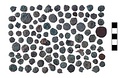
The four Athenian imperial coins (Κ-1641 - Κ-1644) belong to the Athenian Imperial Group III, a series that can be very closely dated to the middle of the ... Mid 3rd c. A.D ... From size, fabric, and the fact that they have been sawed from a bar, it is clear that all 38 flans were cut for the minting of this same coinage.
... Use of the building as a mint need not have gone back much before 250 since there is a gap of one or two generations before the Group III coinage during which Athens did not coin. ... A. Walker coin deposit. |
| Pyre in cut in E-W street, layer 7 (Pyre 14). North edge of Piraeus street, west of the Great Drain Bridge, in the area west of Areopagus.
RSY-Pyre.
Pottery, a little burnt bone, and patches of charcoal ... 250-240 B.C ... The pyre was uncovered in digging a thin layer rich in marble chips. ... The excavator interpreted the successive thin layers of marble chips as road-building material. Possibly, however, marbleworking took place just outside a house to the north, against the wall of which these layers run. hardened earth beneath the pyre indicates burning in situ. ... Organic material:" a minimum of bits of burned bone". |
| Marcie Handler ... The Pyre was revealed in a layer of 4th c. fill in the north end of Room 6, just south of Wall 8. Room 6 is defined by the street wall (Wall A) on the west, Wall 7 on the east, Wall 9 on the south (preserved ... 4th c. B.C ... The Pyre was revealed in a layer of 4th c. fill in the north end of Room 6, just south of Wall 8. Room 6 is defined by the street wall (Wall A) on the west, Wall 7 on the east, Wall 9 on the south (preserved only as a stub on the east side of the area), and possibly Wall 8 or Wall 6 on the north.
2.5 meters SW of the pyre, a patch of floor surface at J/10-1/20 at 52.188 masl. was found. ... This pyre is the northernmost pyre found in Section ΒΖ North, and its location suggests that the Classical Commercial Building continues this far north. |
| Mycenaean Grave to W of Pier 12 (Burial 11).
The northern part of the tomb had been cut away by the foundation trench for the south stylobate of the Square Building that preceded the Stoa, and the dromos, ... Myc. IIB-IIIA:1 ... The chamber was small with an original east-west dimension of 1.60m and a preserved north-south dimension of 1.20m, the walls preserved to a maximum height of 0.90m. A single skeleton lay in some disorder in the eastern part with its head to the south. ... Although it might be argued from the single internment and the absence of any preserved dromos that this was a pit grave, the location of the body along the edge of the cutting would seem rather to indicate a small chamber tomb that has been cut away at the north. |
Grave of 38 year-old female, head NW, legs drawn up. Apparently unlined cist in bedrock or hard-packed dug-bedrock, its outlines no longer distinguishable from surrounding fill. Above skeleton, a number ... Mycenaean? ... Above skeleton, a number of small stones in no order. ... If the offerings were at the feet they would have been disturbed by a late Turkish pit, and if at the head by the builders of the so-called "Burned Building".
|
| Pocket with burning at 60/ΚΗ. "Is this perhaps a disturbed pyre burial." [Nbp. 2928].
Identified as pyre by SIR.
Near north end of corridor, beside its west wall. Concentration of artifacts, tiny scraps ... 4th c. B.C ... "Is this perhaps a disturbed pyre burial." ... Concentration of artifacts, tiny scraps of bone, and carbon in stratum, no pit discerned. the objects lay under an uneven strosis level with the bottom of the rebuilt west wall of the corridor, perhaps dug into a layer topped with marble chips. ... Its identity as the remains of a disturbed pyre is therefore questionable. |
| Disturbed Pyre at 59/ΚΗ (ΚΖ), in the area of the Poros Building west of the Areopagus.
Against east wall of room 5 west. concentration of artifacts, ash, carbon and a few bones in stratum, no pit discerned ... 3rd c. B.C ... Disturbed Pyre at 59/ΚΗ (ΚΖ), in the area of the Poros Building west of the Areopagus.
Against east wall of room 5 west. concentration of artifacts, ash, carbon and a few bones in stratum, no pit discerned. The contents rested on or above a layer that is said to be at about the same level as the pebble mosaic floor, and thus the pyre probably postdates the laying of that floor. |
| Shallow pit below layer I in Stoa Shop VI (Pyre)
Diameter 0.90; D. 0.15m Under shop VI of the Stoa of Attalos Pottery, ash, burning and packing of small stones in pit in stratum. The pyre was covered by ... Ca. 350 or 325 B.C. ? ... Layer II in turn covered a cobbled surface flush with a water channel. ... No contemporary structures, wells, or cisterns were preserved in this area, but it is about 10m south of the mudbrick commercial building that functioned in the second quarter of the 2nd c., and had a predecessor of unknown date. |
Cistern-chamber on the northwest side of Kolonos Agoraios, 10 to 12m west of the end of the Hellenistic Building. Dimensions at bottom 2.50m x 2.75m.
The west chamber of a cistern system composed of two ... Use filling early 1st-2nd c. B.C ... Cistern-chamber on the northwest side of Kolonos Agoraios, 10 to 12m west of the end of the Hellenistic Building. Dimensions at bottom 2.50m x 2.75m.
The west chamber of a cistern system composed of two chambers connected by a passage (91/Ν); the east chamber at 91/Ν (E 5:1) retained little or no traces of its original period of use. |
Hellenistic fill South of Middle Stoa near NW corner of Heliaea. This fill contained material later in date than that which made up the middle Stoa Building Fill.
Only the coins (and a few amphora handles ... To ca. 140 B.C ... This fill contained material later in date than that which made up the middle Stoa Building Fill.
Only the coins (and a few amphora handles [why only these?]) ... See Hesperia 57 (1988), pp. 88-89 for a description of the dating and "The lots collected in Kleiner's Deposit III, however, do not seem to form a logical stratigraphic unit ... " |
Well at 19/ΚΔ, beneath the west colonnade of the Square Market Building in the northeast corner of the Agora. Diameter ca. 1.25m. Water level ca. -3.50m. The construction of the well was rather careless, ... Ca. 580-560 B.C ... Well at 19/ΚΔ, beneath the west colonnade of the Square Market Building in the northeast corner of the Agora. ... The concentration of the more complete vases near the bottom, suggested however that the shaft had served as a water supply. In the mouth of the well was a small amount of supplementary fill (425-400 B.C.) ... T 1653 and P 12680 suggest that the well-diggers may have cut through a child's burial of Mycenaean times.
|
|
|