|
|
Martyr at Δ6. Top strosis (Byzantine-Turkish) discarded.
Strosis 2, late Hellenistic (Lot ΔΕ 21)
Strosis 3, early Hellenistic (Lot ΔΕ 22)
Strosis 4, to mid-4th c. B.C. (Lot ΔΕ 23)
Nothing catalogued from ... To mid-4th c. B.C ... Agora XII, p. 390 ... Agora XXXIII, p. 358. |
Fills associated with construction of New Bouleuterion, i.e. inside porch, unused foundation trenches on west side and south side ... Down to last quarter of 5th c. B.C ... Agora IV, p. 239 ... Agora XII, p. 390. |
Area of early road and Geometric Cemetery: late, disturbed or uncertain levels. Includes Geometric/Proto Attic material thrown in the Turkish well at 35/Δ. Includes between road and bedrock in Β'. Four ... 5 May 1934
19-23 March 1935
2 April 1935 ... Agora VIII, p. 126 ... Agora XII, p. 390. |
Well just outside the southwest corner of the market square ... Late 7th-early 6th c. B.C ... Agora IV, p. 238 ... Agora VIII, p. 126 ... Agora XII, p. 390. |
| Identified as Pyre by SIR.
Debris filling of the middle of the 4th c. B.C. including the remains of a sacrificial pyre.
Objects dispersed in red-clay fill uncovered in removal of modern staircase. A broken ... 4th c. B.C. disturbed ... Hesperia Suppl. 47 (2013), no. 54, p. 166, fig. 102 ... Agora XII, p. 390 ... Agora XXI, p. 98. |
Rectangular shaft at northwest foot of Areopagus; dumped filling of second half of 4th c. B.C. Pit at 16/Δ-Ε recorded one time as an extension of shaft 17/Δ-Ε (see L 506 and nb.p. 395), but items from ... Ca. 325-275 B.C ... Agora IV, p. 238 ... Agora XII, p. 390 ... Agora XXIX, p. 451. |
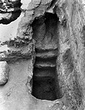
Bottle-shaped cistern with dumped fillings on NW slopes of Areopagus; appears not to have been finished in antiquity: the walls and floor show no traces of stucco.
Lower filling, ca. 375-340 B.C.
Upper ... Ca. 375-275 B.C ... Agora IV, p. 238 ... Agora X, p. 67 ... Agora XII, p. 390. |
| Although separated by a sterile rocky fill the two use fillings are apparently one continuous accumulation (GRE).
Packing around well includes SS 14261, P 25943-P 25953. These are not given a subdivision ... 350-300 B.C. to ca. 225 B.C ... Agora XII, p. 390 ... Agora XXI, p. 98 ... Agora XXIX, p. 451. |
The West Chamber of a double cistern lying between the northeast corner of the Theseion and the Annex to the Stoa of Zeus Eleftherios. ... Both chambers went out of use as water containers simultaneously ... 225-165 B.C ... Agora IV, p. 239 ... Agora X, p. 67 ... Agora XII, p. 390. |
A well on the NW slope of the Areopagus; unfinished well-shaft dug to a depth of only 3.05m., and refilled with broken pottery and other debris. The shaft clearly was begun with the intention of digging ... Ca. 520-480 B.C ... Agora IV, p. 239 ... Agora XII, p. 390 ... Agora XXI, p. 98. |
| Pit with burned debris north of the ancient road leading from the Agora to the Dipylon Gate, probably to be associated with the Persian sack [deposit notebook]. Also includes a similar filling lying over ... Ca. 500-470 B.C ... Agora IV, p. 239 ... Agora XII, p. 390 ... Agora XXI, p. 98. |
Filling of early N-S road and related fills, in the area of the Geometric Cemetery south of the Tholos; various levels including plundered foundation trench.
For late, disturbed or uncertain levels over ... 7th-6th c. B.C ... Agora IV, p. 239 ... Agora VIII, p. 126 ... Agora XII, p. 390. |
| This filling is the largest deposit of its time found in the Agora. It may be compared with H 6:5 and with N 7:3.
Dug in soft bedrock to a depth of 11.40m; footholds cut on opposite sides of the shaft ... Ca. 490-450 B.C ... Agora XII, p. 390 ... Agora XXI, p. 98 ... Agora XXIII, p. 331. |
A cistern leading to the east of the road leading from the southwest corner of the market square. Filled all at one time, last quarter of 2nd. c. B.C. (nbp. 493).
Included are the Hellenistic finds from ... Late 2nd c. B.C ... Agora IV, p. 238 ... Agora XII, p. 390 ... Agora XXIX, p. 450. |
The East Chamber of a double cistern lying between the northeast corner of the Theseion and the Annex to the Stoa of Zeus Eleftherios. ... Both chambers went out of use as water containers simultaneously ... Ca. 200 B.C ... Agora IV, p. 239 ... Agora X, p. 67 ... Agora XII, p. 390. |
| Second century B.C. fill with early 13th c. A.D. fill in mouth.
The Byzantine objects from the mouth are P 13713-P 13718, L 3585.
Lower fill contained bones of many infants and dogs.
The bones from this ... Mid-2nd c. B.C ... Agora XII, p. 390. ... Agora XXII, p. 100 ... Agora XXIX, p. 452. |
Well at 20/ΙΔ.
No POU fill. Bottom packed with sherds, including roof-tile fragments. Above this, were six meters with a "fair quantity" of sherds; then the top meter and a half contained a great quantity ... Ca. 420-390 B.C. |
Cistern at 9/Β (10/Β on plan), at the NW foot of the Areopagus, some 200m to the west of the Coroplast's Dump. It had evidently belonged to one of the small houses in that thickly populated residential ... Second half 4th c. B.C ... Agora IV, p. 238 ... Agora X, p. 67 ... Agora XII, p. 390. |
Perhaps originally a grave cutting ... Ca. 390-380 B.C. |
| A cave-in not long after the digging of this shaft destroyed its possible usefulness as a well and thereafter it was used as a dump. Two principle periods of such use were noted, and within these several ... Ca. 575-480 B.C ... Agora IV, p. 239 ... Agora X, p. 67 ... Agora XII, p. 390. |
Water deposit in Polygonal Drain (43-44/Γ-Ζ and martyra)immediately south of the south foundations of the Middle Stoa. Early branch of the original course of Great Drain. P 2248 added to this deposit by ... Ca. 420-390 B.C. |
Well on the lower north slope of the Areopagus. The pottery apparently belongs to a filling of one period, since it exhibited no marked difference in character to the bottom. No where was the deposit very ... Ca. 410-390 B.C. |
Well (stone-curbed shaft) near middle of Tholos which served the prior building.
Period of Use dated to ca. 500-480(?) B.C., Upper fill dated to ca. 480-470 B.C. or soon after in Agora XXX (a gradual ... Ca. 500-480 B.C ... Agora IV, p. 239 ... Agora XII, pp. 390-391 ... Agora XXIII, p. 332. |
A well about 2.00m. SE of the Tholos precinct wall. The presence of the water-clock strengthens the probability, suggested by its location, that the well served one of the public buildings in the neared ... Ca. 410-390 B.C. |
West Terrace, South End, Layers IV and V. Heavy dumped filling associated with terrace walls at the extreme south end of the excavations in the Areopagus industrial area. The proportion of figured and ... Ca. 420-390 B.C. |
Square pit in bedrock southwest of the Hephaisteion. Many marble chips from the construction of the temple of Hephaestus were found here together with a large quantity of pottery and other objects ... Ca. 450 B.C.
Ca. 390-380 B.C. |
Well in house R of industrial area west of the Areopagus. This well, originally tiled, was abandoned and filled at the time of the conversion of the house into a stone-cutters' workshop.
Tiled well but ... Ca. 425-400 B.C. |
|
|