|
|
Filling in Classical Floor of Agora, to the north of the Temple of Ares; possibly a disturbed pyre ... Early 4th c. B.C. |
Cistern System #1e: Shaft at 11/ΞΑ.
Agora XXIX: "Well (not cistern shaft, as in Agora XII) ... Communicates with water system through small hole (see C 8:1) probably fortuitously. Single fill, mostly of ... 350-300 B.C ... Cistern System #1e: Shaft at 11/ΞΑ.
Agora XXIX: "Well (not cistern shaft, as in Agora XII) ... Communicates with water system through small hole (see C 8:1) probably fortuitously. |
| Eugene Vanderpool Homer A. Thompson ... Mycenaean Tomb to NW of Pier 19 (Burial 7).
The chamber was roughly square in shape (2.70m wide by 2.10m deep), oriented northeast to southwest across in transverse axis. The entrance was at the northwest ... Myc. II-IIIA:1 |
Child's Chamber Tomb opposite piers 16-17.
Miniature chamber tomb complete with a dromos and a door closed with stones, but with a chamber measuring only 0.50m by 0.70m and just large enough to contain ... Myc. III B |
Hephaisteion Garden; fill beside wall. Loose filling encountered in rescue excavation to examine wall found during construction of public toilet in Theseion Park, outside Agora area. SIR 1991
Originally ... Second half of 4th c. B.C. |
| Disturbed Mycenaean chamber tomb.
It was the first Mycenaean burial found in the Agora. It is situated about 20m due south of Tomb VII, only a few meters beyond the south edge of the Augustan foundation ... Myc. IIIA (1st half of 14th c.) |
Listed in nb. as 15/ΞΤ. Pit with bronze casting debris ... To 3rd quarter of 5th c. B.C. |
Well on Slopes of Kolonos, apparently with two periods of active service. The earlier dating from ca. the turn of the era well down into the 1st c. A.D. Probable that the well was never cleaned out in ... POU Early to second half 1st c. A.D. |
Cistern System #1b: Shaft/manhole and gallery at 18-19/ΞΑ-ΞΓ.
Objects divided between the two features, shaft and gallery, according to deposit notebook list, not according to remarks on cards. 22 February ... Late 1st c. B.C.-early 1st c. A.D. |
Narrow trench in bedrock. Cf. Section Σ, p. 4358 (nb. XXII) same trench, same filling.
EV notes that the cutting probably.. to the "narrow cutting in bedrock". The filling seemed to be ca. 425-420 B.C ... Third Quarter to Last Quarter of 5th c. B.C. |
Building Fill NE of Circular Building 13-17/ΚΓ-ΚΣΤ (Roman Group H)
and Connecting Cut NE of Circular Bldg ... First half 2nd c. A.D. |
Well at 19/Λ.
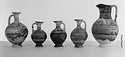
The bottom of this well contained a considerable quantity of dug bedrock which had fallen in before the well came into use; over this was a fill with oinochoae representing the POU. The presence ... 340-325 B.C. |
Pit in deep depression in bedrock. Also includes containers from early fill under late Roman floors down to bedrock at 81-83/ΚΗ-ΛΒ. Notebook cites early fill, ca. 6th. c., with some obviously late disturbance ... 7th c. to ca. 575 B.C. |
Filling around rubble wall (35/ΚΕ). It contained a mass of pottery, most of it uninventoried ... Ca. 425-400 B.C. |
Pit 2 in Grave area. Small deposit in a pit; a fragment of a red-figured nuptial lebes recalls the early Kerch style of the second quarter of the 4th c.; the deposit as a whole runs somewhat later ... Ca. 375-315 B.C. |
Deposit associated with early walls West of the Stoa of Attalos ... Late 5th c. B.C. (?)- early 4th c. B.C. |
A fair-sized pit in bedrock in Stoa Terrace opposite Pier 18, which contained a good deal of pottery mostly coarse. A little additional material as late as second quarter 4th. c. B.C ... Ca. 425-400 B.C. |
A well toward the south end of Kolonos Agoraios. Period of use fill dated to ca. 325-260 B.C. and upper fill dated to ca. 250-225 B.C. in Agora XXX.
Diameter 1.10m, water level 6.90m.
Kernoi and many lead ... Ca. 325-260 B.C ... Period of use fill dated to ca. 325-260 B.C. and upper fill dated to ca. 250-225 B.C. in Agora XXX.
Diameter 1.10m, water level 6.90m.
... Coins:
30 March 1937 #1
31 March 1937 #1-#4
1 April 1937 #1
2 April 1937 #1
12 May 1937 #1
28 May 1937 #29
5 June 1937 #1-#2
8 June 1937 #2
10 June 1937 #1-#2 |
Mycenaean Grave W. of Circular Building. Measuring 1.40m by 0.55m and it was covered with a few rough stone covering slabs, under which lay the skeleton of an adult with the head to the north and the knees ... Myc. III A2-B |
Great Hole at 33/Ζ = Area of early wells Some of the objects may have come from N 18:7 or from a neighboring 7th c, well, not separately cleared, but no definite association is possible ... 7th-5th c. B.C. |
Well, unfinished?
The shallow depth, small diameter, lack of water and any use fill make it possible that this was not a well, although the character of the cutting is difficult to explain otherwise. The ... Ca. 440-420 B.C. |
In "Ballot Box" ... Late 4th-early 3rd century |
Well at 19/ΚΔ, beneath the west colonnade of the Square Market Building in the northeast corner of the Agora. Diameter ca. 1.25m. Water level ca. -3.50m. The construction of the well was rather careless, ... Ca. 580-560 B.C ... Hesperia 8 (1939), p. 212 ... Agora IV, p. 244 ... Agora XII, p. 397. |
Narrow trench in bedrock; one section found to NE of Circular Building west of the Stoa of Attalos, another (Q 8:1) beneath the terrace of the Stoa of Attalos opposite Pier 19. A single filling in both ... Ca. 450-425 B.C. and shortly after |
Well behind Stoa Shop 18 (Well G: EB). Provides useful antecedents for many later shapes both black and plain.
Diameter at bottom 0.88m. Eight pairs of footholds preserved. The influx of water during excavation ... 650-625 B.C |
(now O 9:1) Asterisk: O 8:6* |
PG Well opposite ΣΑ Pier 18 Container 1, chiefly 6th c. B.C. discarded. Estimated Grid ... Protogeometric-Early Geometric |
Geometric Well under Rubble Wall of Predecessor.
Classical pit above a Geometric well with a small amount of pottery from the late 6th to the middle of the 4th c. B.C. Estimated Grid ... Late 8th century B.C. |
The following objects may be from this level or from the 'Mixed Classical Level at 10/Δ: SS 449, SS 450, SS 451 (nbp. 186, 2819). Coins:
4 March 1933 #1-#6 (cf. #7-#13)
7 March 1933 #39 ... 150-86 B.C. |
| Pit (f) in bedrock used for casting archaic bronze statue for the first Temple of Apollo Patroos (Hesperia 6 (1937), pp. 82-84) ... 6th c. B.C. |
Pocket in wall of Turkish bothros. The uninventoried material includes along with earlier pieces, the fragment of a bolsal very close to those from the well R 13:4 ... 450-425 B.C. |
The Tortoise's Grave.
Small deposit in the lower part of a wine-jar (P 21715) set down into the filling of a pit of the archaic period (O 7:9).
Contains tortoise shell ... 425-400 B.C. |
Hole in bedrock; small amount of debris filling ... Last quarter 5th c. B.C. |
Cistern C (pit) in West Room of late Roman House.
Mixed dump of material, with a little Classical, much Roman dating at least as late as 3rd century A.D., and large amount of late Hellenistic. Coins:
1 ... Late Hellenistic and Roman |
Rectangular pit (in Trench IX); dumped filling of late 5th. c. B.C. with some disturbance as late as Early Roman. P 18559 and P 18510 from above this pit ... 5th c. B.C. |
Well at 22/ΚΓ. Diameter 1.05m Coins:
7 June 1938 #7-#10 ... Early Byzantine |
Mycenaean Pit (Bothros?) opposite Pier 17.
Diameter at top 1.30m Estimated Grid ... Mycenaean IIIA:2-B |
House N, Room 4, Pit through layers 5-6. Debris filling, mixed context. Estimated Grid ... Late 4th. c. B.C. into early 3rd c. B.C. |
| Eugene Vanderpool ... Mycenaean Grave under Stoa Terrace, at original north end of Stoa; and PG vases on patches of stones over this burial, and to NE (formerly P 8:7). Cf. Q 8:13. No remains. In some records as Grave XLV ... 1 December 1953 |
Well 8 (in Tholos), put out of use by a fall of the rock walls and replaced by well G 11:3. Scanty use filling at and near the bottom, separated by a mass of fallen rock from a debris filling in the upper ... Ca. 550-500 B.C. and 480 B.C. |
Well at 73/Μ on the lower northeast slope of the Areopagus.
Diameter of 0.90m. It seems to have been abandoned because of the very soft stereo that kept falling in from all sides. Many pieces of terracotta ... Ca. 430-420 B.C. |
Well, neatly stone-curbed to bottom. Diameter 0.70m. The use filling, from about 3.50m to bottom, consisted chiefly of water-jars with a few small vases and some black-figured fragments.
Upper filling, ... Use filling of ca. 575-550 B.C. |
Well L.
Use filling and well-head; abandonment filling chiefly of mud and stones, with a scattering of pottery ... ca. 575-550 B.C.-To early 5th c. B.C. |
A strosis into which were set the foundations of house of 7th c. B.C. to SE of Tholos (=Building A and Trench W, layers h + i) ... 8th-7th c. B.C ... Hesperia Suppl. 4 (1940), pp. 3-8 ... Agora VIII, p. 128 ... Agora XII, p. 392. |
| Homer A. Thompson ... PG grave to NW of Pier 19 (Grave 4).
It consisted of a rectangular pit, oriented north-south, cut into bedrock. Only the lowest part of the tomb pit was preserved; the upper part was cut away in the Classical ... Earlier-Developed Protogeometric |
This shaft in the NE corner of House A, Room III, depth of one tile, is perhaps connected with drain A. Coins:
13 May 1940 #1-#13
14 May 1940 #2-#101 ... Early 3rd. c. B.C. |
Investigations in the Hellenistic Metroon, various levels. Stoa Pits A, B, C, D, E, F, H and I (various layers).
Locations include:
SW corner of Primitive Bouleuterion; from contemporary filling alongside ... 8th-6th c. B.C ... Hesperia Suppl. 4 (1940), pp. 8-15, fig. 9 ... Agora IV, p. 241 ... Agora XII, p. 392. |
| Mycenaean Tomb to NE of Pier 19 (Burial #1)
Most of the doorway and the dromos had been cut away by the ancient Stoa builders. The dimensions of the chamber were 2.90m wide by 1.60m deep. Unusual features ... Myc. III A:1 |
| Margaret Crosby ... Grave, disturbed.
Rectangular cutting in bedrock 1.70m long and 0.60m deep. The north half was cut away by a modern cellar wall and only 0.20-0.10m of fill was left. A the bottom there was a thick layer ... 510 - 490 B.C ... Hesperia 8 (1939), p. 215 ... Agora XXIII, p. 334. |
Eugene Vanderpool Homer A. Thompson ... Mycenaean burial (no offerings) in NW corner of Stoa Terrace (original north end).
" It consisted merely of an adult skeleton lying in an extended position with head to east and the left leg slightly flexed ... Mycenaean or Protogeometric |
Well on the north slope of the Areopagus. Unfinished, probably because of hardness of rock, and refilled at once, perhaps with sanctuary dump and with collapsed rock from the shaft itself.
Diameter 1.15m ... 3rd quarter of the 7th c. B.C. |
| Homer A. Thompson ... PG grave to NW of Stoa Pier 19 (Tomb no. 5 in notebook). In some records as Grave XLII.
It consisted of a rectangular pit, oriented north-south, cut into bedrock. The sides of the pit were lined and the ... Earlier-Developed Protogeometric ... The skeleton of a child (7-8 years at death) was found on its back in a fully extended supine position, head to the south, filling the cist almost entirely. ... This grave is exhibited in the Agora museum. |
| Mycenaean Double Grave (Graves A and B).
Grave A was in Layer II. We laid a skull and a few other bones, three vases and a stone bead. We have dug to a maximum of about 0.06m below the top of Layer II ... Myc. IIIA/B |
| Homer A. Thompson ... PG grave north of Stoa Pier 19 (Grave 6). In some records as Grave XLIII.
Unlined rectangular pit cut into a shallow depression in bedrock that was formed by the collapse of the roof of Mycenaean Chamber ... Developed Protogeometric |
Cistern System #1a: Shaft (Manhole) at 10/ΞΗ (10-11/ΞΖ-ΞΗ). Filling consistently late Hellenistic in hole and in passage; probably 1st c.
B.C. Coins:
26 May 1936 #1 ... 110-75 B.C. |
| Dorothy Burr Thompson ... Grave 14 in notebook. Cutting in bedrock. Cremation: bones in pit (E.L. Smithson: Grave XXIV: PG). Bones discarded.
[JP] Nb. says at 16-17/ΞΖ and 16/ΞΖ on cards and on deposit list.(SD) ... Early Geometric I |
| Homer A. Thompson ... Grave XIII in notebook. Cutting in bedrock. One skeleton. Bones discarded. No offerings.
JP ... LH III/EPG (date uncertain) |
| C.G. Thomas ... Geometric grave. Bones discarded.
Tomb located about 2m west/west-southwest of the EG1 child inhumation, beneath the restored line of a hypothetical wall connecting the western "apse' and the south wall ... Middle Geometric II |
| Grave 1 in notebook (E.L. Smithson: Grave XXV: PG). No remains. Probable trench-and-hole.
JP
Roughly circular pit measuring 0.39m in diameter cut into bedrock to a depth of 0.72m. Pyre refuse-described ... Late PG/EG I |
Well in Marble-Saw Shed. No distinct use filling. Estimated Grid ... Submycenaean |
| Cistern and well in Marble Worker's House. Coins:
5 August 1968 #1-#6 (#5 and #6 disintegrated. Missing 19/7/1973)
6 August 1968 #1bis-#25 (#5 in Lot 503 not a coin but bronze bits of nail. #6 not a coin ... 325-275 B.C. |
Disturbed burial set into a cutting in hardpan. No lot ... 2nd half of 5th c. B.C. |
Mycenaean Chamber Tomb W. of Circular Building (at Σ:30/ΛΕ?)
It had been badly disturbed by a fourth-century B.C. pit which cut into the northeast part of the chamber (rectangular, ca. 1.80m by 1.30m) ... Myc. III A 2 |
| Pit and drain at SE corner of Apollo Temple. Antedates building of Apollo Temple which was assigned to a date 'late in the third quarter' ... 3rd quarter 4th c. B.C. |
| Rebecca Wood Robinson ... Mycenaean Grave C. Lisa's list mentions also Grave D ... Myc. IIIA 1:2 |
| Mycenaean Grave F.
It seemed to be more as a collection of bones and offerings, presumably swept aside to make room for later burials; they are east of and slightly higher than children's graves A and ... Myc. IIIA |
| Eugene Vanderpool ... Infant grave near Phaidon street cistern. No offerings.
Roughly rectangular, almost elliptical cutting in bedrock, measuring 0.70m long, 0.35m wide, and 0.40m deep, oriented south-southwest to north-northeast ... Late Helladic III C/Early Protogeometric (date uncertain) |
| Dorothy Burr Thompson ... Grave 16 in notebook. Adult skeleton.
In some records as Grave XXXIII (JP) ... Middle Geometric I |
| Sacrificial pyre in Poros Building, NW Room (RSY= Pyre 1).
Against east wall of room 5 west. artifacts, bone, carbon and ash in pit in floor sequence. the pyre lay below a floor covered with marble dust, ... Middle of 4th c. B.C. |
| Grave 7b in notebook. Inhumation in Tholos Cemetery; The skeleton positioned directly below the male in Grave 7, but with direction reversed, i.e., head at southeast end. Most grave offerings at lower ... 750-725 B.C ... Hesperia 14 (1945), pp. 305-307, no. 83, figs. 7, 8, pl. LIII (Grave XX) ... Agora VIII, p. 127. |
Filling over Floor of Square Peristyle (beneath Stoa).
122 stamped amphora handles. Many parallels with handles from cistern M 21:1. Latest coin dates ca. 200. latest lamp types 33 A and 34 A. Fragment ... 200 B.C. |
Well by Stoa Pier 8.
Mouth of well discovered in 1950 (p. 2287).
Dumped filling in the 4th c. B.C. but the bulk of the material of the 5th c. B.C. Fill contained much wood, bones, Mycenaean, Geometric, ... 5th c. B.C ... Well by Stoa Pier 8.
Mouth of well discovered in 1950 (p. 2287).
... ; 2 one-handlers 9for one, cf. Agora XII, no. 755, first to second quarter of 4th c. ... B.C.); fish-plate (Cf. Agora XII, no. 1070); lamp (Howland Type 21B).
|
Two chambers connected by a tunnel, all filled at the same time, but with slight Hellenistic disturbance. Chamber A, to west at 14/ΛΗ, B to east at 14-15/ΛΒ on grid for section RR.
Cistern system ca. 20.00m ... Ca. 325-275 B.C. |
Accumulated debris on the west side of the market square.
Related layers added 1999/2000 (JWH), e.g. "Gravelly layer above burning", "Clearing Classical floor", "Lowest level above bedrock", "Below burning", ... First half of 5th c. A.D. |
Well 8: Archaic. On the northwest slope of the Acropolis.
Depth from surface of rock, -16.10m.
Diameter top ca. 0.90; bottom ca 0.80m. Water level, ca. -9m ... Late 6th - early 5th c. B.C ... Agora IV, p. 245 ... Agora X, p. 68 ... Agora XII, p. 399. |
Classical Pit under Rubble Wall of Predecessor of Square Building and above Geometric Well (Q 8:9) |
| Marcie Handler ... The Pyre was revealed in a layer of 4th c. fill in the north end of Room 6, just south of Wall 8. Room 6 is defined by the street wall (Wall A) on the west, Wall 7 on the east, Wall 9 on the south (preserved ... 4th c. B.C. |
| David Scahill ... Protogeometric/Early Geometric well under floors in Room 1, Classical Building II, on north side of south ashlar wall. See J 3:9 for the burial within this well.
Cf. Hesperia Suppl. 50 (2018), p. 106, ... 27 June 2001
17 July 2002 |
| Eugene Vanderpool Homer A. Thompson ... Mycenaean Grave to W. of "Court Room" below Stoa Terrace with "Ballot Box" (Grave XXIX).
Unusual type, conforming neither to our pit nor to our cist graves, and consisted of two parts. The outer part was ... Mycenaean III A-B |
(now Q 8:12) Asterisk: P 8:7* |
(see P-Q 7-8:1) Asterisk: Q 8:2* |
(cancelled) Asterisk: R 8:1* |
(see H 5-6) Asterisk: H 6:8* |
(now R 9:3) Asterisk: O 8:2* |
*Merged with A 20:7. Asterisk: A 20:8* |
Well through foundations of Altar of Ares. Coins:
8 June 1950 #1 ... 8 June 1950
1-15 June 1951 |
| Child burial at SE corner of original North Extension of Stoa Terrace.
A tiny skeleton.
No furniture. See neg LXV-55 and ΣΑ 749.
Bones not found (2022) ... Mycenaean(?) |
Pit in Road at 52/ΚΖ-ΚΗ Coins:
11 March 1938 #10-#17
12 March 1938 #1-#6, #88-#93
14 March 1938 #8-#10
15 March 1938 #21-#23 Herulian? ... Roman |
Grave in south peristyle of Hephaisteion. Grave LXV in notebook. Coins:
13 March 1939 #24
14 March 1939 #8 (Vandal, not kept?) Notebook says: wall of LXIV rests on bones.
Neg. KK 396 ... 13-14 March 1939
16 March 1939 |
| Grave in south peristyle of Hephaisteion. Grave LXVII in notebook.
Crammed with bones (13 skulls): osteotheke. Coins:
13 March 1939 #26-#27 Neg. XV-86 ... 13-14 March 1939 |
Debris, Room I of Street Stoa (R/16,20-13/10,15).
The lack of any rooftiles and similar architectural debris suggests that perhaps it was brought in from an adjacent area and dumped in the room. This is ... 6-8 May 1975 |
Pit (e) in bedrock between Temple of Apollo and Metroon. Not A. Walker coin deposit ... 10 March 1936 |
| Contents of Pithos Y; probably belonging to sacrificial pyre III.
In northern corner of courtyard. Characteristic pyre pottery in fill of one of two pithoi set into the floor of the courtyard as part ... 400-350 B.C. |
Grave 15 ... Dark Ages - Byzantine |
On and over poros water channel (area of Room XX) ... 450-425 B.C. |
Grave in south peristyle of Hephaisteion. Grave LXIV in notebook.
No mention of bones. Coins:
13 March 1939 #21-#23
14 March 1939 #7 Neg. KK 395 ... 13-15 March 1939 |
Grave south of Hephaisteion, in Byzantine cistern. Grave III in notebook. Disturbed. One skeleton ... 30 March 1936 |
|
|