|
|
Pit in Bedrock South of Large Monument Base, just West of the Stoa of Attalos ... First half of 6th c. B.C. |
Archaic Pit at 25/ΙΓ, near the northeast corner of the market square. Filling in upper part of shaft, cleared only to a depth of 3.10m because of rock conditions ... 600-550 B.C. |
A large chamber cistern filled in the second c. BC when a well (C 9:16) was dug through its floor. Well tiles were run up from the floor of the cistern to just below its neck; a double layer of complete ... Late 2nd c. B.C. |
Grave in north peristyle of Hephaisteion. Grave XXXII in notebook.
Loose earth and bones filling. Coins:
25 February 1939 #5-#6
6 March 1939 #2-#4
15 March 1939 #1 Neg. 378 ... 25 February 1939
6 March 1939 |
Grave in west peristyle of Hephaisteion. Grave XLIII in notebook. No mention of bones; pottery Turkish. Coins:
8 March 1939 #21 ... 11 March 1939 |
The Tortoise's Grave.
Small deposit in the lower part of a wine-jar (P 21715) set down into the filling of a pit of the archaic period (O 7:9).
Contains tortoise shell ... 425-400 B.C. |
Exploration of area of small early house walls on the NW slopes of Areopagus. Considerable deposits of late 6th-early 5th c. B.C., but some later (all periods) and some early levels, disturbed.
Objects ... Late 6th-Early 5th c. B.C. |
A burnt deposit set down into Hellenistic fill in a shaft dug into bedrock. A consistent dumped fill [post AD 150, with Group G, layer III, JWH]. Coins:
27 January 1936 #1-#3
28 January 1936 #1-#7
29 January ... First half of A.D. 2nd c. |
Cistern System #1f: Shaft at 1/ΝΘ = Well A. Scanty dumped filling. Coins:
19 February 1936 #2-#3
20 February 1936 #16-#20
21 February 1936 #5-#7
22 February 1936 #1 ... Mid-4th to 3rd c. B.C. |
Layer 7 in South Peristyle of court of Roman House Ε. Irregular cutting in bedrock with sand, gravel, fallen bedrock. Some burning ... 275-250 B.C. |
Well cut through cistern at 6/ΝΕ (C 9:7).
The stele I 3244 in position in the cistern over the mouth of the well is listed with the cistern deposit C 9:7. Coins:
26 February 1936 #2-#4
27 February 1936 ... A.D. 1st |
Part of cistern system with mouths at 47/ΛΒ, 60/ΜΖ and 51/ΜΓ.
Last 1.50m. of 47/ΛΒ probably cut in modern times, contained modern fill in bottom. Coins:
10 March 1934 #2-#7
12 March 1934 #9-#14
16 March ... Hellenistic and modern. |
Well on south slope of Kolonos Agoraios. Stratified deposit. Coins:
8 May 1937 #3
14 May 1937 #1
Coins from dump:
27 May 1937 #2-#9
28 May 1937 #3-#11 Subdivisions:
.1=16.00-17.00m.
.2=17.00-18.00m.
.3=18.00-19.00m ... 3rd. c. B.C.-3rd. c. A.D. |
| Rodney S. Young ... Destroyed urn cremation. No remains. Originally assigned as part of Tomb C 9:14 (Grave 7)
JP
"Large fragments of an urn were found in the packing of a Hellenistic water channel which cut through a LPG ... Final Mycenaean/Submycenaean ... Originally assigned as part of Tomb C 9:14 (Grave 7)
JP
"Large fragments of an urn were found in the packing of a Hellenistic water channel which cut through a LPG burial area and obliterated the urn and urn-hole of LPG grave C 9:14." ... P 6723, although surely an urn, rust-stained inside from the iron jewelry and within a meter of Grave C 9:14, is much earlier than the offerings in that grave and must have come from still another burial trench in the line of the water channel; a narrow burned strip along the edge of the channel opposite the fragments may be part of that trench.
Cf. Agora XXXVI mentions (p. 298) as part of Grave 5 (should read 7) |
Grave in west peristyle of Hephaisteion. Grave XXXVI in notebook. No mention of bones. Coins:
7 March 1939 #1-#6 Neg. KK 355 ... 7-19 March 1939 |
It seems likely that the well was never used due to poor quality of rock. Uniform fill of collapsed bedrock ... 650-625 B.C. |
8/ΛΘ to 14/ΛΒ. Coins:
12 February 1932 #2-#3, #13-#14, #25-#28
13 February 1932 #8, #31-#33
15 February 1932 #7-#12, #13-#27, #28-#42
16 February 1932 #5-#10 ... Late Roman- Ca. A.D. 520-540 |
Grave in cella of Hephaisteion. Grave XLVI in notebook. No mention of bones. Coins:
9 March 1939 #1-#4 ... 8 March 1939 |
| Grave in opisthodomos of Hephaisteion. Grave XLIX in notebook.
No mention of bones. Coins:
9 March 1939 #8-#13 Neg. KK 365 ... 9 March 1939
16 March 1939 |
Grave in north peristyle of Hephaisteion. Grave LX in notebook.
No mention of bones. Coins:
11 March 1939 #9-#11 Neg. 397 ... Byzantine |
Two periods of use.
Outside the SW corner of the market square, to the west of the north-south road; lower use of filling, of 1st to early 2nd c. A.D. Coins:
26 May 1937 #1 [to 8.30m.]
9 June 1937 #2-#4 ... 10 -11 June 1935
20 May-20 June 1937 |
Accumulated debris on the west side of the market square.
Related layers added 1999/2000 (JWH), e.g. "Gravelly layer above burning", "Clearing Classical floor", "Lowest level above bedrock", "Below burning", ... First half of 5th c. A.D. |
| Grave in opisthodomos of Hephaisteion. Grave LIII in notebook.
No mention of bones. Coin
9 March 1939 #16 Neg. KK 361 ... Turkish |
| Grave in west peristyle of Hephaisteion. Grave XXXIX in notebook.
No mention of bones. Coins:
7 March 1939 #12-#13
8 March 1939 #4-#5
10 March 1939 #3-#9 Neg. KK 367 ... 7-10 March 1939 |
"Red Fill" (extending to bedrock or near, over most of area). Mainly first century after Christ with later disturbance. Coins:
17 April 1936 #10-#13
18 April 1936 #1
20 April 1936 #13-#17
21 April 1936 ... 1st-2nd c. A.D. |
| Grave in opisthodomos of Hephaisteion. Grave L in notebook. Coin
9 March 1939 #14-#15 Neg. KK 364
Cf. container K 464 (under Grave L) ... 16 March 1939 |
Grave in south peristyle of Hephaisteion. Grave LXVI in notebook.
Burned layer with bones, skulls. Coins:
13 March 1939 #25
14 March 1939 #9-#10 Neg. KK 394 ... Byzantine |
| Grave 8 in notebook.
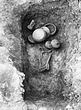
Inhumation in Tholos Cemetery. Length of shaft 1.75m; Width at upper end 0.95m; Depth from cover 0.70m.
One end cut into sloping rock.
Skeleton of a woman, with head southeast. Most ... 750-725 B.C. |
Part of cistern system at 94/Θ. Coins:
12 March 1934 #7-#9
14 March 1934 #38-#41 ... 275-200 B.C. |
| Pyre in layer 8a in SW corner of Room 7 of Greek House δ.
Oval pyre; 0.60 (n-s)x 0.35 (e-w).
The pyre was covered by the surface of layer 8 and extended slightly into layer 9 below it. Small bone fragments, ... 325-300 B.C. |
Foundry dumps north of Church of Holy Apostles. Coins
27 March 1952 #3-#6
28 March 1952 #1-#3
29 March 1952 #1-#7
14 April 1952 #15-#17
15 April 1952 #7
22 April 1952 #5-#6
29 April 1952 #1
9 May 1952 ... |
Cistern (diameter 0.90m) with two channels; the fill of the cistern proper, below the scant upper (Byzantine) deposit, appears to have been dumped all at the same time, to 325-275 B.C. Notebook says "all ... 325-275 B.C ... Hesperia 53 (1984), pp. 343, 347, 349, pl. 16:7, 7-9 ... Agora XII, p. 387 ... Agora XXIX, p. 442. |
| Sacrificial Pit II in notebook = RSY Grave 7 ... Ca. 540 B.C ... Hesperia 20 (1951), pp. 89-90, pls. 40 b (Grave 7) ... Hesperia 9 (1940), p. 304 and fig. 44 ... Agora XXIII, p. 330. |
The following objects may be from this level or from the 'Mixed Classical Level at 10/Δ: SS 449, SS 450, SS 451 (nbp. 186, 2819). Coins:
4 March 1933 #1-#6 (cf. #7-#13)
7 March 1933 #39 ... 150-86 B.C. |
| Hellenistic filling in N.W. corner of Section (39-46/ΙΘ-ΚΓ inclusive). Coins:
14 July 1931 #42, #64
15 July 1931 #6 but grid 42/ΚΔ, #34-#37
16 July 1931 #15-#16
17 July 1931 #4-#12
18 July 1931 #1-#5, ... 4th.-early 2nd. B.C. |
Cistern A for 1935 (there is another Cistern A, for 1936, D-E 8-9:1) Coins:
16 May 1935 #4-#5
17 May 1935 #1-#2
18 May 1935 #1-#2
20 May 1935 #1-#2
22 May 1935 #1
23 May 1935 #2-#6
24 May 1935 #1-#7
25 ... 16-25 May 1935
6 February 1936 |
Cistern in valley west of the Areopagus. Dumped filling of late 1st. to early 2nd. c. and of 5th to 6th century. Coins:
7 June 1939 #12
8 June 1939 #18-#19
9 June 1936 #26 ... 1st.-2nd. c. A.D. |
Primarily late Roman material but some scrappy early Roman. Coins:
5 March 1934 #1-#4
6 March 1934 #1-#3
7 March 1934 #1-#2
8 March 1934 #1-#4
9 March 1934 #1-#4
10 March 1934 #1 ... Ca. A.D. 350 dumped fill |
Baskets 1-21 (containers 1-20). The following objects, although listed in deposit notebook as being from level .1, are from depths within the .2 range:
MC 318, MC 433-MC 437, T 1309, T 1394, T 1396, IL ... 110 to early 1st c. A.D. |
Dumped filling of 6th c. A.D. Coins:
3 May 1939 #1-2 (red earth above well)
9 June 1939 #1
10 June 1939 #1
12 June 1939 #1-#5
13 June 1939 #1
19 June 1939 #1-#2, #3 (Dump)
7 May 1940 #1
9 May 1940 #1
27 ... Early 1st-5th c. A.D. POU |
Well-shaft abandoned before use because of crumbling of rock.
From top to 15.00m. a dumped fill predominantly early Roman but containing material of late 1st c. B.C. to mid-1st c. A.D. A rock filled shaft ... 1st c. B.C. to mid-1st c. A.D. |
South House, Room 12, over pebble mosaic floor. Herulian destruction debris in a house. Coins:
29 April 1956 #1-#7
2 May 1956 #1-#3
9 May 1956 #1
26 May 1956 #1-#4
2 June 1956 #1-#4 PD 1350 ... 9 May 1956 |
Roman Water Mill: construction fill in footing trench of mill race wall Coins:
24 April 1933 #2-#30, #39-#40, #43-#44, #46-#67, #69-#76, #82-#95
25 April 1933 #30, #32-#35, #37-#40, #42-#43, #45, #47 ... 450-475 A.D. |
Hellenistic cistern, part of the same system as 94/ΝΣΤ (D 4:1) and connected with it by a passage. Later cleaned out for reuse and filled with destruction debris of the late 4th c. A.D. Coins:
23 March ... Second half 4th c. A.D. |
Cistern system, 88/ΝΓ (shaft and passages). Apparently a dumped filling of Roman times, drawn mostly from some Hellenistic deposit. Coins:
31 March 1937 #1-#5
1 April 1937 #4-#5
3 April 1937 #1-#2
5 April ... Hellenistic and Roman, 4th c. A.D. |
| Upper mixed dumped fill (last quarter 3rd c.-4th c.) with Roman POU below 10.40m. Coins:
16 February 1937 #1 (disintegrated)
17 February 1937 #1 (disintegrated)
8 April 1937 #5-#10 (dump)
9 April 1937 ... 2nd half of 1st c.-first half of 3rd c. A.D. |
Klepsydra: Pits or cuttings beneath Paved Court ... Mycenaean ... Hesperia 10 (1941), pp. 7-8 ... Hesperia 9 (1940), p. 7 ... Agora XIII, pp. 261-262, 275, pl. 64. |
Hellenistic-Early Roman fill over bedrock, along west side of Kolonos Agoraios. Consistent dumped filling; occasionally there is a late Roman fragment intruded from the filling above, but this seems not ... 26-29 February 1936
2-12 March 1936 |
Burnt Layer inside retaining wall of Middle Stoa Terrace (Θ) and NW Corner of Middle Stoa, burnt debris inside terrace retaining wall (Ζ). Coins Ζ: Coins Θ:
1 June 1951 ... Mid-3rd c. A.D. |
Dumped fillings thrown in during second quarter of 1st c. B.C. containing mostly debris resulting from Sulla's sack in 86 B.C.
Agora XXIX, p. 464: Four fills distinguished during excavations ... but seemingly ... Late 2nd c. and early 1st c. B.C. POU; 110-75 B.C ... B.C. containing mostly debris resulting from Sulla's sack in 86 B.C.
Agora XXIX, p. 464: Four fills distinguished during excavations ... but seemingly with no chronological differentiation (p. 580).
... Coins:
7 March 1938 #16-#17
8 March 1938 #23-#25
9 March 1938 #8
10 March 1938 #6-#17
11 March 1938 #3-#12
12 March 1938 #14-#29
14 March 1938 #7-#14
15 March 1938 #10-#11
10 May 1938 #1-#10 |
Roman Group L.
Layer I (cont. 59-64) Pre-Herulian second half of 3rd c. (bottom, 15.95-13.90).
Layer II (cont. 42-58) 4th c.-first quarter of 4th c. (11.90-13.90).
Layer III (cont. 17-41) -4th c. (10.00 ... Second half 3rd c.-early 5th c. A.D. |
Well near west edge of level area south of the Hephaisteion. Dumped filling thrown in near end of 4th. c. but by far the greater part belonging to the 30 years before 350 B.C.
Diameter of shaft 0.98m ... Ca. 380-350 B.C. |
See I 870, a piece of which was found in disturbed red fill in Β' southeast of Tholos.
Although apparently from the same context as P 5339 (tins 24-26, undisturbed fill), P 5336-P 5338 are recorded from ... 27 February-8 April 1935 |
Cistern with two fills. Lower fill in cone on floor, with dumped upper fill above. Coins:
27 April 1940 #3-#5
14 May 1940 #5-#6
15 May 1940 #3-#7
17 May 1940 #11-#13
20 May 1940 # 8-#9
21 May 1940 #1 ... Late Hellenistic |
Cistern connected by tunnel to another chamber filled in Byzantine period. Small Hellenistic deposit on floor. somewhat contaminated by Byzantine fill above
No stamped amphora handles later than 3rd c.; ... 250-190 B.C. |
Middle Stoa Building Fill (with filling to S) (See also Κ: H-I-J 14-15 and Λ: K-M 13-14)
This deposit is not definitive and must be considered with the above deposits before details are entered into database; ... To ca. 180 B.C ... Agora VIII, p. 129 ... Agora XII, p. 393 ... Agora XXII, p. 102. |
A cistern leading to the east of the road leading from the southwest corner of the market square. Filled all at one time, last quarter of 2nd. c. B.C. (nbp. 493).
Included are the Hellenistic finds from ... Late 2nd c. B.C. |
Cistern on the lower Acropolis slopes, west of Panathenaic Way; dumped filling of 1st century B.C.
Bottom diameter 3.90m. Cistern with connecting draw-shaft and a dead end tunnel dates from Late Hellenistic ... 1st century B.C. |
Fillings to either side of the Great Drain, in the southern part of the area west of the Areopagus; various levels, late 6th. and early 5th c. B.C. to Sullan destruction. Coins:
26 July 1946 #1-#2
30 July ... Late 6th. c. B.C.-1st. c. A.D. |
Pit at 18-20/Λ-ΛΓ.
The cistern S 19:3 and the well S 19:8, together with a Roman well, S 19:1, had collapsed to form a large pit S 19:5. The upper part of the pit was dug to a depth of ca. -8m as deposit ... 7-8 April 1938
28 April-26 May 1938 |
| Use filling of middle of 1st to late 6th c. (Roman Group M); dumped filling of 9th and 10th c. Down to a depth of about 21.00m. the fill of the well contained very few objects, the latest of them being ... 1st-6th c. A.D. |
House A destruction debris over floors. All floors (rooms 1-7) dug in 1939. Re-examination of House A in 1967 (nbpp. 648 ff.). Coins:
27 February 1939 #5-#9
7 March 1939: #1
9 March 1939 #4-#6
11 March ... First half 3rd. c. A.D. |
"Oinophorus Well".Tiled well in House H (diameter 0.80m, water level -4.70m). Height of tiles 0.64m Heavy well deposit; lamps,, type XXVII; many basket-handled water jars; oinophoros with labors of Herakles ... Use filling of early 2nd-mid.-3rd c. A.D. |
Part of the cistern system 44/ΙΓ - 46/ΙΑ - 42/Θ.
Objects with context as "cistern 44ΙΓ, mouth of 46/ΙΑ" are listed with D 12:2.
The following objects are from "earth", i.e. no context layer:
SS 5334, ... Late Hellenistic-Early Roman |
| Grave V in notebook = RSY Grave 5. PD 731-c, Ptg. 244 ... Second quarter of the 6th. c. B.C ... Hesperia 20 (1951), pp. 88-89, fig. 7 and pls. 38 f, 39 a (Grave 5) ... Hesperia 9 (1940), p. 303, fig. 43 ... Agora XII, p. 385. |
| In area West of the Areopagus. Fills with many figurines and molds, possibly from a terracotta factory.
Twelve stamped amphora handles; no long-petal bowls; Type 54 A lamp Coins:
31 May 1939 #11
1 June ... Mostly 200-150 B.C. |
| Pit, partly cleared; dumped filling of first half of 3rd. c. B.C., but with considerable material of the 4th. c. Hellenistic.
Its rotten schist walls collapsed some time near then and it was filled up ... 4th-3rd c. B.C. |
| Extract from notebook ΠΘ XIX, pp. 3644-3646. Well at 105/ΝΗ (report on sorting of pottery, July 19, 1951 - H.S. Robinson).
"Not a useful well" HSR.
Well dug to 1.50m., vi/9/36; dug from 1.50m. to bottom ... Early Roman; use fillings of 2nd. c. B.C. and 1st. and 4th. c. A.D.; dumped filling of late 4th. c. (HSR)
Fill I: 2nd. c. B.C.
Fill II-V: to second half of 4th. c. A.D.
Fill VI: mixed to Byzantine. |
A 3rd. c. B.C. cistern and an unfinished rectangular cutting of the 2nd c. B.C. which destroyed some of its upper part. These two features are combined in this deposit; the following objects are identified ... 3rd-2nd c. B.C. |
Great Drain South (ca. 70-113, from SW edge of section as far north as the Roman Bath) Hellenistic Sand Fill. Silted-up filling of the southern branch of the Great Drain, abandoned due to some damage at ... 4th. c.-86 B.C. |
West Road and Drain. (Road, drain and closely related cuts.) Packing in line of ancient road running along the northwest shoulder of the Areopagus. Includes excavation of 1957 titled "Road Area to North", ... Late 6th c. B.C. - Roman |
| Dorothy Burr Thompson ... Grave 2. Urn cremation (trench-and-hole). In some records as XXIII.
Variously labeled as grid 7/Δ, 7/Γ and 7/Γ-Δ.
Rectangular pyre trench cut through earth into bedrock, with only the lowest 0.04m surviving ... Transitional Late Protogeometric/Early Geometric I |
Fillings associated with early houses on the lower north slopes of the Areopagus; various levels and dates.
Both houses were built in the 6th century B.C. and destroyed by the Persians; both also have ... 6rd c. B.C.-3rd c. A.D. |
| Stucco-lined bottle-shaped cistern, with tunnel and subsidiary manhole, in SW Baths, Room Α 10. Homogeneous dumped fill, mostly of mold-made bowls and and molds for terracotta figurines. Sixteen stamped ... 225-190 B.C. |
Pit at 79-83/ΜΒ-ΜΖ (or 81/ΜΣΤ=pit under floor of Room 11 in Roman Bldg. 2, 82/ΜΓ, 83/ΜΕ=well at 83/ΜΗ). Purpose of pit obscure. Evidently filled in Hellenistic times and disturbed in Roman times. Coins: ... 275-200 B.C. with later disturbance |
Cistern at 9/Β (10/Β on plan), at the NW foot of the Areopagus, some 200m to the west of the Coroplast's Dump. It had evidently belonged to one of the small houses in that thickly populated residential ... Second half 4th c. B.C. |
Great Drain: fillings in south part of section; Martyrs I, II and III, all layers (essentially no difference in the layers).
Pottery sorted and recorded by H.A. Thompson 12 may 1950: "Having gone through ... Second half of 2nd c. B.C.-Early 1st c. B.C. |
Baskets 22-53 (containers 21-47). Abandonment of cistern. Includes finds from NW channel leading out of 84/ΝΣΤ (containers 50-51). The following objects, although listed in deposit notebook as being from ... 125-86 B.C. |
Evidence of stratification into five layers, although joins between the layers. Layer VI added when the construction of the Roman building above required it. No subdivisions assigned.
Flask-shaped cistern ... Early 3rd-late 2nd c. B.C. |
| Well in Room 6 of Street Stoa U/2,U/3-13/15.
Associated with the building lying under the Roman Street Stoa. Its fills divided into 5 separate layers, with the bulk of finds belonging to Layer 1, the ... 14 June-21 August 1973 |
| Herulian Debris in a house on the lower slopes of the Hill of the Nymphs: House P = South House; Room 2 = Dining Room; Room 3 = Kitchen; Room 18; Room 23; Room 24. Coins:
9 August 1947 #1-#37, #47-#49 ... Mid 3rd c. A.D. |
Hellenistic fill South of Middle Stoa near NW corner of Heliaea. This fill contained material later in date than that which made up the middle Stoa Building Fill.
Only the coins (and a few amphora handles ... To ca. 140 B.C. |
Filling of Middle Drain (Tr. H+F in Section Ζ). Sand and gravel filling of the old course of the west branch of the Great Drain, a large (ca. 1.00m. deep and 1.30m. wide) underground channel in the area ... 150-100 B.C. |
Cistern at the southeast foot of Kolonos Agoraios.
Nbp. 2369: Two chamber cisterns, 88/ΛΔ and 100/ΚΘ, united by a long straight passage running almost due N-S. A draw shaft at 95/ΚΘ is set just off the ... Use filling of late 4th-early 3rd c. B.C.
Accumulative fillings of late 3rd-early 2nd and late 1st c. B.C.
Upper dumped filling of 3rd c. A.D. |
|
|