|
|
Well C - Passage, belongs with II - Brick Shaft. All dumped fills. No objects catalogued from Well C of section ΟΑ. One object (I 5422) catalogued from modern fill in shaft, one from dump (I 5545). Coins: ... 2nd c. A.D.- Byzantine |
| Marcie Handler ... The Pyre was revealed in a layer of 4th c. fill in the north end of Room 6, just south of Wall 8. Room 6 is defined by the street wall (Wall A) on the west, Wall 7 on the east, Wall 9 on the south (preserved ... 4th c. B.C. |
Accumulated debris on the west side of the market square.
Related layers added 1999/2000 (JWH), e.g. "Gravelly layer above burning", "Clearing Classical floor", "Lowest level above bedrock", "Below burning", ... First half of 5th c. A.D. |
Well with 4th. c. fill, no well deposit at the bottom. Coins:
2 April 1936 #1
3 April 1936 #8-#19
4 April 1936 #11
8 April 1936 #3-#4
22 May 1936 #5
25 May 1936 #2
27 May 1936 #2
28 May 1936 #2-#5
29 May ... Second half A.D. 4th. c. |
| Hellenistic Pyre below packed clay floors of Room 2; west of Late Roman wall extension, below tile platform terracotta drain installation, bordered on the north by bedding foundation stones of crosswall ... Ca. 300 B.C. |
| Cistern at 77/Μ on lower north slopes of the Areopagus. Bottom diameter of 2m connected by tunnel to cistern M-N 18:1.
Only stamped amphora handle dates slightly after 240. Latest coin dates about 200 ... 3rd c. B.C.-196/190 B.C. |
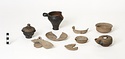
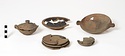
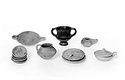
| Excavation of this pit began in 1995, tentatively identified as a pyre. This proved to be so with continued excavation in 1996. The deposits J 2:8 and J 2:9 were combined to become J 2:9. Miniature vessels ... Ca. 300 B.C. |
Great Drain: fillings in south part of section; Martyrs I, II and III, all layers (essentially no difference in the layers).
Pottery sorted and recorded by H.A. Thompson 12 may 1950: "Having gone through ... Second half of 2nd c. B.C.-Early 1st c. B.C. |
Well shaft cut through a cistern channel which was then packed with three amphorae (P 3123, P 3125, P 4201) of 1st or at latest early 2nd c. A.D. (These three amphorae could be considered with F 15:2) ... 3rd-4th c. A.D. |
Cistern at 9/Β (10/Β on plan), at the NW foot of the Areopagus, some 200m to the west of the Coroplast's Dump. It had evidently belonged to one of the small houses in that thickly populated residential ... Second half 4th c. B.C. |
Cistern at the southeast foot of Kolonos Agoraios.
Nbp. 2369: Two chamber cisterns, 88/ΛΔ and 100/ΚΘ, united by a long straight passage running almost due N-S. A draw shaft at 95/ΚΘ is set just off the ... Use filling of late 4th-early 3rd c. B.C.
Accumulative fillings of late 3rd-early 2nd and late 1st c. B.C.
Upper dumped filling of 3rd c. A.D. |
| Extract from notebook ΠΘ XIX, pp. 3644-3646. Well at 105/ΝΗ (report on sorting of pottery, July 19, 1951 - H.S. Robinson).
"Not a useful well" HSR.
Well dug to 1.50m., vi/9/36; dug from 1.50m. to bottom ... Early Roman; use fillings of 2nd. c. B.C. and 1st. and 4th. c. A.D.; dumped filling of late 4th. c. (HSR)
Fill I: 2nd. c. B.C.
Fill II-V: to second half of 4th. c. A.D.
Fill VI: mixed to Byzantine. |
Cistern-shaft at the southeast foot of Kolonos Agoraios.
Nbp. 2369: Two chamber cisterns, 88/ΛΔ and 100/ΚΘ, united by a long straight passage running almost due N-S. A draw shaft at 95/ΚΘ is set just ... Upper fill, Late Roman with some Hellenistic.
Middle fill, Sullan debris to last quarter of 1st c. B.C.
Lower fill, 4th-3rd c. B.C.=POU and abandonment |
|
|