|
|
Flaring ring foot. Torus mouth; round handles. Black glaze on the neck inside, on the mouth, and the handles, and two bands round the body below the lower attachment of the handles, also on the outer face ... Ca. 525 B.C. |
Reserved: outer face of foot, resting surface, center of stem inside with circle and dot, handle-panels. Thickened rim. Mottled glaze ... 525-500 B.C. |
Flat underside, reserved.
Similar, P 5329 E 13:1. Also a pair, P 11778-9 H 12:6 ... Ca. 425 B.C. |
Over half of body and rim, tip of one spur, and half of foot restored. Outer edge of resting surface worn.
Scraped groove in resting surface; concave underside.Ribbed body.
Slightly flaring, rising spurs ... 325-300 |
P 19055 a, b
Body (b) mended from ten fragments, lid (a) from thirteen fragments, with most of bottom of body and small parts of lid restored; burning on bottom of body.
Bottom nearly flat. Upper wall ... 325-300 |
Chips of wall and floor missing.
Flaring foot, concave to outside; rounded resting surface; slightly convex underside. Angular wall. Dull black glaze; finger marks on foot and lower wall.
The earliest ... Ca. 260? |
Both handles and much of wall and rim missing.
Groove in upper surface of foot; rather low stem. Reserved: outer face of foot, resting surface, center of underside and handle-panels.
Cf. Hesp. 55 (1986), ... 500-480 B.C. |
Unglazed.
Cf. P 2880 G 13:4 Hesperia, III, 1934, p. 326, fig. 9, A 66 and P 13243 G 12:20 Suppl. IV, 1940, pp. 134-135, fig. 99 c ... End of 4th c. B.C. |
Flat bottom rising to central tube. Reserved bottom. Glaze worn and peeled for the most part.
A little earlier, P 2350 R 13:4 Hesperia, IV, 1935, p. 510, 63 ... Ca. 425 B.C. |
Intact.
Slightly concave underside with string marks. Steep, convex wall.
Pink fabric (7.5YR 7/4); thin, dull black glaze.
Other fairly well glazed saucers of Hellenistic date: P 19872--P 19875 (Young ... 350-300 |
Domed lid; knob rounded off on top.
Similar, with pointed knob, P 2875 G 13:4 Hesperia, III, 1934, p. 324, fig. 8, A 58 ... Context ca. 350-325 B.C. |
Slight nipple on underside. Glazed inside and out. Re- served: resting surface and junction of foot and wall.
Similar but still shallower, P 1836 G 13:4 Hesperia, III, 1934, p. 318, fig. 4, A 18 ... 375-350 B.C. |
Wall fragment.
Male (body, start of left arm and of right thigh) running to left.
Preliminary sketch.
Perhaps by the Painter of the Oxford Grypomachy. Cf. the two bell-kraters in Vienna: 1129 (ARV2 ... Early 4th century B.C. |
Floor fragment. Line on outside, probably from stacking in kiln.
Max. dim. 0.048; est. diam. of tondo 0.09.
I, youth (back of head, left shoulder and arm) to left. Reserved line for tondo border. Preliminary ... Ca. 500 B.C. |
Part of foot, floor and wall.
Flaring ring foot; lower part of wall slightly concave, a groove at the junction with the upper wall. Reserved: under- side with glazed circle, band, two circles and dot ... Ca. 420 B.C. |
Flaring ring foot; low strap handle. Added red: two lines below level of lower handle-attachment. Glaze much peeled.
P 14046 Q 18:1-POU Hesperia, VIII, 1939, p. 257, fig. 13, 4, of the third quarter of ... Ca. 525 B.C. |
Flat bottom, left rough; thickened lip. Angular profile; wide neck; a groove at the top of the shoulder. Light red clay with large white particles; dull red to black glaze, much worn and peeled. Extremely ... Context ca. 580-560 B.C ... Extremely heavy fabric, the interior no more than a slender tube.
Somewhat similar, but the profile less angular, P 4793 F 12:5 Agora, VIII, pl. 13, 237, possibly from Egypt. |
Ring foot. Decoration inside: four palmettes within roulet- ting. Reserved: junction of wall and foot, and groove in resting surface.
From the same deposit, P 1818, P 1835, P 1837 Hesperia, III, 1934, ... 350-325 B.C. |
Flat floor, thickened rim. Handbuilt of household ware with straw tempering; black glaze inside. Graffito on rim: ΜΙ.
Also from a late archaic context, P 20816 R 12:1; and, from a context of the second ... Context ca. 520-480 B.C. |
Part of foot and floor with trace of handle- attachment.
Rounded ring foot; shape of rim uncertain. Reserved: underside with band and line (center missing). Decoration inside: ring of ovules, zone of ... 430-420 B.C. |
Handle and much of wall missing; profile not complete.
Ring foot; ribbed body. Around the neck, olive wreath in added clay with traces of gilding.
Besides the pieces catalogued that have added clay and ... 325-310 B.C. |
Handle missing.
Torus ring foot with concave moulding beneath; nipple on underside. Horizontal handle at top of lip. Reserved: resting surface and underside with two glazed circles.
Same workshop, P ... 375-350 B.C. |
Neck and shoulder fragment. Roots of handles preserved. Groove at junction of neck and shoulder. P.H. 0.18.
A--B, women (heads, shoulders missing), frontal, foot of one to right (illustrated), the other ... Ca. 420 B.C. |
Round rim thickened above and below. Top of rim glazed and alternate black and added red circles inside, with central dot. Worn at edge.
Very similar, P 24997, from the same deposit, with the whole of ... 575-550 B.C. |
Wall fragment with part of outturned rim. Glaze on outside fired greenish in many places. P.H. 0.098; diam. of rim 0.091. M. Farnsworth, Archaeology 12, 1959, p. 245, fig. 4.
Youth (left foot missing) ... Ca. 430-420 B.C. |
Part of shoulder and root of one handle.
Flat shoulder. Groove at start of neck which was inset and reserved. Reserved: band on shoulder decorated with five lines of dilute glaze.
Another fragmentary ... Early 6th c. B.C. |
Ring foot with concave moulding on inner face; plump body. Neck offset from shoulder. Two shallow grooves on the neck and two at junction of mouth and neck. Reserved: under foot and a band on the wall ... Ca. 425 B.C. |
Both handles missing.
Flaring ring foot; slightly concave lower part of wall, a light groove at its junction with the upper wall. Reserved: resting surface and center of underside with glazed band, two ... 425-400 B.C. |
Handles restored.
Rim rounded on top and projecting, flat beneath; spreading disc foot. Two bands of glaze outside.
For an earlier version of the projecting rim see 1783; for the disc foot, 1784. The ... Context ca. 510-480 B.C. |
Wall fragment. Glaze misfired slightly reddish brown on outside. Deep scratch on outside. Max. dim. 0.056.
Athena and chariot, the team to left. What remains of the horses is a bit of their withers and ... Ca. 460-450 B.C. |
Body fragment. Max. dim. 0.056.
Sphinx (end of wings, most of legs, a little of tail missing) to left, with right forepaw raised. In front of her is a spiral plant. Dilute glaze: cover feathers ... Late 5th century B.C. |
Small portion of wall, rim, and foot; center of floor missing.
Slightly flaring foot; flat resting surface. Angle near top of wall.
Slightly downturned, rilled rim with two scraped grooves. Broad scraped ... Ca. 275 |
One handle, over half of upper body, and part of lower body and foot restored.
Scraped groove in resting surface; concave underside with nipple.
High, slightly tapering stem. Cylindrical upper body ... 275-260 |
Ring foot; rilled rim, sloping inwards. Two raised rings on underside. Concave moulding on undersurface. Decoration on floor:light central circle within two circles of enclosed ovules. Two string holes ... Ca. 425 B.C. |
Small series. Outcurved rim, disc foot with rounded edge.
On some of the small coarsely made examples of the late 5th century the rim is nearly flat on top and has the cross stripes or banding of the ... Context ca. 425-400 B.C. |
Two non-joining floor fragments. Max. dim. a) 0.043, b) 0.037; est. diam. of tondo 0.11.
I, youth to right, looking back. Fragment a (illustrated) preserves his wreathed head and chest, the start of his ... Ca. 440-430 B.C. |
Fragmentary; no join between upper and lower parts; for a reconstruction of the profile see Fig. 12.
Collar rim, concave on exterior; inside, at lower edge of rim, a small segmental ledge. One-piece body, ... Context ca. 440-425 B.C. |
One-piece jar; plain rim, flaring ring foot. Dilute wash outside; dark brown glaze on inside of rim, for bands down handles, at shoulder and around foot.
The kados shape, common in cooking ware, Pl. 65, ... Context ca. 520-480 B.C. |
Mended with missing pieces restored in plaster and painted. Two concentric circles with central dot on underside of floor. H. 0.082; diam. at rim 0.178; width with handles 0.252; diam. of tondo 0.078; ... Ca. 510 B.C ... Thompson, Hesperia 24, 1955, pp. 64--65, fig. 3, pl. 28:d; Ginouvès, Balaneutikè , p. 63, pl. 12:36; D. B. Thompson, An Ancient Shopping Center (Agora Picture Book 12), Princeton 1971, fig. 23; M. Lang, Graffiti in the Athenian Agora (Agora Picture Book 14), Princeton 1974, fig. 36; R. ... Roberts, Hesperia 55, 1986, p. 10, cat. no. 2, p. 5, fig. 2, p. 23, fig. 13, pl. 1.
|
P 17517 a, b, c
Four nonjoining sections preserving slightly less than half of circumference of flange (a, b), part of edge of dome (c), and section of cylinder (a, b, d). (Only fragments b and c are ... 350-300? |
Floor fragment. Max. dim. 0.043; est. diam. of tondo 0.08.
I, youth (head, start of shoulder) bending over to right. Before him are an aryballos and sponge (part of each). Reserved line for tondo border, ... Ca. 510 B.C. |
Low ring foot. Petal ribbing. Two light grooves on lowest part of wall. Double handle.
There are six other specimens in the Agora with this distinctive petal ribbing besides 215. Two merely follow 215, ... 450-425 B.C. |
Mended with small missing pieces restored in plaster and painted. Lower part of body, all of foot missing. Thin glaze, reddish in places, abraded in others. P.H. 0.23; max. diam. 0.235; diam. of mouth ... Ca. 480-470 B.C. |
Fragment of lid with start of knob (offset by ring) and brim. Glaze partly flaked and abraded. Est. diam. 0.105; max. dim. 0.092.
Pairs of women's heads facing, water bird between. On the left, forehead ... Second quarter of the 4th century B.C. |
Rim flat on top. On the neck, in large letters, graffito: ΛΥ.
Other examples from this deposit carry the same in- scription; cf. P 24912 Hesperia, XXV, 1956, pl. 22 d, the graffito read as the first two ... Context ca. 520-480 B.C. |
Preserved except for foot. Mended from many fragments with small missing pieces restored in plaster and painted. Glaze abraded slightly on handles. P.H. 0.056; diam. at rim 0.187; width with handles 0.252; ... Ca. 510-500 B.C. |
Mended from four fragments.
Slightly convex underside with string marks. Straight wall, concave near bottom. Very micaceous, pink fabric (7.5YR 7/4); unglazed.
Similar: P 28572 and P 28573 (from same ... 325-275 |
Two non-joining fragments, P 4811 of rim with start of wall, P 3445 of wall. Narrow band on inside of P 4811 (at rim), another 0.065 below rim. Glaze fired red except for palmette ornament on P 4811 and ... Ca. 460 B.C. |
Floor fragment with part of ring base. Max. dim. 0.048.
Woman (back of hair, shoulder with drapery) to right. At the upper left, at the break, reserved line for border. Preliminary sketch ... Probably second quarter of the 5th century B.C. |
Bowl fragment with start of ring base. Max. dim. 0.045; est. outer diam. of tondo 0.105.
I, part of wave pattern in black glaze around tondo. A, lower part of a draped figure to left.
For the wave pattern, ... Probably first half of the 4th century B.C. |
Floor fragment with start of stem on underside. Glaze misfired grayish on inside, especially contour line. Max. dim. 0.078; est. diam. of tondo 0.101.
Archer (legs, right bent sharply back), moving to ... Ca. 510-500 B.C. |
P 4674 andTwo non-joining wall fragments, P 4674 with turn of shoulder. Thin glaze on inside. Max. dim. P 4674: 0.089, P 4694: 0.024.
Komos. P 4674 shows a youth (wreathed head, body to waist, right arm) ... Ca. 500-490 B.C. |
Much of body with the stub of one handle, nearly all of flaring foot. H. 0.104; est. diam. of rim 0.13. J. Oakley, Hesperia 57, 1988, p. 180, cat. no. 27.
A, youth with aulos, and man. The aulos-player ... Ca. 470-460 B.C. |
Part of spout and top side. Thin brownish glaze on inside; on outside, reddish brown in places. Max. dim. 0.07.
On one side, a duck or swan (part of head and wing) to right; on the other, a panther (part ... Early 4th century B.C. |
Flaring ring foot. Concave lower part of wall, a scraped groove at its junction with the upper part, and above this a groove. Groove at the rim on the outside. Reserved: under- side with glazed center ... 420-400 B.C. |
Ring askos, the sides rounding over into large central opening; saucer mouth; spout tilted back against handle. Buff slip or surfacing; good black glaze on rim, inside and out, on top of handle and for ... Context ca. 520-490 B.C. |
P 10900 a
Neck and about half of shoulder preserved; partiallyrestored.
Convex shoulder with smooth transition to long, cylindrical neck.
Torus rim. Decoration in brown glaze: band on rim and at base ... 1st-century context |
Stamped Plate.
Center of floor preserved.
Convex underside, with trace of groove around edge. At center of floor, six-petaled rosette within hexagon with concave sides, all within circular field. Reddish ... Late Hellenistic? (Roman context) |
Wall fragment with a little of projecting rim. Glaze misfired reddish brown in places on outside; a bit greenish on inside. Max. dim. 0.074.
Fight(?). The fragment preserves the raised, bent right arm ... Ca. 510-500 B.C. |
Plate Or Bowl: Central Italian.
Foot and part of floor preserved.
Angular ring foot; rounded resting surface; pointed underside. Three circles on floor: four stamps within inner two circles; very fine ... Context of 150-86 |
Wall fragment from just below the shoulder. P.H. 0.06; est. diam. at shoulder 0.072.
Woman at tomb. The woman (head, arms, most of torso) dressed in a chiton stands to right, mourning, right hand outstretched, ... Ca. 430 B.C. |
Mended with small missing pieces restored in plaster and painted, handle B/A completely modern. Glaze flaked slightly on outside. Top of rim reserved. H. 0.103; diam. of rim 0.29; diam. of tondo 0.113; ... Ca. 510-500 B.C. |
Two non-joining fragments.
Ring foot, lipped, with concave moulding beneath. Thickened rim, sloping inwards, inturned. A fillet on the lowest part of the wall. Decoration inside: enclosed ovules, linked ... 430-420 B.C. |
Mended with small missing pieces restored in plaster and painted. Lip offset on inside; foot offset on underside. Glaze slightly abraded on handles. H. 0.074; diam. of rim 0.18; W. with handles 0.238; ... Ca. 510-500 B.C ... Thompson, An Ancient Shopping Center (Agora Picture Book 12), Princeton 1971, fig. 67 (I); Agora XIV, pl. 87; Beck, Album, pl. 60:307 (I); ARFV:Archaic, fig. 48; Guide (1976), p. 245, fig. 128; C. ... Camp, The Athenian Agora: Excavations in the Heart of Classical Athens, London 1986, pl. 8, opp. p. 135 (I); LIMC III, 1986, p. 460, no. 428, pl. 349 (B), s.v. ... Beazley accepted the attribution but with some hesitation (see especially The Berlin Painter [Melbourne 1964], pp. 1, 12, 13); yet he included the cup among the painter's works in both ARV2 (1963) and Paralip. (1971). |
Wall fragment.
Amphoriskos. Thin fabric with a few white bits, the core black, the surfaces red and covered outside with a pinkish orange slip. Decoration in red, black and white: bands, and a double ... |
Wall fragment. Burned (clay is gray). Glazed misfired reddish brown on outside. Max. dim. 0.06.
Pelias and daughters. The fragment shows the cauldron with the foreparts of the ram (head missing). On the ... Probably mid-5th century B.C. |
Floor fragment with stem and start of fillet. Incision at edge of fillet. Max. dim. 0.069.
I, runner (head, upper part of right arm, right leg from the knee down and left foot missing) to right. In his ... Ca. 520 B.C. |
Fragment of inset lip and start of bowl. Max. dim. 0.069.
On exterior, lozenge pattern, each reserved lozenge decorated with a lozenge and dot drawn in dilute glaze.
The lozenge pattern on the exterior ... Ca. 430-420 B.C. |
| Wall fragment from black glazed skyphos.
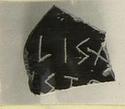
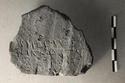
Inscribed inside: Ostrakon fill, first layer under wall B. 8330 Leica ... 20 October 1949 ... Agora XXV, no. 455, pp. 12-13, 77. |
| From the wall of a banded amphora?
Incised outside:
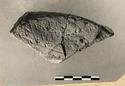
Buff surface; thin brown glaze, or deposit, inside. Red gravelly fill with kalikia. 4965 Leica ... 9 June 1947 ... Agora XXV, no. 755, pp. 12-13, 109. |
Rim and three-fourths of body restored.
Low foot; curved resting surface; nearly flat underside with spiral marks. Upper and lower body of equal height, both slightly curved.
Smooth transition to neck ... Late 2nd to early 1st century? (3rd-century context,disturbed) |
Mended from many fragments, with missing pieces restored in plaster and painted, notable among them the left horizontal handle and part of the wall below it. Glaze fired greenish around left handle; abraded ... Ca. 430 B.C. |
Body fragment with small missing pieces restored in plaster and painted. P.H. 0.123; P.W. 0.172. M. F. S. Hood, ArchReports, 1957, p. 4, fig. 1:b; H. A. Thompson, AA, 1957, cols. 59--60, fig. 2; Fasti ... Ca. 490 B.C. |
Fragment of shoulder.
Shoulder slightly convex. Decoration in brown glaze: broad band at angle with two narrow bands above; tendrils of ivy(?) garland on shoulder. Hard, friable, light red fabric (2.5YR ... |
Bowl fragment. Max. dim. 0.032; est. diam. of tondo 0.14. H. A. Thompson, Hesperia 28, 1959, pl. 22:a, c.
I, around tondo, stopped-maeander pattern with cross-squares. A, nude man or youth (from the waist ... Ca. 490-480 B.C. |
Cup With Moldmade Feet: Imitation Pergamene?
One foot, most of rim, and half of body restored.
Three moldmade feet: grinning satyr mask with bald head, full, curly beard, and bunches of grapes over ears ... Context of 115-50 |
| Fragment from the base of a large open vase. The base rises toward the center.
Glazed inside and out with very thin brownish wash. Old drain, gravel filling. Leica ... 12-13 May 1933 ... Agora XXV, no. 645, pp. 12-13, 15, 96. |
Wall fragment from the receptacle of a rhyton(?). Max. dim. 0.063.
Maenad (most of draped legs, hanging leg of her nebris), probably dancing to right. Above her right thigh at the break is a bit of reserve ... Probably early 5th century B.C ... During his visit to the Agora in the summer of 1953, Beazley suggested that 1673 is a fragment of a plastic vase, presumably a rhyton. ... Hoffmann, Attic Red-Figured Rhyta, Mainz 1962, pl. 13), both from the Cow-Head Group; Naples Stg. 62 by the Eretria Painter (ARV2 1251, 37; Lezzi-Hafter, Eretria-Maler, p. 348, cat. no. 258, pl. 170); Boston, M.F.A. 01.8105 (ARV2 1551, 11; Hoffmannn, pl. 19:1, 2); and Ruvo, Jatta 1116 (ARV2 1551, 12) from the Group of Class W to which Hoffmann assigns a third, Bayonne 118 (p. 42, cat. no. 112, pl. 22:1) but which Beazley (ARV2 1704) places near the Group. |
P 134 andThree non-joining wall fragments, P 5110 a with roots of one handle. Glaze flaked in many places; fired brown on much of inside. P.H. of P 5110 a) 0.185; P.W. 0.29; max. dim. P 134: 0.184, P 5110 ... Third quarter of the 5th century B.C. |
| Joining fragments preserve most of neck and lip and upper part of handle. Wide cut-away mouth; flanged handle, the flanges bridged by a reel at point of attachment to lip.
Brown clay with many white ... 4 October 1947 ... Agora XXXIII, no. 79, fig. 13, pl. 12. |
Stamp on top: chi.
Glaze: red except on bottom.
Clay: reddish, little mica Assembly Place, filling of Period III ... 1931 |
| Few missing pieces restored in plaster. Rounded bottom; ovoid body; wide cylindrical neck; sharply slanting rim with handle, round in section, attached at low point, thickened lip at high point. Irregular ... February-April 1937 ... Agora XXXIII, no. 77, fig. 13, pl. 12. |
| Small part of rim, wall, and upper handle attachment. Rope handle with rotelle at attachment to rim.
Soft, fine, household fabric (2.5Y 8/3). Inventoried 1 July 1999. Layer 4 between walls C-D-E. 3038 ... 17 May 1940 ... Agora XXXIII, no. 78, fig. 13, pl. 12. |
| Parts of wall and rim missing; restored in plaster. Round-bottomed scoop with sloping handle and wide mouth with trefoil lip.
Micaceous cooking ware fabric, rather heavy. Tiled Well, containers 6, 7 ... June 1955 ... Agora XXXIII, no. 76, fig. 13, pl. 12. |
Medicine Bottle.
Handle and half of neck and mouth missing.
Flat base with string marks. Irregular, barrel-shaped body with slightly angular shoulder. Short, thick neck; plain, slightly outturned rim ... Context of late 1st century B.C. and 1st century after Christ ... XVIII, and p. 62, said to be from a 3rd-century context; Perdrizet 1921, no. 352, p. 128, pl. ... Although the epsilon is lacking in the Agora stamp, its last line may tentatively be read as suggested above on analogy with the latter. ... Thompson 1948, p. 191; Guarducci 1952; Sjöqvist 1960, p. 82, fig. 15, pl. 20; Prouglo 1966, p. 13, fig. 2; Hershkovitz 1986, no. 1, pp. 47, 50; Smith 1992, p. 166, note 38; Panayotou and Chrysostomou 1993, no. 12, pp. 381--382, figs. 17, 18). |
Kylix base with black glaze. Inscribed on bottom. Oscar Broneer, Nb. No. 4. Protect from abrasion. 175 88-395 ... 29 May 1937 |
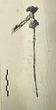
| Head missing; shaft broken in two pieces.
Traces of binding? Round lower part of shaft. Agora sample no. 628. Grouped with IL 12 as a single pin by E.L.S., July 1952. Found with burial, inside geometric ... 8 March 1932 |
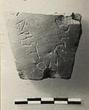
| On convex surface scratched in the dry clay:
Grayish pink clay (burned?). Good, though clouded, glaze inside and out. Cistern, interior well. Leica PD 1133-15(C 12) ... 21 March 1932 ... Agora XXI, p. 13, no. C 12, pl. 4. |
| Wall fragment from a pithos(?).
Inscribed on outside:
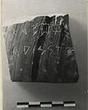
Coarse micaceous brown clay; orange at core. Horos Terrace Trench, ostrakon pit. 581 Leica ... 10 April 1953 ... Agora XXV, no. 554, pp. 12-13, 85, fig. 17. |
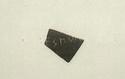
| Coarse unglazed tile fragment, incised on smoothed outer face. Building fill of poros building. Leica PD 1864 ... 9 April 1935 ... Agora XXV, no. 33, pp. 12-13, 36, fig. 2. |
| Slightly concave side of fragment glazed with rather thin and dull black glaze, through which has been scratched in the dry clay the letters:
Other side unglazed.
Attic clay. Leica ... 17 March 1932 ... Agora XXV, no. 654, pp. 12-13, 99, fig. 21. |
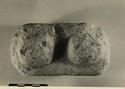
| Inscribed mastoid weight.
Very battered, but intact.
On one of the long faces the letters: "ΛΔΚ".
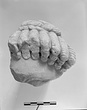
Pentelic marble. Found in late context outside the Market Square, in the area south of the church of the ... 21 March 1938 ... Agora X, no. SW 13, p. 37, pl. 12. |
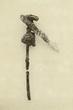
| Broken in three pieces, but complete.
About 0.018 below the head, the shaft of the pin passes through a small conical lump of bronze.
Bit of bone from burial attached to pin by corrosion. Agora sample ... 8 March 1932 |
| From the wall of a very heavy amphora, with dull streaky glaze outside.
Incised inside:
Coarse clay with bits. Sand. 4382 Leica, XXXIII-51 ... 30 April 1947 ... Agora XXV, no. 598, pp. 12-13, 17, 90, fig. 18. |
| Fragment of a cover tile.
Incised inside:
Black glaze outside only. Red gravelly fill. 4442 Leica ... 5 May 1947 ... Agora XXV, no. 355, pp. 12, 16, 70, fig. 13. |
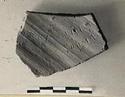
| From the wall of an amphora covered with streaky glaze wash and horizontal bands.
Incised outside: Red gravelly fill with kalikia. 4949 Leica ... 6 June 1947 ... Agora XXV, no. 361, pp. 12, 15, 70, fig. 13. |
| From the wall of an unglazed pot.
Incised outside:
Attic clay, buff at the surface. Gravelly red fill; 5th. c. 4316 Leica PD 636-8 ... 23 April 1947 ... Hesperia 19 (1950), p. 384, no. 13, fig. 8 ... Agora XXV, no. 315, pp. 12-13, 17, 66, fig. 12. |
| Fragment of head with elaborate headdress from an archaic or archaistic sculpture. Left eye and part of forehead preserved.
Pentelic marble. House 650β/12 (650b/12). Leica, LXXII-39, LXXII-40 ... 22 December 1936 |
| From the wall of a semi-glazed krater.
Incised outside:
Red glaze inside only.
Joins P 17683 (ΝΝ 2670). Sand under red gravelly fill. 4376 Leica ... 29 April 1947 ... Agora XXV, no. 332, pp. 13, 15, 68, fig. 12. |
| From a closed Geometric pot; bands of brownish glaze outside.
Incised inside: Sand under red gravelly fill. 4382 Leica, XXXIII-52 DA 15276 ... 30 April 1947 ... Agora XXV, no. 340, pp. 9, 13, 68, fig. 12. |
|
|