|
|
E.D. Townsend Vermeule ... PG grave no. 1. Mycenaean Chamber tomb under Temple of Ares. No remains, but cf. P 21275. Cf. under J 7:2 (PG grave no. 1), Agora XIII, pp. 183-190 ... Protogeometric ... PG grave no. 1. Mycenaean Chamber tomb under Temple of Ares. No remains, but cf. ... Cf. under J 7:2 (PG grave no. 1), Agora XIII, pp. 183-190. |
Grave in north peristyle of Hephaisteion. Grave LVIII in notebook. No mention of bones. Neg. KK 391 ... Byzantine |
Well 7: Late Neolithic
No water. Diam., top ca. 1.25x1.10, bottom ca. 1.10x0.80 Turkish disturbance (Lot ΟΑ 209) ... Late Neolithic |
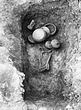
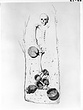
| E.D. Townsend Vermeule ... Protogeometric Grave no. 2 at North of Temple of Ares (Grave XXXVII). Rectangular stone-lined pit in filling of Mycenaean chamber tomb (J 7:2); the skeleton of a boy. Cf. P 21275 which is from the "preliminary ... Middle Protogeometric |
Hellenistic fill, north of Temple of Ares, on either side of wall running east-west over 50/ΙΓ. Mostly coarse pottery including many stamped amphora handles.
Cf. also nb. P XII, pp. 2297-2298. Coins:
13 ... 275-200 B.C ... Delos XXVII, p. 302 (under no. E 1, cited as K 6-7:1) ... Agora XXIX, p. 459 ... Agora XXXIII, p. 363. |
| Grave in opisthodomos of Hephaisteion. Grave LIII in notebook.
No mention of bones. Coin
9 March 1939 #16 Neg. KK 361 ... Turkish |
| Marcie Handler ... The contents of this Hellenistic cistern shaft were excavated in a series of layers: the preserved top of the shaft, six layers in the shaft and the fill within the tunnel. At the bottom of the shaft on ... POU: Mid-3rd c. BC
Dumped fill: after 225 BC |
Soft Trench behind Stoa Stylobate, opposite Piers 21 and 22, along W face of Shop front wall. Herulian destruction debris at the north end of the Stoa of Attalos. Coins:
20 February 1954 #1-#2
22 February ... Late 3rd c. A.D. |
Grave in south peristyle of Hephaisteion. Grave LXI in notebook.
No mention of bones. Coins:
11 March 1939 #12-#14
13 March 1939 #4
14 March 1939 #2-#4 Neg. KK 393 ... 11-13 March 1939
18 March 1939 |
Grave north of Hephaisteion. Grave XIII in notebook. One damaged skeleton. No pottery, no coins ... 20 May 1936 |
Accumulated debris on the west side of the market square.
Related layers added 1999/2000 (JWH), e.g. "Gravelly layer above burning", "Clearing Classical floor", "Lowest level above bedrock", "Below burning", ... First half of 5th c. A.D. |
| Eugene Vanderpool Homer A. Thompson ... Mycenaean Grave to W. of "Court Room" below Stoa Terrace with "Ballot Box" (Grave XXIX).
Unusual type, conforming neither to our pit nor to our cist graves, and consisted of two parts. The outer part was ... Mycenaean III A-B |
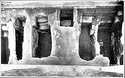
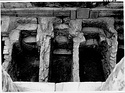
Grave in cella of Hephaisteion. Grave XXXA in notebook.
No mention of bones ... 13 March 1939
18 March 1939 |
Grave in cella of Hephaisteion. Grave XXIX in notebook. No mention of bones. Coins:
25 February 1939 #1 ... 23 February 1939
8 March 1939 |
Grave in cella of Hephaisteion. Grave XXX in notebook.
Filling: loose earth. No mention of bones. Lot 401b ... 8 March 1939 |
| Grave in cella of Hephaisteion. Grave XXVIII in notebook. No mention of bones. Negs. XV-74 , KK 357 ... 25 February 1939 |
Grave in cella of Hephaisteion. Grave XLVI in notebook. No mention of bones. Coins:
9 March 1939 #1-#4 ... 8 March 1939 |
Grave in cella of Hephaisteion. Grave XXIV in notebook. Two skeletons. No sherds. Coins:
23 February 1939 #4 Neg. KK 375 ... 23 February 1939 |
Grave in west peristyle of Hephaisteion. Grave XLIII in notebook. No mention of bones; pottery Turkish. Coins:
8 March 1939 #21 ... 11 March 1939 |
Grave in west peristyle of Hephaisteion. Grave XXXVI in notebook. No mention of bones. Coins:
7 March 1939 #1-#6 Neg. KK 355 ... 7-19 March 1939 |
| Grave in opisthodomos of Hephaisteion. Grave XLIX in notebook.
No mention of bones. Coins:
9 March 1939 #8-#13 Neg. KK 365 ... 9 March 1939
16 March 1939 |
Grave in south peristyle of Hephaisteion. Grave LVII in notebook.
No mention of bones. Coins:
10 March 1939 #2 Neg. KK 389 ... 9-11 March 1939 |
Grave in north peristyle of Hephaisteion. Grave LX in notebook.
No mention of bones. Coins:
11 March 1939 #9-#11 Neg. 397 ... Byzantine |
| Grave in west peristyle of Hephaisteion. Grave XLI in notebook. No mention of bones. Coins:
8 March 1939 #6-#20 Neg. XVI-19 ... 10 March 1939 |
| Grave in opisthodomos of Hephaisteion. Grave LI in notebook.
No mention of bones. Neg. KK 363, XIX-8 (dismantling of the walls of the graves( ... 10 March 1939
16 March 1939 |
Grave in north peristyle of Hephaisteion. Grave LXII in notebook.
No mention of bones. Pottery discarded. Coins:
11 March 1939 #15
14 March 1939 #5 Neg. KK 385 ... 18 March 1939 |
Grave in north peristyle of Hephaisteion. Grave LIX in notebook.
No mention of bones. Containers 473 and 474 represent filling between graves. Coins:
11 March 1939 #16 Neg. KK 391 ... Byzantine |
| Grave in opisthodomos of Hephaisteion. Grave LII in notebook.
No mention of bones. Neg. KK 362 ... 16 March 1939 |
| Grave in west peristyle of Hephaisteion. Grave XXXIX in notebook.
No mention of bones. Coins:
7 March 1939 #12-#13
8 March 1939 #4-#5
10 March 1939 #3-#9 Neg. KK 367 ... 7-10 March 1939 |
Grave in north peristyle of Temple of Hephaisteion. Grave XXXI in notebook. No mention of bones. Coins:
25 February 1939 #4
27 February 1939 #5-#11
6 March 1939 #1 Negs. KK 376, KK 379 ... 25-27 February 1939
6 March 1939 |
Grave in south peristyle of Hephaisteion. Grave LIV in notebook. No bones mentioned in description. Photo on p. 1847 (KK 369) is probably Grave LVI and photo on p. 1851 (KK 388) is probably Grave LIV ... 9-11 March 1939 |
Grave in west peristyle of Hephaisteion. Grave XXXVII in notebook. No mention of bones.
Orlandos Grave A. Coins:
7 March 1939 #7-#10 Neg. KK 354 ... 7-10 March 1939 |
| David Scahill ... Beneath toichobate floor level in Room 1 of Classical Building II, against the south ashlar wall, ca. 1.50m. east of the southwest corner of the building. Deposit of broken pyre pots in small pit, 1.00m ... Ca. 325 B.C. |
Upper fill (top to around 4.50m.) was in a pit of large dimensions above the preserved well shaft. From the bottom and shaft proper no catalogued pottery. No tiling in place in well but fragments of tiles ... 3rd-4th c. A.D. |
At 67/ΙΗ, at the northeast slope of the Areopagus.
Cistern with drawshaft, 4.60m deep. The drawshaft had been cleared to bottom in the eighteenth or nineteenth century, and some of the fill in the main ... Most second half of 3rd c. B.C. |
Chamber of water system with one blind tunnel and two cisterns connected by tunnel. Pottery consistent throughout, late Hellenistic. Late 2nd c. B.C.
Ten stamped amphora handles. Most of bowls long-petal ... 100-75 B.C. |
Evidence of stratification into five layers, although joins between the layers. Layer VI added when the construction of the Roman building above required it. No subdivisions assigned.
Flask-shaped cistern ... Early 3rd-late 2nd c. B.C. |
Well C - Passage, belongs with II - Brick Shaft. All dumped fills. No objects catalogued from Well C of section ΟΑ. One object (I 5422) catalogued from modern fill in shaft, one from dump (I 5545). Coins: ... 2nd c. A.D.- Byzantine |
| Cistern in the valley between the Areopagus and the Hill of the Nymphs. Simple, flask-shaped chamber withdraw-shaft; no tunnels. Mouth cut away in Byzantine times. Lower filling, 3rd c. B.C. Coins:
25 ... 25-30 April 1947 |
Tile-lined well at T/7-13/10,ca. 0.75m in diameter, top at ca. 64.90. Three tiles per circuit, ca. 0.63m high each; 10 rows of tiles. No POU.
Fill was largely dumped earth of the 3rd and 4th c. A.D., apparently ... Late 3rd to 5th century A.D. |
Well on the north slope of the Areopagus; depth at 9.65m; scanty dumped fillings. From about 3.20m to the bottom, little but tile fragments appeared; in the fillings above, the lower is characterized by ... Ca. 350-290 B.C. |
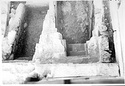
| Mycenaean Chamber Tomb with niches.
One of the few tombs found in the Agora that has an almost architectural regularity with squares chamber (1.75m wide by 2.10m deep) and axially centered dromos (4m long ... Myc. III A 1:2 |
Displaced curbing stone had fallen into top of shaft; fill with and around it is presumably second half of 2nd c. A.D. Below tumbled filling at top, shaft was empty to 10.80m. Tiles were missing to ca ... Late 1st-early 2nd c. |
Roman use fill in lowest 6.70m; Byz upper fill (dump). Notebook lists eight fills; subdivisions based on shelf groupings.
Subdivisions:
.1=Dumped fills 1-2, Byzantine
.2=Fill 3 (baskets 18-37)
.3=Fill ... 50-150 A.D. to Early Byz. |
Dumped filling of 6th c. A.D. Coins:
3 May 1939 #1-2 (red earth above well)
9 June 1939 #1
10 June 1939 #1
12 June 1939 #1-#5
13 June 1939 #1
19 June 1939 #1-#2, #3 (Dump)
7 May 1940 #1
9 May 1940 #1
27 ... Early 1st-5th c. A.D. POU |
Dromos of a Mycenaean Tomb at N end of Stoa Terrace (Burial 3). No remains. Perhaps to be associated with dromos of a Mycenaean chamber tomb (?) observed in this area (XIV, p. 2707).
Tomb found when workmen ... Myc. III A |
| Extract from notebook ΠΘ XIX, pp. 3644-3646. Well at 105/ΝΗ (report on sorting of pottery, July 19, 1951 - H.S. Robinson).
"Not a useful well" HSR.
Well dug to 1.50m., vi/9/36; dug from 1.50m. to bottom ... Early Roman; use fillings of 2nd. c. B.C. and 1st. and 4th. c. A.D.; dumped filling of late 4th. c. (HSR)
Fill I: 2nd. c. B.C.
Fill II-V: to second half of 4th. c. A.D.
Fill VI: mixed to Byzantine. |
Klepsydra: Filling in antechamber, behind the parapet of the Klepsydra. Dated to the time of the rebuilding of the springhouse after the Sullan sack, but containing earlier material. Coins:
31 May 1938 ... Second quarter of 5th c. to middle of 1st c. B.C. |
"Oinophorus Well".Tiled well in House H (diameter 0.80m, water level -4.70m). Height of tiles 0.64m Heavy well deposit; lamps,, type XXVII; many basket-handled water jars; oinophoros with labors of Herakles ... Use filling of early 2nd-mid.-3rd c. A.D. |
| Grave 7 in notebook. Area disturbed in Roman times; outlines of the shaft had been obliterated.
The northwest end, however, was preserved in a cutting in the rock of the sloping hillside. This cutting, ... 750-700 B.C ... Hesperia 14 (1945), pp. 306, no. 86, figs. 7, 8, pl. ... Hesperia Suppl. 2 (1939), pp. 93-94, figs. 1, 64, 73 (Grave XIX). ... Agora VIII, p. 127. |
| Eugene Vanderpool ... Grave (E.L. Smithson: Grave III: SM).
The close proximity and similarity of this tomb and tomb M 16-17:1 strongly suggests that they were intentionally laid out in relation to one another and were contemporary ... Late Mycenaean/Submycenaean-Earliest Protogeometric |
| A well on the lower slope of the Hill of the Nymphs, (diam. 1.20m -water level -7m), to 7.90m. The scanty use filling at the bottom contained water jars and pitchers as well as the inventoried objects; ... Second quarter of 6th. c. B.C. |
Well at 115/ΣΤ (all the 5th c. fills of 116/ΣΤ). The lower part of the shaft contained a heavy deposit of pottery and other objects of the late archaic period, both coarse and finer wares; probably a post-Persian ... Ca. 500-480 B.C.-Roman |
| Mycenaean Chamber Tomb under north side of Temple of Ares, towards its west end.(1951).
The tomb had a hasty and unfinished appearance oddly at variance with its long history and the quality of the pottery ... 1st: Myc IIB-IIA:1-2, 2nd: Myc. IIIC:1 (1450-1200 B.C.) |
Great Drain: fillings in south part of section; Martyrs I, II and III, all layers (essentially no difference in the layers).
Pottery sorted and recorded by H.A. Thompson 12 may 1950: "Having gone through ... Second half of 2nd c. B.C.-Early 1st c. B.C. |
Cistern at the southeast foot of Kolonos Agoraios.
Nbp. 2369: Two chamber cisterns, 88/ΛΔ and 100/ΚΘ, united by a long straight passage running almost due N-S. A draw shaft at 95/ΚΘ is set just off the ... Use filling of late 4th-early 3rd c. B.C.
Accumulative fillings of late 3rd-early 2nd and late 1st c. B.C.
Upper dumped filling of 3rd c. A.D. |
Cistern at 9/Β (10/Β on plan), at the NW foot of the Areopagus, some 200m to the west of the Coroplast's Dump. It had evidently belonged to one of the small houses in that thickly populated residential ... Second half 4th c. B.C. |
| Well in Room 6 of Street Stoa U/2,U/3-13/15.
Associated with the building lying under the Roman Street Stoa. Its fills divided into 5 separate layers, with the bulk of finds belonging to Layer 1, the ... 14 June-21 August 1973 |
| Marcie Handler ... The Pyre was revealed in a layer of 4th c. fill in the north end of Room 6, just south of Wall 8. Room 6 is defined by the street wall (Wall A) on the west, Wall 7 on the east, Wall 9 on the south (preserved ... 4th c. B.C. |
Grave in south peristyle of Hephaisteion. Grave LXIV in notebook.
No mention of bones. Coins:
13 March 1939 #21-#23
14 March 1939 #7 Neg. KK 395 ... 13-15 March 1939 |
| Brian Martens ... Mycenaean Chamber Tomb J 1:11, located in the area north of Wall K, was partially excavated during the 2014 season. At this point the full western extent of the chamber has not been located because of ... LHIIIA |
Rodney S. Young ... Grave 17 in notebook. No offerings.
Amphora containing skeleton of small child was laid on its side in pit. RSY
Lot Β 304 Fill over Grave 17 ... Early 6th century B.C (?) |
Part of the cistern system 44/ΙΓ - 46/ΙΑ - 42/Θ.
Objects with context as "cistern 44ΙΓ, mouth of 46/ΙΑ" are listed with D 12:2.
The following objects are from "earth", i.e. no context layer:
SS 5334, ... Late Hellenistic-Early Roman |
May be of Hellenistic origin when cistern system went out of use.
For a general note on the cistern see Nb. ΟΕ III, pp. 246 ff.
Objects from B 586 various depths (no subdivision): S 2324-S 2330,
P 34894, ... Late 2nd-early 6th c. A.D. |
| Pyre in layer 8a in SW corner of Room 7 of Greek House δ.
Oval pyre; 0.60 (n-s)x 0.35 (e-w).
The pyre was covered by the surface of layer 8 and extended slightly into layer 9 below it. Small bone fragments, ... 325-300 B.C ... Hesperia Suppl. 47 (2013), no. 1, pp. 98-100, figs. 6, 7, 15-18 ... Agora XXIX, p. 467. |
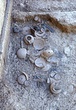
Pocket of soft fill in bedrock at corner of Late Roman house, with a hoard of lead tokens. No pottery catalogued.
Herulian debris: cf. D 10:1, D 11:7 Coins:
25 May 1935 #8 Estimated Grid
No pottery catalogued ... 25 May 1935 |
Tiled well, ca. 30m south of the Tholos. Associated with Building D. Hellenistic Group A with Late Roman fill in upper 3.00m. Objects A 245 and P 4597 are from fill on floor around well-head, contemporary ... 325-260 B.C. |
| Cistern on lower north slope of Areopagus.
Latest of thirteen amphora handles dated ca.199; twelve legible coins, the latest dating ca. 196-190. Three intrusive pieces:two semiglazed fragments and piece ... 260-190 B.C. |
| In area West of the Areopagus. Fills with many figurines and molds, possibly from a terracotta factory.
Twelve stamped amphora handles; no long-petal bowls; Type 54 A lamp Coins:
31 May 1939 #11
1 June ... Mostly 200-150 B.C. |
Cistern connected by tunnel to another chamber filled in Byzantine period. Small Hellenistic deposit on floor. somewhat contaminated by Byzantine fill above
No stamped amphora handles later than 3rd c.; ... 250-190 B.C. |
Dumped fillings thrown in during second quarter of 1st c. B.C. containing mostly debris resulting from Sulla's sack in 86 B.C.
Agora XXIX, p. 464: Four fills distinguished during excavations ... but seemingly ... Late 2nd c. and early 1st c. B.C. POU; 110-75 B.C ... B.C. containing mostly debris resulting from Sulla's sack in 86 B.C.
Agora XXIX, p. 464: Four fills distinguished during excavations ... but seemingly with no chronological differentiation (p. 580).
... Coins:
7 March 1938 #16-#17
8 March 1938 #23-#25
9 March 1938 #8
10 March 1938 #6-#17
11 March 1938 #3-#12
12 March 1938 #14-#29
14 March 1938 #7-#14
15 March 1938 #10-#11
10 May 1938 #1-#10 |
| Grave 8 in notebook.
Inhumation in Tholos Cemetery. Length of shaft 1.75m; Width at upper end 0.95m; Depth from cover 0.70m.
One end cut into sloping rock.
Skeleton of a woman, with head southeast. Most ... 750-725 B.C. |
| Grave 7b in notebook. Inhumation in Tholos Cemetery; The skeleton positioned directly below the male in Grave 7, but with direction reversed, i.e., head at southeast end. Most grave offerings at lower ... 750-725 B.C ... Hesperia 14 (1945), pp. 305-307, no. 83, figs. 7, 8, pl. ... Hesperia Suppl. 2 (1939), pp. 94-97, figs. 1, 65-67 (Grave XX) ... Agora VIII, p. 127. |
| Grave V, under room 18 in House 3, plus burned deposit at 94/IΘ. Identified as sacrificial pyre by SIR on Agoraios Kolonos:
In southeast corner of house 3. 35 artifacts, bone and charred material in pit, ... Ca. 300-275 B.C ... Hesperia Suppl. 47 (2013), no. 21, pp. 123, 124, figs. 1, 50, 51 ... Agora IV, p. 238 ... Agora XII, p. 389. |
A filling lying over a cobbled floor in a house-complex on the lower north slopes of the Areopagus.
Area in front of E-W retaining wall, just above cobble pavement, disturbed by coins and pottery as late ... 375-275 B.C. |
| Pyre in House N, room 4 (RSY=Pyre 7), in the industrial area west of the Areopagus.
Pottery, mall pieces of calcined bone, log, wood cinders, and charcoal in diamond-shaped pit in floor sequence. The pyre ... Late 4th-early 3rd c. B.C ... Hesperia Suppl. 47 (2013), no. 46, pp. 158, 159, figs. 1, 4, 78, 91 ... Agora IV, p. 235 ... Agora XII, p. 385. |
Investigations within the Stoa of Zeus, the north part, various levels.
Notebook references: Stoa Trench E Layers IV and V, Stoa Pits A, B and C, and Layers I and II of area between back wall and retaining ... 5th c. B.C. |
Sand fill N of Base A.
... Because of the uncertainty of ground level contemporary with Base A and of the possibility of missing a continuous strosis or disturbance in this soft sandy fill, I have kept ... Last quarter 2nd-first quareter 3rd c. A.D. |
| Pyre in House N, room 2, layer 5 (RSY=Pyre 8).
Near northern corner of room 6. Artifacts, bone, burnt logs, and cinders in square pit dug from level of layer 5, through layers 5 and 6; thin clay floor ... 325-300 B.C. |
| Sacrificial pyre in Poros Building, NW Room (RSY= Pyre 1).
Against east wall of room 5 west. artifacts, bone, carbon and ash in pit in floor sequence. the pyre lay below a floor covered with marble dust, ... Middle of 4th c. B.C. |
| Pyre in House T, Room 1, Layer 5-6 (RSY=Pyre 3) in the industrial area west of the Areopagus.
First quarter 4th. c. B.C.
Artifacts, bone, and cinders in pit in floor sequence. The pyre was found in digging ... 400-375 B.C.(?) |
Well at 15/ΙΕ = Pocket in side of Turkish Pit at 15/ΙΔ.
Shallow well on the lower slopes of the Acropolis, east of the Panathenaic Way, in the area later occupied by the Archaic Building.
Located 3.5m ... 700-675 B.C. with intrusions |
|
|