|
|
A drain pit with red gravely fill. Coins:
5 April 1939 #1-#8
Pottery continuing to at least 3rd c. A.D. ADDENDA: See also tins Lot ΝΝ 70, ΝΝ 71.
ADDENDA: P 14822 probably also belongs ... Mixed Hellenistic to Roman ... A 18:7 ... A 18:7 |
| Filling in eastern channel at W. end of casting pit A 16:1. Early Roman (1st c. A.D.) but with some later disturbances (3rd. and 4th. c. A.D. and Byz.). P 25747 (VG thinks strayed from A 16:1)
Estimated ... 1st. c. A.D ... A 16:2 ... A 16:2 |
| Debris filling in a bronze casting pit and workshop, characterized by mold fragments but including also a few plain vases and fragments of wine jars. Third quarter of 4th. c. BC.
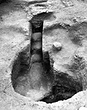
The pit was cut into the ... Ca. 350-325 B.C ... Debris filling in a bronze casting pit and workshop, characterized by mold fragments but including also a few plain vases and fragments of wine jars. ... The pit was cut into the soft bedrock to a depth of -1.43m and is 1.70m wide at its broadest extremity. The ground plan is that of a slightly lop-sided keyhole. |
| (RSY=Pyre 2). Pyre in the industrial area west of the Areopagus, in House B. In northern corner of room. No pit discerned. A deposit of small stones (a marker/) lay 0.30m above the level of the pyre, ... Third quarter of the 4th. century ... Hesperia 20 (1951), pp. 115-116, pl. 49 a, 50 b (Pyre 2). |
Grave over Drain A1 (House A)
*Now A 18:9 (SIR). Asterisk: A 20:2* ... Grave over Drain A1 (House A)
*Now A 18:9 (SIR) ... Asterisk: A 20:2* |
*Merged with A 20:7. Asterisk: A 20:8* ... A 20:8 ... A 20:8 |
Grave (?) under wall 4. Infant burial(?); a kados, P 16747, lying sideways with a tall cylindrical stand, P 16748, set over it as a cover; the upper parts of the pots cut away ... Late 6th. c. B.C ... Infant burial(?); a kados, P 16747, lying sideways with a tall cylindrical stand, P 16748, set over it as a cover; the upper parts of the pots cut away. |
| Hole (Well) and adjoining water channel with 4th c. pottery, probably a dumped fill.
At a depth of about -5.70m we started yielding some very crude potsherds, clearly not made on the wheel (maybe Prehistoric) ... Prehistoric-Roman ... Hole (Well) and adjoining water channel with 4th c. pottery, probably a dumped fill.
At a depth of about -5.70m we started yielding some very crude potsherds, clearly not made on the wheel (maybe Prehistoric) p. 2367 ... B 1199 has been placed with A 16:1. |
This shaft in the NE corner of House A, Room III, depth of one tile, is perhaps connected with drain A. Coins:
13 May 1940 #1-#13
14 May 1940 #2-#101 ... Early 3rd. c. B.C ... This shaft in the NE corner of House A, Room III, depth of one tile, is perhaps connected with drain A. |
Not a group, one object only.
Dug bedrock. Coins:
29 April 1947 #1 ... Not a group, one object only.
|
Scanty debris filling in a pit. The wishbone-handled bowl (P 16753) is of the middle of the third quarter of the 5th. c. century, as are also two red figured fragments, P 25820 and P 25821; the deposit ... Ca. 450-400 B.C ... A 20:7 ... A 20:7 |
| Grave over drain A1 (House A). Date based on the fact that the lopas has the upturned handle and the flat rather than domed lid, not found in examples from the later pyres. LT
West of House C. Pottery ... First half of 4th. c. B.c ... A 18:9 ... A 18:9 |
| Sacrificial pyre, disturbed; a small pyxis (P 14864) is close to that from B 18:4. First half of 4th. c. B.C., perhaps first quarter.
West of House C. Pottery and cinders in pit in stratum. The pyre was ... First half 4th. c. B.C ... Sacrificial pyre, disturbed; a small pyxis (P 14864) is close to that from B 18:4. ... Its integrity as a single pyre was not recognized until later. ... Published together with A 18:9 in Hesperia 47. |
Pits ( A 19:3, A 19:4, A 19:5, A 19:6 in area 96-100/ΝΕ-ΝΘ (lower east slopes of Hill of the Nymphs, near extreme west edge of excavated area).
Sometimes called as "Pit 2". Pit with reddish black fill ... 350-300 B.C ... Pits ( A 19:3, A 19:4, A 19:5, A 19:6 in area 96-100/ΝΕ-ΝΘ (lower east slopes of Hill of the Nymphs, near extreme west edge of excavated area).
... Many fills in areas A 19 and A 20 similar in character to the fills in these pits can probably be cited only with area locations; many have container dates. 1-10-58
The early ΞΞ numbers given [to finds] come from the time the area was dug; the later from the time the pottery was sorted (1957). |
| A well in the industrial area of the Areopagus, about 7.00m. west of the West Bath, to a depth of 14.60m. This well was the direct successor to A 17:1, replacing it when it collapsed. The use filling at ... Second quarter 6th. c ... A 17:2 ... A 17:2 |
| A compact group of four complete vases and a lamp, found on a house floor; possibly the remains of a sacrificial pyre but without evidence of burning or the characteristic votive vases.
Layer II, "nest ... 425-400 B.C ... A 20:4 ... A 20:4 |
"South Triangle" abandonment filling over Brown House (House A) in the industrial area. Layers 1-3 and layer 4, to floor of second period. As late as the 3rd. c. B.C. but composed largely of earlier material ... 3rd c. B.C. and earlier ... "South Triangle" abandonment filling over Brown House (House A) in the industrial area. ... For fillings connected with construction and rebuilding of house, see
A 20:6. |
Rodney Young ... Grave. RSY Grave 50. Outside archaic cemetery on the lower slopes of the Hill of the Nymphs, cremation burial. Roughly square pit (0.80x1.00m). This pit contained a heavy deposit of cinders and ash; its ... Beginning of the last quarter of the 6th century ... This pit contained a heavy deposit of cinders and ash; its walls and floor were reddened and hardened by fire, which must have burned on the spot. Among the ashes and cinders were found a few splinters of calcined bones, evidently human. |
| Listed in notebook as at 6/ΛΗ but later found to be at 12/ΛΗ.
Originally B 16:1.
Large cistern distinguished by a short (1.75m) blind tunnel running SW from its floor, and a shallow (ca. 0.80m originally) ... Ca. 150 B.C ... Large cistern distinguished by a short (1.75m) blind tunnel running SW from its floor, and a shallow (ca. 0.80m originally) settling basin just south of the cistern mouth. |
Pits in area 96-100/ΝΕ-ΝΘ (lower east slopes of Hill of the Nymphs, near extreme west edge of excavated area).
Scanty debris filling in a pit. Many fills in areas A 19 and A 20 similar in character to ... 325-300 B.C ... A 19:5 ... A 19:5 |
| A well on the lower slope of the Hill of the Nymphs, (diam. 1.20m -water level -7m), to 7.90m. The scanty use filling at the bottom contained water jars and pitchers as well as the inventoried objects; ... Second quarter of 6th. c. B.C ... A 17:1 ... A 17:1 |
Fills from construction and reconstruction of a house. "Brown House" = House A (RSY Hesp. 20) (and pit under Layer 4) in the industrial area west of the Areopagus.
Under the original floor of this house ... Second half of the 5th. c. B.C ... Fills from construction and reconstruction of a house. "Brown House" = House A (RSY Hesp. 20) (and pit under Layer 4) in the industrial area west of the Areopagus.
|
Pits in area 96-100/ΝΕ-ΝΘ (lower east slopes of Hill of the Nymphs, near extreme west edge of excavated area).
Pit with bones. Many fills in areas A 19 and A 20 similar in character to the fills in these ... 350-300 B.C ... Many fills in areas A 19 and A 20 similar in character to the fills in these pits can probably be cited only with area locations; many have container dates. 1-10-58
The early ΞΞ numbers given [to finds] come from the time the area was dug; the later from the time the pottery was sorted (1957). |
Pits in area 96-100/ΝΕ-ΝΘ (lower east slopes of Hill of the Nymphs, near extreme west edge of excavated area).
Shallow pit in bedrock against N. face of wall. dMax. depth 0.20m.d.
Many fills in areas ... Ca. 325-300 B.C ... A 19:6 ... A 19:6 |
Nb page 5044: Great shapeless pit with a well (62/Ξ) at its bottom which we were unable to dig because it was too dangerous. Fill in the pit was of sand and white ash. The finds and pottery 4th. and perhaps ... Late 4th.-early 3rd. c ... Nb page 5044: Great shapeless pit with a well (62/Ξ) at its bottom which we were unable to dig because it was too dangerous. |
Note of 20-III-52 (deposit nb): Have looked up notebook pp. 1101 ff. The fill of this well was certainly Roman, also some part of the fill behind the tiles - but is that only a part tunneled as a passage ... 2nd-3rd c. A.D ... The fill of this well was certainly Roman, also some part of the fill behind the tiles - but is that only a part tunneled as a passage from another cistern, which was stopped up by late jars when the late people found the shaft of 86/ΞΕ? |
| Mycenaean grave to west of House N, room 5, with the burial of two young children. Rough rectangular cutting in soft stereo (0.95x0.64x0.28), lying under the western wall of a Geometric house, contained ... Myc. III C:1 ... Rough rectangular cutting in soft stereo (0.95x0.64x0.28), lying under the western wall of a Geometric house, contained the doubled-up skeletons of two small children. |
| Extract from notebook ΠΘ XIX, pp. 3644-3646. Well at 105/ΝΗ (report on sorting of pottery, July 19, 1951 - H.S. Robinson).
"Not a useful well" HSR.
Well dug to 1.50m., vi/9/36; dug from 1.50m. to bottom ... Early Roman; use fillings of 2nd. c. B.C. and 1st. and 4th. c. A.D.; dumped filling of late 4th. c. (HSR)
Fill I: 2nd. c. B.C.
Fill II-V: to second half of 4th. c. A.D.
Fill VI: mixed to Byzantine ... Robinson).
"Not a useful well" HSR.
... After Christ: practically no fine ware except P 21656 (ΠΘ 3373) and frags. of a grey-ware platter; type XVIII and XX lamps (L 2988-89); numerous amphorae, including frags. of two with high pointed handles (cf. ... One coin (iv/9/37 #1) of Constantine II (323-361 A.D.) suggests a late 4th cent. date for this destruction fill. |
| Pyre(?) in House N, S.W. Room. (=House C, Room 10)
In room 10. Vessels from an earlier pyre were found dispersed in the makeup of the latest "floor" in the room, with tile fragments trodden into its surface ... First quarter of the 4th c. B.C ... A 19:1 ... A 19:1 |
| Report on sorting of pottery, August 1951, by H.S. Robinson [nb p. 3666].
Cistern discovered and dug to 1.60m., vi/10/36; dug to bottom iv/22/37-v/6/37. Diam. At mouth 0.26m.; neck begins to widen out ... 1st. c. B.C. to post-Herulian ... Well-plastered, without footholds; at 2.90-3.85m. a passage opens out to the south, curving slightly eastward, for 5.00m., at which point it is blocked by fill from another (cistern?) |
| Coins:
1 April 1936 #2
17 April 1936 #1
20 April 1936 #1 Subdivisions:
.1=Layer 2: 3rd. c.-Hellenistic.
.2=Layer 4: B.C.-A.D.: pre-Herulian ... 27 March-22 April 1936 ... A 12:1 ... A 12:1 |
Hellenistic Coins:
17 April 1936 #1
20 April 1936 #1 ... 3rd c ... A 12:1.1 ... A 12:1.1 |
Coins:
1 April 1936 #2 ... B.C.-A.D.: pre-Herulian ... A 12:1.2 ... A 12:1.2 |
Coins:
23 April 1937 #1-#16 d22.80m. (bottom)-22.25m.d ... 2nd. c. B.C. POU ... A 14:1.1 ... A 14:1.1 |
Coins:
22 April 1937 #1-#5 Containers 7-5 ... Second half of 1st. c. A.D. POU ... A 14:1.2 ... A 14:1.2 |
Coins:
9 April 1937 #1-#2
10 April 1937 #1-#2
12 April 1937 #1 Fill III (ca. 21.30m., cont. 4) period of disuse, to end 3rd. c. A.D.
Fill IV (20.20-21.00m., cont. 1-3) another period of use, 4th. c.
Fill ... To second half of 4th. c. A.D ... A 14:1.3 ... A 14:1.3 |
Coins:
9 June 1936 #2-#4
Coins from the dump:
18 May 1937 #1-#15
4 June 1937 #1, #3-#4
10 June 1937 #3-#5 d1.50m. to top.d. Mixed to Byzantine ... A 14:1.4 ... A 14:1.4 |
"baskets" 1-5 Coins:
22 April 1937 #7
23 April 1937 #17-#18
24 April 1937 #1
coins from Dump:
28 May 1937 #31-#32 ADDENDA Top-early 4th. c. consistent with coins of Licinius and Maximinus in good condition ... post-Herulian ... A 14:2.1 ... A 14:2.1 |
Coins:
26 April 1937 #1-#7
27 April 1937 #2-#5
28 April 1937 #1 ... 1st. c. B.C.-1st. c. A.D ... A 14:2.2 ... A 14:2.2 |
"baskets" 11-12 Coins:
29 April 1937 #1-#2
6 May 1937 #1 d5.20m.-Bottomd.
ADDENDA Bottom-see 1970 Hayes's list ... 1st. c. B.C.-1st. c. A.D ... A 14:2.3 ... A 14:2.3 |
Shaft (= well + caves) at 116-118/ΚΕ-ΚΣΤ Coins:
6 May 1939 #16-#21
8 May 1939 #35-#37
9 May 1939 #1
24 April 1940 #6 ... 2nd. quarter - mid-5th. c. A.D ... A 21:1 ... A 21:1 |
According to dates of finding: 'Mixed Greek and Roman' ... A 16:4.1 ... A 16:4.1 |
Chronology based VG's analysis of jars and stamps, 12 June 1957.
P 25802: Pergamene and Arretine fragments, recorded along with the wine jars, but the pottery apparently not kept separate and these pieces ... To ca. 140 B.C ... A 16:4.2 ... A 16:4.2 |
Diam. ca. 2.00m ... A 17:2.1 ... A 17:2.1 |
Diam. of well ca. 1.00m ... A 17:2.2 ... A 17:2.2 |
| Pit, partly cleared; dumped filling of first half of 3rd. c. B.C., but with considerable material of the 4th. c. Hellenistic.
Its rotten schist walls collapsed some time near then and it was filled up ... 4th-3rd c. B.C ... A 17:3 ... A 17:3 |
| Cistern in the valley between the Areopagus and the Hill of the Nymphs. Simple, flask-shaped chamber withdraw-shaft; no tunnels. Mouth cut away in Byzantine times. Lower filling, 3rd c. B.C. Coins:
25 ... 25-30 April 1947 ... A 18:1 ... A 18:1 |
Coins:
25 April 1947 #1
26 April 1947 #1-#5
28 April 1947 #1-#3 ... A 18:1.1 ... A 18:1.1 |
Coins:
29 April 1947 #2-#4
30 April 1947 #1-#2 ... 2nd. c. B.C ... A 18:1.3 ... A 18:1.3 |
Well K: PG, ELS ... Protogeometric ... A 19:2 ... A 19:2 |
E.L. Smithson: Group H: Collapsed well west of the Great Drain.
First described as 105-107/Protogeometric Pit ... Protogeometric ... A 20:5 ... A 20:5 |
| Mycenaean tomb: Myc. III A:1-2.
SAI
Small rectangular chamber, 2.30m wide by 1.80m deep,, entered from the east through a dromos 1.10m wide which contracted to a doorway 0.92m. wide. the doorway preserved ... 2nd half of 14th c ... A-B 18:1 ... A-B 18:1 |
Hephaisteion Garden; fill beside wall. Loose filling encountered in rescue excavation to examine wall found during construction of public toilet in Theseion Park, outside Agora area. SIR 1991
Originally ... Second half of 4th c. B.C ... A 8-9:1 ... A 8-9:1 |
Early cutting beside Great Drain: 103-111/Λ-ΛΓ (= "Deep cutting" Pit at 107/ΛΑ).
Abandonment filling in channel for early drain; the fragment of a red figured bell krater, P 17000, probably to be dated ... Ca. 425-395 B.C ... A 20-21:1 ... A 20-21:1 |
| Pit (6x10) in the valley between the Areopagus and the Hill of the Nymphs. Large cutting in bedrock with 540 ostraka, mainly of the late eighties of the 5th. c. B. C. Much pottery, principally of the early ... Ca. 500-450 B.C ... A 18-19:1 ... A 18-19:1 |
West Terrace, South End, Layers IV and V. Heavy dumped filling associated with terrace walls at the extreme south end of the excavations in the Areopagus industrial area. The proportion of figured and ... Ca. 420-390 B.C ... A-B 21-22:1 ... A-B 21-22:1 |
Great Drain South (ca. 70-113, from SW edge of section as far north as the Roman Bath) Hellenistic Sand Fill. Silted-up filling of the southern branch of the Great Drain, abandoned due to some damage at ... 4th. c.-86 B.C ... A-B 19-20:1 ... A-B 19-20:1 |
Fillings to either side of the Great Drain, in the southern part of the area west of the Areopagus; various levels, late 6th. and early 5th c. B.C. to Sullan destruction. Coins:
26 July 1946 #1-#2
30 July ... Late 6th. c. B.C.-1st. c. A.D ... A-B 19-20:2 ... A-B 19-20:2 |
A pit running E-W under Holy Apostle St., about 1.20m. square and 0.90m. deep. Built with stones about the size of a man's head. Coins:
24 April 1935 #12-#13 ... 18th c ... Pit A |
Pit A lies tangent to Pit B (J 18:4) and cuts into its loose fill.
Small deposit ... Second half of 5th c. B.C ... Pit A lies tangent to Pit B (J 18:4) and cuts into its loose fill.
|
Well A
Mostly uniform dumped fill. use level probably late. The well head (A 2753) had evidently been broken up and thrown in as soon as the well went out of use. Dumped filling, second quarter of 7th ... 7th century B.C ... Well A |
Well A (depth 10.20m, diameter 1.04m, water level 4m) outside the SW corner of the market square, to the east of the north-south road.
At the bottom of the well were scanty remains probably from a period ... Ca. 425-375 B.C ... Well A (depth 10.20m, diameter 1.04m, water level 4m) outside the SW corner of the market square, to the east of the north-south road.
At the bottom of the well were scanty remains probably from a period of use, but without whole water jars; above this lay a heavy deposit of mud, containing little pottery; the dumped filling in the top of the well was extremely fragmentary and carried considerable traces of burning. |
Cistern System #1f: Shaft at 1/ΝΘ = Well A. Scanty dumped filling. Coins:
19 February 1936 #2-#3
20 February 1936 #16-#20
21 February 1936 #5-#7
22 February 1936 #1 ... Mid-4th to 3rd c. B.C ... Cistern System #1f: Shaft at 1/ΝΘ = Well A. Scanty dumped filling. |
Well shaft cut through a cistern channel which was then packed with three amphorae (P 3123, P 3125, P 4201) of 1st or at latest early 2nd c. A.D. (These three amphorae could be considered with F 15:2) ... 3rd-4th c. A.D ... Well A |
Dumped fill in shaft. Estimated Grid ... Byzantine ... Fill A. |
Cistern (diameter 0.90m) with two channels; the fill of the cistern proper, below the scant upper (Byzantine) deposit, appears to have been dumped all at the same time, to 325-275 B.C. Notebook says "all ... 325-275 B.C ... Cistern A |
Cistern chamber in the area of the southeast Temple, the mouth cut back in antiquity ... Late 4th - early 3rd c. B.C ... Cistern A |
| Grave 14 in notebook.
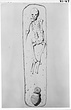
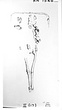
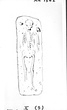
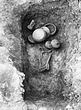
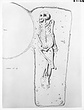
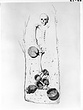
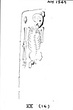
Length of shaft 2.12m; width 0.46m; depth from cover 0.60m. Man's skeleton stretched NE-SW with head at NE. Offering at foot of shaft, with the skyphos in the mouth of the pitcher ... 750-725 B.C ... On the NE edge of the cover slabs was a small flat stone, perhaps to support a grave marker. |
Coins:
10 April 1937 #5 ... 4th-3rd c. B.C ... Casting Pit A |
Deposits containing much ash and charcoal, probably to be associated with the Persian sack. Layers IV-VI of trial pit between Stoa piers IV and V ... 1st quarter 5th c. B.C ... a) (Pre-)Persian |
| Grave II in notebook = RSY Grave 17. PD 731-j ... Ca. 510-490 B.C ... Hesperia 20 (1951), pp. 98-99, fig. 14 and pl. 45 a-b (Grave 17). |
| Grave XVII in notebook = RSY Grave 15.
Only lower half of skeleton preserved. Bones discarded? ... Last quarter of the 6th. c. B.C ... Hesperia 20 (1951), pp. 96-97, fig. 12 and pl. 44 a-b (Grave 15). |
| Grave V in notebook = RSY Grave 5. PD 731-c, Ptg. 244 ... Second quarter of the 6th. c. B.C ... Inhumation of a female |
| Grave XXVI in notebook = RSY Grave 12 ... Ca. 525-500 B.C. or sightly later ... Inhumation, probably a female |
| Grave 7 in notebook. Area disturbed in Roman times; outlines of the shaft had been obliterated.
The northwest end, however, was preserved in a cutting in the rock of the sloping hillside. This cutting, ... 750-700 B.C ... Inhumation of a Man |
| Grave 16 in notebook.
Length of shaft 1.81m; width 0.64m; depth from cover 0.54m.
Skeleton of a woman , head at northwest end. Most of pots piled over feet and legs of skeleton at southeast end.
An iron ... 750 B.C ... Skeleton of a woman , head at northwest end. ... An iron fibula and a bronze pin lay to the right of the skull, other metal jewelry was among the pots at the feet.
A bit of human bone and some fragments of Minyan ware found in random positions suggest that Grave XVII was cut through an earlier burial. |
Cistern A for 1935 (there is another Cistern A, for 1936, D-E 8-9:1) Coins:
16 May 1935 #4-#5
17 May 1935 #1-#2
18 May 1935 #1-#2
20 May 1935 #1-#2
22 May 1935 #1
23 May 1935 #2-#6
24 May 1935 #1-#7
25 ... 16-25 May 1935
6 February 1936 ... Thiseion Cistern A (1935) |
House A destruction debris over floors. All floors (rooms 1-7) dug in 1939. Re-examination of House A in 1967 (nbpp. 648 ff.). Coins:
27 February 1939 #5-#9
7 March 1939: #1
9 March 1939 #4-#6
11 March ... First half 3rd. c. A.D ... House A, destruction debris |
| Geometric burial. Burial A in notebook.
Shaft in bedrock dug to 0.30m, oriented NE to SW. Upper part was disturbed by Grave XXIV. Skeleton of youth. L. as it lay 1.34m. Pots laid across grave at feet of ... 750-725 B.C ... Grave of a youth |
| Grave 8 in notebook.
Inhumation in Tholos Cemetery. Length of shaft 1.75m; Width at upper end 0.95m; Depth from cover 0.70m.
One end cut into sloping rock.
Skeleton of a woman, with head southeast. Most ... 750-725 B.C ... Skeleton of a woman, with head southeast. |
| Grave 19 in notebook. Bones only AA 3.
Length 2.15m; width 0.63m; depth 0.52m.
Woman' skeleton with head at north. Cover slabs piled at foot of grave, probably by the diggers of Well J 18:8, who rifled ... Late Geometric ... Inhumation of a Woman |
| Grave 7b in notebook. Inhumation in Tholos Cemetery; The skeleton positioned directly below the male in Grave 7, but with direction reversed, i.e., head at southeast end. Most grave offerings at lower ... 750-725 B.C ... Inhumation of a Woman |
| Grave XX in notebook = RSY Grave 16. PD 731-i ... Late 6th. c. B.C ... Inhumation of a male |
| Grave XXI in notebook = RSY Grave 11. Pottery discarded; late Roman, mostly coarse. PD 731-e ... Ca. 530 B.C ... Inhumation of a male |
| Grave VII in notebook = RSY Grave 21. PD 731-k ... Date uncertain, presumably 7th. or 6th. c. B.C ... Inhumation of a female |
RSY Fido's Grave ... Hellenistic ... Grave of a dog |
| Grave XXV in notebook = RSY Grave 4. PD 731-b ... 750-725 B.C ... Inhumation of a young female |
RSY Grave A.
Under the Roman House with three rooms floored with mosaic near the southwest side of the area. The burial consisted of a pot laid on its side over the bedrock, presumably containing a child ... 7 August 1947 ... Geometric Grave, RSY Grave A |
| Burned Deposit. A thick deposit of ash, cinders and pottery fragments extending alongside wall of cemetery. Character of pottery like the pyre of F 12:2 ... Late Geometric ... Burned Deposit. A thick deposit of ash, cinders and pottery fragments extending alongside wall of cemetery. |
| Grave 21 in notebook. Grave twice disturbed. Of the skeleton only the thigh bones were found. No offerings.
Objects listed in nb. as from Grave 21 are taken to be with grave 20 (probably pyre objects) ... Late Geometric ... Inhumation, Probably of a Man |
| Grave X in notebook = RSY Grave 14. PD 731-g ... Ca. 525-500 B.C ... Inhumation, probably of a female |
Sand fill N of Base A.
... Because of the uncertainty of ground level contemporary with Base A and of the possibility of missing a continuous strosis or disturbance in this soft sandy fill, I have kept ... Last quarter 2nd-first quareter 3rd c. A.D ... Sand fill N of Base A.
... Because of the uncertainty of ground level contemporary with Base A and of the possibility of missing a continuous strosis or disturbance in this soft sandy fill, I have kept the pottery from the separate patches dug separately; hoping that when the pottery of 2nd and 3rd c. A.D is published a more precise date for the lower fill will be possible [p. 3062].
|
| Urn Burial in Tholos Cemetery. Grave 9 in notebook.
Amphora containing bones of a small child. Little pots had been put under its neck ... Late 8th-Early 7th c. B.C ... Urn-Burial of a Small Child |
Two chambers connected by a tunnel, all filled at the same time, but with slight Hellenistic disturbance. Chamber A, to west at 14/ΛΗ, B to east at 14-15/ΛΒ on grid for section RR.
Cistern system ca. 20.00m ... Ca. 325-275 B.C ... Two chambers connected by a tunnel, all filled at the same time, but with slight Hellenistic disturbance. Chamber A, to west at 14/ΛΗ, B to east at 14-15/ΛΒ on grid for section RR.
... Basically a single dumped filling; the presence in the filling of a few later objects ... possibly as late as the second half of the 3rd c., probably indicates a supplementary filling. |
Horos terrace trench Layer III, under line of tiles. Coins:
19 March 1953 #16-#17 ... 2nd c. A.D ... A. Walker Coin Deposit in ΜΣ |
P 5302 may be from disturbed fill ("soft spot", container B 57, nbp. 1246) ... 12 March-6 April 1935
7 May 1935 ... a) Undisturbed filling of the building |
| Grave 20 in notebook. Objects recorded in nb. from Grave 21 (earlier and disturbed by Grave 20) are included here. A pyre [using pieces of pots from Grave 21] was probably burned beside grave 20 and some ... Late Geometric ... Inhumation with Remains of a Sacrificial Pyre |
| Homer A. Thompson ... (Grave XXX: EG)
Rectangular cutting with burned bones of a female 40-45 years old, and both burned and unburned pottery fragments.
Rectangular trench, measuring approximately 0.80m long, 0.40m wide, with ... Middle Geometric I ... Homer A. Thompson |
|
|