|
|
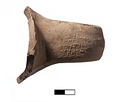
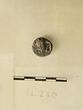
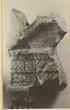
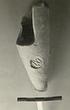
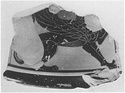
Under side smooth, upper side with figure of man marching to the right. Wall Trench I. 1334 ... 15 July 1937 ... PNM 90 ... PNM 90 |
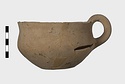
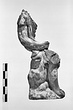
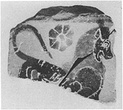
Slightly flaring walls. Winged creature (griffin?) left.
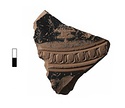
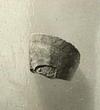
Battered rim fragment. No relief contour. Assembly Place, Filling of Period III ... 1931 ... PNP 90 ... PNP 90 |
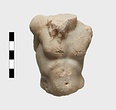
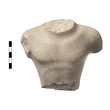
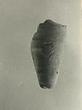
Only the chest remains.
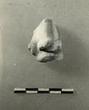
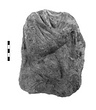
The upper part of a male torso, a broad strap passes diagonally
across it leading down from the right shoulder.
Clay: Gritty, ash grey inside, bug outside, faint traces of white ... Early fourth century B.C ... PNT 90 ... PNT 90 |
Bottom broken off. Unequal sides. Late type.
Incised on top: triangular shape (sketch on original ID card). After firing.
Glaze: black all over.
Clay: reddish, little mica. Assembly Place, filling ... 1931 ... PNW 90 ... PNW 90 |
Clay; fine, light buff, small bubble holes. East Sanctuary; Clearing North of Terrace Wall ... October 1932 ... PNAH 90 ... PNAH 90 |
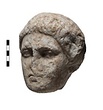
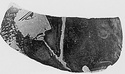
Head of female figure wrapped in mantle. Munsell (fabric) 2.5 YR 6/6 light red Oscar Broneer, Nb. No. 1. 103 ... 2 March 1932 ... AF 90 ... AF 90 |
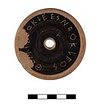
| Kylix base with black glaze. Some red lines. Inscribed on bottom. Chipped at rim but name is legible. Oscar Broneer, Nb. No. 4. 178 88-396 ... 31 May 1937 ... AO 90 ... AO 90 |
NM 16059
Flat bottom; continuous profile.
Black to brown glaze.
Others include Kerameikos V, 1, pl 139, inv. no. 356; C.V.A., Munich 3[9], 117[399], 7-8; C.V.A., Copenhagen 2[2], 70[71], 6; Thorikos ... LG IIB ... H 90 ... H 90 |
| Slightly rising; broad, widening to neck.
Coarse yellowish-red clay, greyish toward core; traces of light slip.
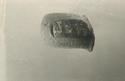
Impression set obliquely, incomplete upper left and corner lower right. Ἐπὶ Ἀσκληπιο[δ]ώ ... 26 June 1931 ... SS 90 ... SS 90 |
| On rim, wavy lines.
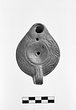
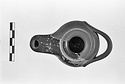
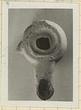
Plain discus, with central filling hole. Handle, solid, triple grooved.
On bottom, double concentric grooves.
Brown glaze.
Red clay.
Type XXVIII of Corinth collection.
ADDENDA For ... 18 June 1931 ... L 90 ... L 90 |
| Fragment from left side of head of cock figurine.
Front (beak, etc. ) broken away.
Fluted comb indicated over large eye; start of beak set off from head by double groove; neck feathers faintly indicated ... 13 February 1932 ... T 90 ... T 90 |
A rosette and a disk.
Rosette of the larger size, practically complete.
Pierced for attachment.
Plain disk slightly broken.
Single piercing. Finished Mycenaean chamber tomb, general dump.
Cf. J 46. Stoa ... 19 June 1939 ... J 90 ... J 90 |
| Ring foot and start of flaring side wall preserved.
Greenish blue glass. Green sand, drain fill. Found with P 9057 and L 2748.
Early Roman to 2nd c. A.D. Leica PD 2815-1 ... 23 February 1937 ... G 90 ... G 90 |
Wall fragment from lower part. P.H. 0.209; P.W. 0.155.
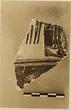
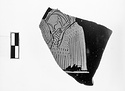
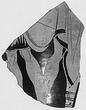
Warriors (part of legs of each): lower part of short chiton and round shield (seen in three-quarter view) of left, part of chlamys of right, who ... Ca. 400 B.C ... Preliminary sketch.
90 is best compared with the large loutrophoros Athens (ex Schliemann)--Berlin 3209, published by G. ... It, like 90, represents the departure of a warrior for battle. |
| Only inscribed face and back preserved.
ΑΔΙΟΝΥΣΙΟΥΙ series. Leica ... 26 February 1935 ... Ν 90 |
| Broken above, below and at right.
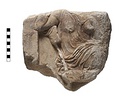
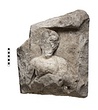
A woman seated in a chair, facing right, head and legs missing. Her right arm is raised and rests on the back of the chair. A pilaster frames the relief at the left.
Pentelic ... Late 5th c. B.C ... ΕΛ 90 |
| Left side of body broken off. Horizontal band handle broken away.
Body narrows slightly toward top. Medium wide rim, down sloping; set off from body by wide deep groove.
Long nozzle, flat on top; rather ... 24 February 1932 ... Α 90 |
| The tip of handle missing.
On rim, conventionalized grape vine pattern.
Plain discus, depressed.
Handle solid, double grooved above, triple below.
On the reverse, palm branch, conventionalized, within ... 21 March 1933 ... Η' 90 |
| Mended from six pieces; rather more than half preserved, with hole out of side.
Plain base. Broad fluting on sides. Plain band, about 0.035m. wide, above fluting. Scraped grooves colored with miltos around ... 22 April 1932 ... ΣΤ' 90 |
| Herm. Msc: prob from jar dated in the term of =AGHSIPOLIS= andr =ERMOFANTOS= andr* Cistern; middle fill. [ Ἐπὶ ] Ἀνδρο[μέ]
[νε]υς Χρυσ[ίπ]
[πο]υ Κνίδι[ον]
[sun]
(Σ lunate) Leica ... 10 February 1937 ... Χ 90 |
| From a head about half life size. Preserved from bridge to upper lip.
Carefully modelled.
Smooth light buff clay. Roman House B, small drain from Room 2 to Great Drain. 150 Leica ... 27 June 1947 ... ΠΠ 90 |
| The handle missing.
Flat bottom, deep round body with long nozzle and vertical strap handle. Shallow convex rim. Unpierced lug on one side.
Wheelmade. Buff clay. Red glaze mostly peeled off.
Type 35A ... 125-75 B.C ... Β' 90 |
| Intact.
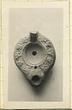
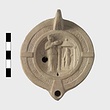
Scrolls on panelled rim; grooved pierced handle. On the discus, at left, a draped female figure, standing three-quarters right, holds a large tray with cakes (?), and looks toward a small naiskos ... 13 February 1937 ... ΛΛ 90 |
| Obverse : Head of Hermes, right.
Counterstruck at right, dolphin.
Reverse : Plain.
Cf. IL 235, for type. Hole B. Leica ... 27 May 1935 ... ΠΘ 90 |
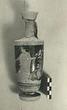
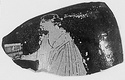
| Neck broken. Surface worn; much of glaze gone. Woman hastens right, looking left, with ivy spray. She is dressed in chiton and himation. Above, maeander. On shoulder, palmettes and rays. Grave 7 (12) ... 21 March 1936 ... ΟΧ 90 |
| Broken all around. Fragment from lower part of panel. Interior unglazed.
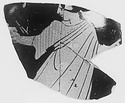
Lower part of draped figure, right. Below panel, two red lines. Remains of white on the garment and red on one of the loose ends ... 27 February 1937 ... Φ 90 |
| Mended from many pieces; small fragments of wall missing; restored in plaster. Small flattened bottom; rounding walls merging into gently out-turned lip. Single vertical handle, round in section, from ... 17-26 March 1937 ... ΟΑ 90 |
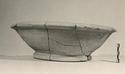
| Most of lower part of bowl and of foot preserved, and small segment of rim with attachment of one handle. Low broad, sharply profiled foot; wide low bowl with plain almost flat lip. In center, eight interlaced ... 24-26 August 1937 ... ΚΤΛ 90 |
| A single fragment preserves the profile from rim to floor of a Pergamene bowl. Plain rim, outward-flaring side. Bottom flat as far as preserved. Rouletting on floor.
The glaze dark; somewhat worn. Cistern, ... 3 May 1939 ... ΕΕ 90 |
| Inscribed fragment.
Broken on all sides and back.
Twelve lines of incomplete inscription preserved; stoichedon.
Hymettian marble. Found north of the Stoa of Basileios. Leica ... June 1970 ... ΒΓ 90 |
| Inscribed fragment.
A bit of the top, picked fairly fine preserved; otherwise broken all around.
The surface much weathered.
"POLEITAI" account.
Eleven lines of the inscription preserved.
Pentelic marble ... 8 May 1934 ... ΑΡ 90 |
| Fragment from left side of inscribed stele.
Side, fine picked, and back rough picked, preserved; other edges broken.
Decree of club or religious organization (?).
Part of sixteen lines of the inscription ... Late 2nd. or 1st. centuries B.C ... Ι 90 |
| Upper right corner of large inscribed base; grave monument.
Top uneven but smooth. Moulding at upper edge broken away.
Letters shallow cut.
Part of six lines of the inscription preserved.
Pentelic marble ... Second half of 4th. century B.C ... Ζ 90 |
| Inscribed fragment of stele.
Fragment of pedimental stele.
Face, left side, left corner of pediment preserved.
Eight letters remain.
Pentelic marble. Found in the area of the Stoa of Attalos. Leica ... February 1936 ... ΣΑ 90 |
About one-sixth of circumference of rim, with flange and part of upper body; lip missing.
Flange projects nearly horizontally. On outer edge of flange, orange crosses. On upper body, traces of fine garland ... 275-260 ... Agora XXIX, no. 90 |
| Fragment from left side (?) of inscription.
Back rough picked.
Otherwise only inscribed surface preserved, which however gives the left margin of inscription. The third line is apparently a later interpolation ... 2nd. century A.D ... Δ 90 |
| Inscribed large piece from top of columnar grave monument.
Mended from two pieces.
Top surface, and more than half of the circumference preserved, with the full width of the inscription.
Below convex band, ... 11 February 1932 ... Ε 90 |
| Inscribed fragment.
Broken on all sides.
The inscribed surface convex.
Five and a half letters remain.
Hymettian marble. Found in late context, south of the New Bouleuterion. Leica ... 3 February 1934 ... Β 90 |
Flaring ring foot; plump body. Low round handle with thumb-rest on top. Two rings, one at junction of neck and body, one a little higher. Added red: on the top of the rim, a pair of lines round the body ... 575-550 B.C ... Agora XII, no. 90 |
| Preserved from the lower part of neck to upper part of hip. Arms missing save for a little of right upper arm. Over the front side of the right shoulder and breast five straggling locks of beard. The muscular ... 10 February 1932 ... ΣΤ 90 |
| The handle is missing, and much of the body. Restored in plaster. Low slightly projecting base, low neck-mouth with flaring rim. On body, narrow glaze bands; on shoulder below neck a wavy horizontal line ... 23-29 April 1937 ... Agora VIII, no. 90. |
| Two non-joining fragments possibly not from same pot.
Thick, rather gritty, pinkish-buff clay, gray core; red burnished slip on exterior with traces of horizontal lines of paint(?). Well 20. Leica ... 1961 ... Agora XIII, no. 90. |
| Pinkish-buff clay, buff slip. Cutting strosis to working floor and over water channel. Ἀριστοδήμου Leica ... 3 May 1954 ... Hesperia 57 (1988), p. 90. |
| Fountain House Porch to stepped retaining wall, layer 1. [---]ΡΙ (retr) 2110 Leica ... 25 April 1953 ... Hesperia 57 (1988), p. 90. |
| Pontic. Cutting strosis to working floor. Ἀσ̣[τυνομοῦντος]
Καλ[λιχόρου τοῦ]
Πρ̣ω̣[ταγόρου dog]
Εὐκ[λῆς] Leica ... 11 May 1954 ... Hesperia 57 (1988), p. 90. |
| Lyre. Cutting intermediate strosis to working floor. Δῖος lyre Leica ... 20 May 1954 ... Hesperia 57 (1988), p. 90. |
| Rose. Finished Cutting intermediate strosis to working floor. Α rose Ρ (in O) Leica ... 20 May 1954 ... Hesperia 57 (1988), p. 90. |
| Male figure seated on a rock; preserved from right shoulder to bottom; most of left side missing above knee.
One non-joining fragment preserves part of drapery at front; another part of the rock, a third ... 4 April 1956 ... Hesperia 32 (1963), p. 90. |
| Finely modeled torso of marble statuette. Finished Oscar Broneer, Nb. No. 4. 161 86-11-14, 90-7-34, 90-7-35, 90-7-36, 90-7-37, 90-8-0 ... 25 May 1937 ... 86-11-14, 90-7-34, 90-7-35, 90-7-36, 90-7-37, 90-8-0 |
| Lower part of female figure unreserved. Legs and top broken off. Dorothy A. Schierer, Nb. No. 11. 90-91 90-7-12, 90-7-13, 90-7-14, 90-7-15 ... 8 June 1937 ... 90-91 ... 90-7-12, 90-7-13, 90-7-14, 90-7-15 |
| Broken at top, bottom, and left.
Part of left side and arms of draped female figure. Rough-picked right side of stele; very rough-picked back. Back of arm hacked away.
Traces of red paint on background ... 31 March 1953 ... Agora XXXV, no. 279, pl. 90. |
| Broken off below chin and broken away from background all around. Nose broken. Whole somewhat battered and encrusted.
Head of a youth or a woman with cropped hair in two-thirds view facing left.
From an ... 4th c. B.C ... Agora XXXV, no. 90, pl. 27. |
| Upper part of stele with part of molding at top preserved.
Original surface preserved along right edge. Dowel hole in back at lower right.
Upper part of standing, draped female figure, much battered.
Pentelic ... March 1956 ... Agora XXXV, no. 278, pl. 90. |
| Right edge of relief with preserved framing band; other edges broken. The figure is broken at the neck and above knees. The coarsely grooved drapery of the himation is held at the breast by the right hand ... 24 April 1931 ... Agora XXXV, no. 280, pl. 90. |
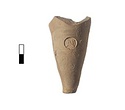
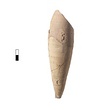
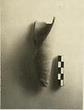
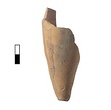
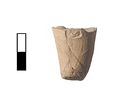
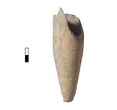
| Part of conical tip of unguentarium preserved.
Fine, hard orange-pink clay, with black core; buff slip; a streak of brownish-red glaze down one side shows the upper body was glazed.
Small roughly circular ... Late Roman ... Agora XXXII, no. 1811, pl. 90. |
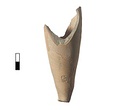
| The tip is broken away; missing toe.
Fine hard clay, mostly red, grey at surface.
A streak of paint down one side shows the upper body was painted or glazed; small rectangular stamp. Early Byzantine ... Late Roman ... Agora XXXII, no. 1799, pl. 90. |
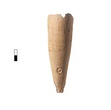
| Small pointed base, broken away above.
Red clay, gray at core.
On one side, a round stamp enclosing a device like an hour-glass. Provenience uncertain. ΠΧΙ (?) (Ρ,Χ,Ι monogram in O) Leica ... Late Roman ... Agora XXXII, no. 1802, pl. 90. |
| Fragment of top only.
Recessed center panel, and cross panels, on rim. On discus, four masks, of which two remains.
Unglazed.
Fine buff clay.
Type XXVII of Corinth collection.
ADDENDA Late 1st. early ... 16 April 1952 ... Agora VII, no. 224, p. 90. |
| Mended from two pieces. From a small amphora(?) or squat lekythos(?). Fragment depicts Aphrodite riding on a goose(?). The bird is seen from the front, with both wings outspread; the head turned to the ... 18 April 1934 ... Agora XXX, no. 903, pl. 90. |
| Squat lekythos. Shoulder fragment depicting erect female, facing left, in chiton and himation, holding box in outstretched right hand. No relief contours. Trial pit behind retaining wall of stoa, layer ... 24 February 1935 ... Agora XXX, no. 909, pl. 90. |
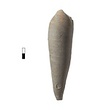
| Lower part of unguentarium preserved, tapering to a small flat bottom.
Fine hard red clay; grey core and dark grey surface.
Stamped just above the bottom. Fill II. ΜΕΛΟΚ (Μ,Ε,Λ,Ο,Κ monogram in O) Leica ... 21 April 1936 ... Agora XXXII, no. 1808, pl. 90. |
| Bottom of Roman unguentarium.
Pale red clay, traces of light red slip.
Monogram near tip.
“Small groups”, drawer 6. On strosis, with coins nos. 5-12 for the day. ΙΧΙ (Ι,Χ,Ι monogram in O) Leica ... 5th century ... Agora XXXII, no. 1801, pl. 90. |
| Part of pointed unguentarium.
On upper part, thin glaze with many runs. Finished Red fill. Leica ... Late Roman ... Agora XXXII, no. 1805, pl. 90. |
| Upper part broken away.
Similar to SS 4624 (Π 599), but the clay is brown to buff clay, with a brown slip, and traces of a dark wash on the upper body.
Near the bottom, a deep circular stamp.
Source: ... Late Roman ... Agora XXXII, no. 1780, pl. 90. |
| Neck and parts of wall missing.
Orange-buff clay with buff slip; reddish-brown wash on upper body.
Near the bottom, a deep circular stamp.
Source: should be Cibyra W. Pisidia-fringe of Lycia/Phrygia) ... Late Roman ... Agora XXXII, no. 1781, pl. 90. |
| Mouth and most of neck missing.
Very like SS 4626 (Π 601), but the slip is ruddier.
Near the bottom, a deep circular stamp.
Source: should be Cibyra W. Pisidia-fringe of Lycia/Phrygia) see S. Japp, Anatolian ... Late Roman ... Agora XXXII, no. 1779, pl. 90. |
| Lower body only preserved.
Clay deep pink with grey core; buff pink slip; light red wash on upper body.
The stamp smaller than on SS 4624.
Source: should be Cibyra W. Pisidia-fringe of Lycia/Phrygia) ... Late Roman ... Agora XXXII, no. 1782, pl. 90. |
| Most of upper body and tip missing. Shape as SS 4624 (Π 599).
Clay, glaze and slip identical with SS 4628 (Π 603)
Near the bottom, a deep circular stamp.
Source: should be Cibyra W. Pisidia-fringe of ... Late Roman ... Agora XXXII, no. 1784, pl. 90. |
| Lower part only preserved. Shape as SS 4624.
Brownish clay; buff slip with traces of red wash on upper body.
Near the bottom, a deep circular stamp.
Source: should be Cibyra W. Pisidia-fringe of Lycia/Phrygia) ... Late Roman ... Agora XXXII, no. 1785, pl. 90. |
| Mouth, neck and large part of upper body missing. Shape as SS 4624 ( P 599).
Pink clay at inner surface, brownish-buff at outer; brownish-buff slip; black to brown wash on upper body.
Same stamp as SS ... Late Roman ... Agora XXXII, no. 1787, pl. 90. |
| Lower body only preserved. Shape as SS 4624 (Π 599).
Mostly gray clay, wιth pink at surfaces; pinkish-buff slip; traces of reddish-brown wash on upper body.
Circular stamp, fairly large.
Source: should ... Late Roman ... Agora XXXII, no. 1788, pl. 90. |
| Lower body only preserved. Sahpe as SS 4624 (Π 599).
Brown clay at surface, gray core; brown slip; dull brown wash on upper body.
Same stamp as SS 4634 (Π 609), from same die, but badly struck.
Source: ... Late Roman ... Agora XXXII, no. 1789, pl. 90. |
| Mouth, neck and good part of shoulder and body missing. Shape as SS 4636 (Π 599).
Ruddy-brown clay at surfaces, dark gray at core; buff to buffy-brown slip;reddish-brown wash on upper body.
Small stamp; ... Late Roman ... Agora XXXII, no. 1791, pl. 90. |
| Lower part of body only preserved. Shape as SS 4624 (Π 599).
Clay like SS 4636 (Π 611); slip ruddier; wash with more red in it.
Same stamp.
Source: should be Cibyra W. Pisidia-fringe of Lycia/Phrygia) ... Late Roman ... Agora XXXII, no. 1792, pl. 90. |
| Upper body missing. Shape as SS 4624 (Π 599).
Pinkish clay; ruddy-buff slip; pale purplish-red wash on upper body.
Same stamp as SS 4636.
Source: should be Cibyra W. Pisidia-fringe of Lycia/Phrygia) see ... Late Roman ... Agora XXXII, no. 1793, pl. 90. |
| Upper body and tip missing. Shape as SS 4624 (Π 599).
Dark clay, purple at inner surface, lighter at outer; with gray core (close to outside); dull greyish-brown slip; dark wash.
Same stamp as SS 4636 ... Late Roman ... Agora XXXII, no. 1794, pl. 90. |
| Mouth, neck and shoulder missing. Shape as SS 4624 (Π 599).
Grey clay except a thin layer of brown at outer surface; slip and glaze nearly uniform grey with a few brownish spots.
Same stamp as SS 4636 ... Late Roman ... Agora XXXII, no. 1795, pl. 90. |
| Lower body only preserved. Shape as SS 4624 (Π 599).
Deep brownish-pink clay, with a grey core where it is thickest; pinkish slip with no trace of colored wash.
Same stamp as SS 4636 (Π 611).
Source: ... Late Roman ... Agora XXXII, no. 1790, pl. 90 |
| Lower part of body only preserved. Shape as SS 4624 (Π 599).
Pinkish-buff clay; deep buff slip; traces of red to black wash on upper body.
Same stamp as SS 4636 (Π 611).
Source: should be Cibyra W. Pisidia-fringe ... Late Roman ... Agora XXXII, no. 1796, pl. 90. |
| Fragment of tip only preserved. Shape as SS 4624 (Π 599).
Βrown clay; grey at core; brown slip; traces of reddish-brown wash.
Same stamp as SS 4636 (Π 611); partly broken away.
Source: should be Cibyra ... Late Roman ... Agora XXXII, no. 1797, pl. 90. |
| Upper body missing. Shape as SS 4624 (Π 599).
Grey clay; brown slip; traces of reddish-brown wash on upper body; both glaze and slip burnt grey at one side.
Same stamp as SS 4636 (Π 611).
Source: should ... Late Roman ... Agora XXXII, no. 1798, pl. 90. |
| Amphora base preserved.
Fine hard ruddy brown clay, large grey core; traces of reddish matt glaze at top.
Small circular stamp; stamped on toe. West of column 3, over stylobate; late Roman context. ΝΑΤ ... 25 May 1935 ... Agora XXXII, no. 1800, pl. 90. |
| Lower part of amphoriskos preserved.
Red glaze on upper part, running down to lower.
Small circular stamp. Tiles in south central part of Room 4 of late Roman Building. two diamonds in frame (in O) Leica ... 20 May 1936 ... Agora XXXII, no. 1810, pl. 90. |
| Broken all around. Very worn.
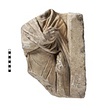
Togate figure preserved from neck to hips. Left arm hangs down, right arm bent across body. Back flat and rough-picked. Hence a relief, though all background now broken away ... 4 June 1971 ... Agora XXXV, no. 281, pl. 90. |
| Three joining fragments give part of one side; profile complete. Flat raised base; downturned rim, rounded on top.
Buff clay and surfacing, with added grit on the floor inside. Well A, box 12, context ... 27 April 1953 ... Agora XII, no. 1886, pl. 90. |
| Mended from many pieces. About half preserved. Raised base, projecting; vertical face rounded. Wall thickened towards rim which projects and slopes slightly downwards.
Light pinkish-buff clay with lighter ... June 1952 ... Agora XII, no. 1887, pl. 90. |
| Broken all around. Probably from a heavy lid.
A band of moulded egg and dart around center of fragment with decorated surfaces above and below. Above: a kernos in very heavy added clay with a branch through ... 1 April 1953 ... Agora XXIX, no. 1215, pl. 90. |
| Broken away above. Large chip of surface missing at left. Sphinx seated, left front paw raised. Head, top of wing and some of hind quarters missing. Added red on belly and for strokes on wings. Black glaze ... June-July 1932 ... Agora XXIII, no. 1274, pl. 90. |
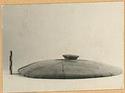
| Profile complete; more than one-quarter preserved. Shallow domed lid, with small stemmed disk handle. Upper surface entirely covered with concentric grooves.
Micaceous gray clay, in places burned black ... 14 October 1947 ... Agora XXXIII, no. 720, fig. 90. |
| Three joining fragments preserve part of the wall of a small closed pot; squat lekythos(?). Preserved is part of the figure of a woman, running right, looking back left; both arms outstretched. She wears ... 8 May 1939 ... Agora XXX, no. 907, pl. 90. |
| Minor fragments missing. Very shallow convex lid with small plain knob.
Orange micaceous clay. Cistern, containers 6 and 7, lower fill. Leica PD 911-g ... 9 April 1949 ... Agora XXXIII, no. 727, fig. 90. |
| Two joining fragments; broken top and bottom; one foot of a tripod pyxis.
Lion right, with incised rosette above. Added red on mane and haunch. Edge of glazed floor preserved above. Early byz. fill on ... 8 April 1952 ... Agora XXIII, no. 1273, pl. 90. |
| Wall fragment from a squat lekythos. Part of a bearded male head, at large scale, to right; his beard apparently resting on the reserved ground line. He wears a head covering of which a little remains ... 8-11 August 1947 ... Agora XXX, no. 906, pl. 90. |
| Fragment from lower wall of a large amphora. Parts of two standing figures; at the left one facing, carrying a shield; a bordered cloak falls to his knees. At the right, another, right; the corner of his ... 7 July 1947 ... Agora XXX, no. 90, pl. 16. |
| Mended from many pieces; knob, most of rim and part of middle section preserved. Large round cover, curving down to rim; nearly flat on top; small stemmed knob, flaring at top.
Very coarse, pinkish-brown ... May 1947 ... Agora XXXIII, no. 719, fig. 90. |
| Mended from many pieces; several fragments missing. Round lid, very slightly convex; low cup-shaped knob.
Very coarse red clay. Komos cistern. Leica PD 911-h ... May 1947 ... Agora XXXIII, no. 728, fig. 90. |
| Toe preserved.
Brownish-buff clay; streaks of matt red-brown paint.
Monogram stamp near bottom. Dark Age to early Byzantine fill. ΚΡΗ (Κ,Ρ,Η monogram) 4664 Leica ... 19 March 1954 ... Agora XXXII, no. 1804, pl. 90. |
| Small fragment from near toe of unguentarium or amphoriskos.
Light red brown clay; traces of matt red streaked on surface.
One end of a rectangular stamp preserved. Dark Age fill; Byzantine disturbance ... 19 March 1948 ... Agora XXXII, no. 1812, pl. 90. |
| Device.
Early Knidian. Cutting strosis to working floor and over water channel. device Leica ... 3 May 1954 ... Hesperia 57 (1988), p. 90. |
| Early Knidian. Fountain House Porch to stepped retaining wall, layer 1. ΠΡ ΚΙ (Π,Ρ lig, Κ,Ι lig) 2110 Leica ... 25 April 1953 ... Hesperia 57 (1988), p. 90. |
|
|